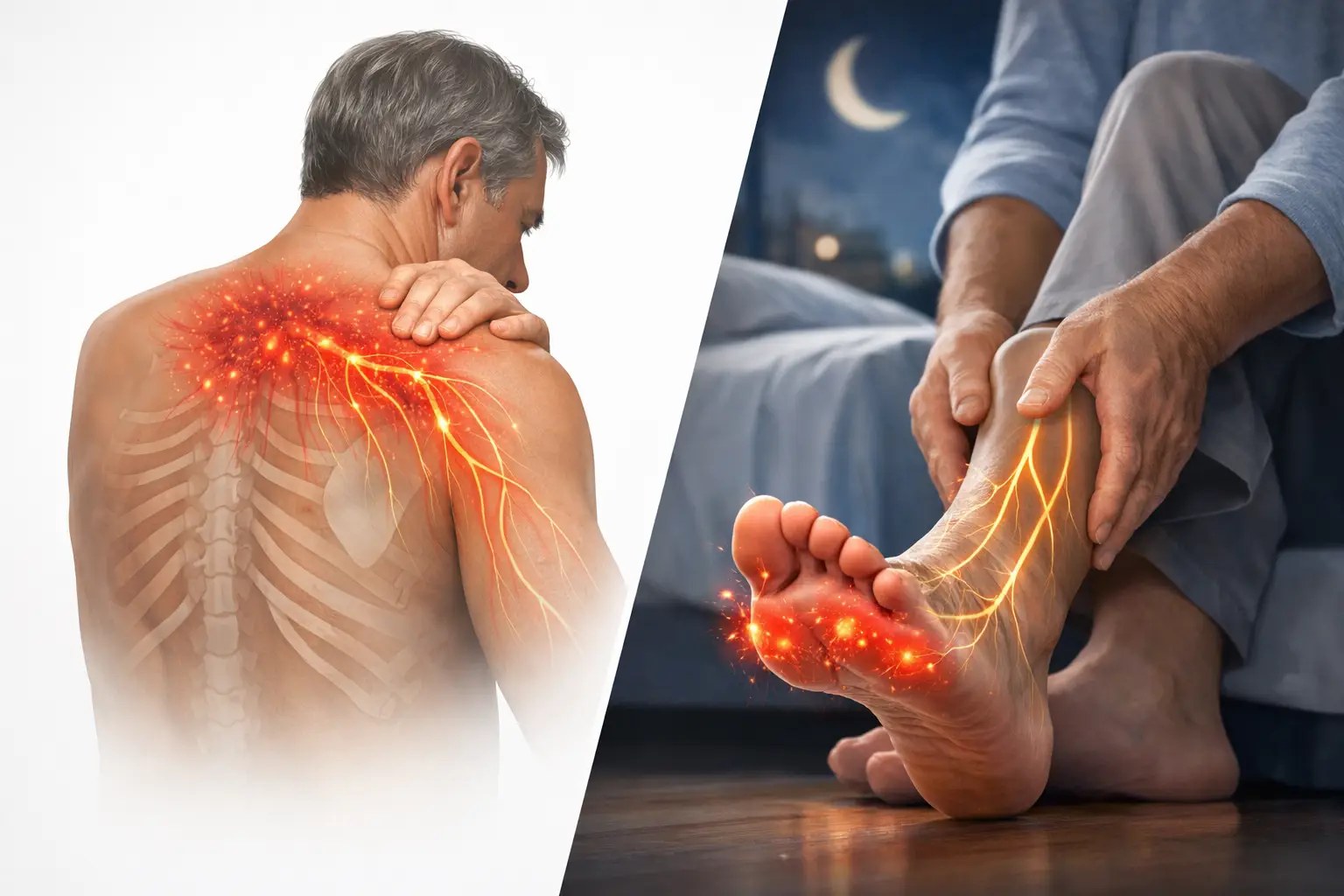
Postherpetic neuralgia is nerve pain that continues after shingles, usually in the same one-sided area where the rash appeared. Peripheral neuropathy is a broader nerve problem that often affects the feet, legs, hands, or arms and may be caused by diabetes, vitamin B12 deficiency, alcohol exposure, medications, kidney disease, thyroid disease, autoimmune conditions, or other causes. The biggest clue is the pattern: localized pain after shingles points toward postherpetic neuralgia, while gradual numbness, burning, tingling, or balance problems in both feet often points toward peripheral neuropathy.
A burning, stabbing, or tingling nerve pain can feel similar no matter what name ends up on the chart. That is why many adults searching postherpetic neuralgia vs peripheral neuropathy are really trying to answer a more practical question: why does this hurt, and what does the pattern of symptoms suggest?
The distinction matters because these two conditions do not start the same way, do not spread in the same pattern, and do not always call for the same workup. Postherpetic neuralgia usually follows shingles. Peripheral neuropathy is a broader category of nerve damage with many possible causes, including diabetes, alcohol use, certain medications, vitamin deficiencies, and other medical conditions.
Postherpetic neuralgia vs peripheral neuropathy: the core difference
The clearest difference is origin. Postherpetic neuralgia is nerve pain that continues after a shingles outbreak, usually in the same area where the rash appeared. Peripheral neuropathy refers to damage or dysfunction in peripheral nerves, often affecting the feet, legs, hands, or arms in a more diffuse or symmetrical pattern.
In plain terms, postherpetic neuralgia is a specific complication of a viral event. Peripheral neuropathy is an umbrella term. One points back to shingles. The other raises a longer list of possible explanations.
That single difference often shapes the rest of the story. If someone had a painful blistering rash wrapping around one side of the chest three months ago and still has sharp, sensitive skin in that exact strip, postherpetic neuralgia rises quickly on the list. If someone has gradual numbness and burning in both feet that worsens at night, peripheral neuropathy is usually the more likely direction.
Postherpetic Neuralgia vs Peripheral Neuropathy: Key Differences
The easiest way to separate the two is to look at the trigger, location, timing, and spread of symptoms. Postherpetic neuralgia usually points back to shingles, while peripheral neuropathy usually requires a broader search for causes.
| Feature | Postherpetic Neuralgia | Peripheral Neuropathy | Why It Matters |
|---|---|---|---|
| Usual trigger | Follows a shingles outbreak | May be linked to diabetes, B12 deficiency, alcohol, medications, kidney disease, thyroid disease, autoimmune disease, or other causes | A known shingles rash narrows the story; diffuse neuropathy usually needs a broader workup. |
| Typical location | Localized to the same area where the shingles rash occurred, often one-sided | Often starts in both feet or toes and may move upward over time | A one-sided strip of pain suggests a different pattern than symmetric burning feet. |
| Common sensations | Burning, stabbing, raw skin, electric shocks, itching, sensitivity to light touch | Burning feet, numb toes, pins-and-needles, reduced sensation, balance problems, weakness in some cases | Sensations overlap, so pattern and history are more useful than pain words alone. |
| Spread over time | Usually remains in the same dermatome or rash area | May slowly spread from toes to feet, legs, and sometimes hands | Spreading symptoms may suggest a broader neuropathy evaluation. |
| Testing focus | Often clinical history and exam, especially if shingles history is clear | Blood sugar, B12, thyroid, kidney function, medication review, nerve studies when appropriate | The suspected label changes what doctors are trying to confirm or rule out. |
How symptoms usually feel different
There can be overlap. Both conditions may cause burning, shooting pain, tingling, and abnormal sensitivity. But the pattern and context often separate them.
Postherpetic neuralgia
Postherpetic neuralgia tends to stay in one localized area. It often affects the torso or face and usually appears on one side of the body. Pain may be constant or intermittent, and even light touch from clothing or bedsheets can feel intense. Some people describe it as raw skin, electric shocks, or deep aching after the visible shingles rash has already healed.
For a medical overview of shingles complications and postherpetic neuralgia, see the CDC guide to shingles symptoms and complications.
A key clue is timing. The pain begins with or after shingles, not out of nowhere. The skin may remain unusually sensitive, itchy, or painful for weeks to months. In some cases, discomfort lasts longer.
Peripheral neuropathy
Peripheral neuropathy more often starts gradually, especially in the feet. Numbness, pins-and-needles sensations, reduced balance, burning soles, or a feeling of wearing invisible socks are common descriptions. Symptoms may move upward over time from the toes to the feet and lower legs. When the hands become involved later, clinicians sometimes call it a stocking-glove pattern.
Pain is not always the main feature. Some people notice numbness first. Others feel weakness, cramping, or reduced coordination. That variation is one reason peripheral neuropathy can take longer to sort out.
Why people confuse them
From the patient side, both problems are often filed under nerve pain. That is understandable. The body does not label sensations neatly.
Confusion is more likely when someone had shingles in the past but now has symptoms in the feet, or when the original rash was mild and forgotten. Age adds another layer, since adults over 45 may also be dealing with diabetes, prediabetes, low vitamin B12, medication side effects, spinal issues, or circulation concerns. A person can also have more than one problem at the same time. That is where self-diagnosis starts to get shaky.
Causes and risk factors are not the same
Postherpetic neuralgia develops after reactivation of the varicella-zoster virus, the same virus that causes chickenpox. The risk rises with age, and older adults are more likely to have prolonged pain after shingles. A severe rash and intense early shingles pain may also increase the chance of lingering nerve pain.
Peripheral neuropathy has a much wider cause list. Diabetes is one of the most common drivers, but it is far from the only one. Other possibilities include alcohol overuse, chemotherapy, nerve compression, autoimmune disease, kidney disease, thyroid disorders, and nutritional deficiencies, especially vitamin B12 deficiency in some patients. That broader range is why a clinician may order blood work or ask detailed questions about medications, alcohol intake, and medical history.
This is where caution matters. Vitamin B12 can be relevant when deficiency contributes to neuropathy symptoms, but it is not a blanket explanation for every burning or tingling sensation. If pain began after shingles and follows the same rash distribution, postherpetic neuralgia is a different clinical picture.
What doctors look for during evaluation
A careful history often does much of the work.
For suspected postherpetic neuralgia, the clinician usually asks about a prior shingles rash, where it occurred, when it healed, and whether pain remained in that same area. The diagnosis is often clinical, meaning it is based largely on the story and symptom pattern rather than extensive testing.
For suspected peripheral neuropathy, the evaluation is often broader. A doctor may ask when symptoms started, whether both feet are affected, whether numbness or weakness is present, and whether there is a history of diabetes, alcohol use, gastrointestinal disorders, or medications known to affect nerves. The exam may include reflexes, vibration sense, pinprick sensation, and balance testing.
Blood tests are more commonly part of the neuropathy workup because the goal is often to find an underlying cause. Depending on the situation, testing may include glucose-related measures, vitamin B12, thyroid markers, kidney function, and other labs. In selected cases, nerve conduction studies or electromyography may help clarify the type of nerve involvement.
Testing Clues: Postherpetic Neuralgia vs Peripheral Neuropathy
Postherpetic neuralgia is often recognized by its shingles-related pattern. Peripheral neuropathy usually requires a broader search for underlying causes.
| Evaluation Step | More Relevant For | What It May Clarify | Important Limitation |
|---|---|---|---|
| Shingles history | Postherpetic neuralgia | Whether pain follows the same area where the shingles rash appeared | Some rashes are mild or forgotten, and old shingles does not explain every new symptom. |
| Skin and sensory exam | Both | Allodynia, localized sensitivity, numbness, reduced sensation, or stocking-like sensory loss | Sensory symptoms can overlap across nerve pain conditions. |
| Blood sugar testing | Peripheral neuropathy | Diabetes or prediabetes as a possible contributor | Normal results do not rule out every neuropathy cause. |
| Vitamin B12 testing | Peripheral neuropathy | Whether low or borderline B12 may be contributing to nerve symptoms | B12 deficiency does not explain pain that clearly follows a shingles rash pattern. |
| Thyroid, kidney, medication, and alcohol review | Peripheral neuropathy | Metabolic, toxic, or medication-related contributors | These clues need context from symptoms and exam findings. |
| Nerve conduction study or EMG | Peripheral neuropathy or unclear cases | Large-fiber neuropathy, nerve-root involvement, or muscle-related findings | May be normal in some small-fiber pain syndromes. |
Treatment approach: why the label changes the plan
This is not just a naming exercise. The likely cause affects management.
Postherpetic neuralgia treatment usually focuses on pain control and symptom reduction. That may involve prescription medications or topical options, depending on the severity and the patient profile. There is often less emphasis on hunting for a metabolic cause because the trigger is already known.
Peripheral neuropathy management depends more heavily on what is driving the nerve problem. If diabetes is involved, glucose management becomes part of the picture. If vitamin B12 deficiency is identified, correcting the deficiency matters. If a medication appears responsible, the prescribing clinician may review alternatives. Symptom relief is still important, but addressing the source can change progression and expectations.
This is also where supplement marketing tends to get ahead of the evidence. Some ingredients may support normal nerve health or help correct a documented deficiency, but that is different from claiming to fix all neuropathic pain. Adults shopping for nerve-support products should read labels carefully, look for sensible dosing, and keep claims in perspective.
Research Snapshot: Postherpetic Neuralgia vs Peripheral Neuropathy
Medical sources describe postherpetic neuralgia as a shingles-related nerve pain syndrome, while peripheral neuropathy is a broader category with many possible causes and symptom patterns.
| Research Finding | Clinical Relevance |
|---|---|
| Postherpetic neuralgia occurs where the shingles rash was located | Localized one-sided pain, burning, itching, numbness, or extreme sensitivity after shingles supports a postherpetic neuralgia pattern. |
| Age increases PHN risk | Older adults are more likely to develop prolonged nerve pain after shingles, especially when early shingles pain is severe. |
| Peripheral neuropathy has many possible causes | Diabetes, B12 deficiency, alcohol exposure, medications, kidney disease, thyroid disease, infections, autoimmune conditions, and inherited disorders may all be considered. |
| Symptom words alone are not enough | Burning, stabbing, tingling, and electric pain can occur in both conditions, so location, timing, trigger, and spread matter more. |
| B12 is relevant only in the right context | Correcting B12 deficiency may matter for neuropathy, but B12 should not be presented as a treatment for postherpetic neuralgia itself. |
Editorial note: This snapshot summarizes broad medical education themes. It is not intended to diagnose the cause of nerve pain, choose treatment, or replace evaluation by a qualified healthcare professional.
When postherpetic neuralgia vs peripheral neuropathy is not obvious
Sometimes the answer is not immediate. A person may have had shingles years ago and later develop diabetic neuropathy. Another may assume tingling is from neuropathy when the real issue is lumbar spine disease or poor foot mechanics. Burning feet can come from several directions, and nerve symptoms do not always stay in one tidy category.
That is why pattern recognition matters more than internet guessing. Localized one-sided pain after shingles points one way. Gradual, often bilateral foot symptoms point another. Sudden weakness, bowel or bladder changes, rapidly progressive numbness, or new severe neurologic symptoms call for prompt medical attention rather than watchful waiting.
Important: New weakness, foot drop, one-sided numbness, rapidly worsening symptoms, bowel or bladder changes, facial weakness, severe back pain, fever, or major walking problems should not be treated as routine nerve pain.
These symptoms may suggest a condition that needs timely medical evaluation. Postherpetic neuralgia and peripheral neuropathy can both cause nerve pain, but sudden or progressive neurologic changes may point to another problem that should be assessed promptly.
Practical questions to ask yourself before an appointment
It helps to notice whether symptoms are on one side or both, whether they follow a healed shingles rash, and whether numbness is present in addition to pain. Think about timing too. Did symptoms start right after shingles, or have they been slowly building for months? Have you had diabetes, prediabetes, digestive surgery, long-term acid-reducing medication use, or anything else that might affect nutrient absorption?
Those details can make a medical visit more productive. They also help separate a focused post-shingles pain problem from a broader neuropathy workup.
The bottom line for adults comparing these two conditions
If you are weighing postherpetic neuralgia vs peripheral neuropathy, the biggest clue is the story behind the pain. Postherpetic neuralgia usually stays tied to a prior shingles outbreak and a specific area of skin. Peripheral neuropathy usually reflects a broader nerve problem, often beginning in the feet and linked to one of several possible underlying causes.
That difference may sound technical, but it has real consequences for testing, treatment decisions, and what role nutrition or supplements may realistically play. A careful diagnosis is what turns nerve symptoms from vague and frustrating into something that can be evaluated with more precision. If your symptoms have been lingering, changing, or spreading, that conversation is worth having sooner rather than later.
If you’re trying to understand what may be behind numbness, tingling, burning feet, or nerve pain, our guide to peripheral neuropathy causes and relief explains the most common causes and what may help support nerve health.
Frequently Asked Questions About Postherpetic Neuralgia vs Peripheral Neuropathy
These answers are for education only and should not replace medical evaluation.
Is postherpetic neuralgia the same as peripheral neuropathy?
No. Postherpetic neuralgia is a specific type of nerve pain that continues after shingles, usually in the same area where the rash appeared. Peripheral neuropathy is a broader term for nerve damage or dysfunction with many possible causes.
How can I tell if nerve pain is from shingles?
Pain that stays in the same one-sided area where a shingles rash appeared is more suggestive of postherpetic neuralgia. Pain that starts gradually in both feet or spreads upward may suggest a broader peripheral neuropathy pattern.
Can peripheral neuropathy feel like postherpetic neuralgia?
Yes. Both can cause burning, stabbing, tingling, electric pain, or sensitivity to touch. The location, timing, trigger, and spread of symptoms are often more useful than the pain description alone.
Can vitamin B12 deficiency cause peripheral neuropathy?
Yes. Vitamin B12 deficiency can contribute to numbness, tingling, burning sensations, balance problems, fatigue, and neurological changes. It is most relevant when deficiency, low intake, or absorption problems are present.
Can B12 help postherpetic neuralgia?
B12 may help correct a deficiency if one is present, but it should not be presented as a treatment for postherpetic neuralgia itself. Postherpetic neuralgia usually needs pain-focused management guided by a healthcare professional.
What tests are used for peripheral neuropathy?
Evaluation may include a neurologic exam, blood sugar testing, vitamin B12, thyroid markers, kidney function, medication review, alcohol history, and sometimes nerve conduction studies or EMG depending on the pattern.
Can someone have both postherpetic neuralgia and peripheral neuropathy?
Yes. A person can have lingering shingles-related nerve pain in one area and also have peripheral neuropathy from another cause, such as diabetes, B12 deficiency, alcohol exposure, or medication effects.
When should nerve pain be evaluated promptly?
Prompt evaluation is important for new weakness, foot drop, rapidly worsening numbness, one-sided neurologic symptoms, bowel or bladder changes, facial weakness, severe back pain, fever, frequent falls, or major walking problems.
Medical Disclaimer:
This article is for educational purposes only and does not diagnose, treat, or replace medical care. Postherpetic neuralgia, shingles-related pain, and peripheral neuropathy symptoms can have multiple causes. Persistent, progressive, one-sided, spreading, or unexplained burning, tingling, numbness, weakness, balance problems, foot drop, frequent falls, bowel or bladder changes, facial weakness, severe headache, fever, rash near the eye, immune suppression, or severe unexplained pain should be discussed with a qualified healthcare professional.

- Can Low B12 Cause Dizziness? - July 9, 2026
- B12 Deficiency and Cracked Corners of the Mouth - July 9, 2026
- Can Low B12 Cause Dry Mouth? - July 8, 2026