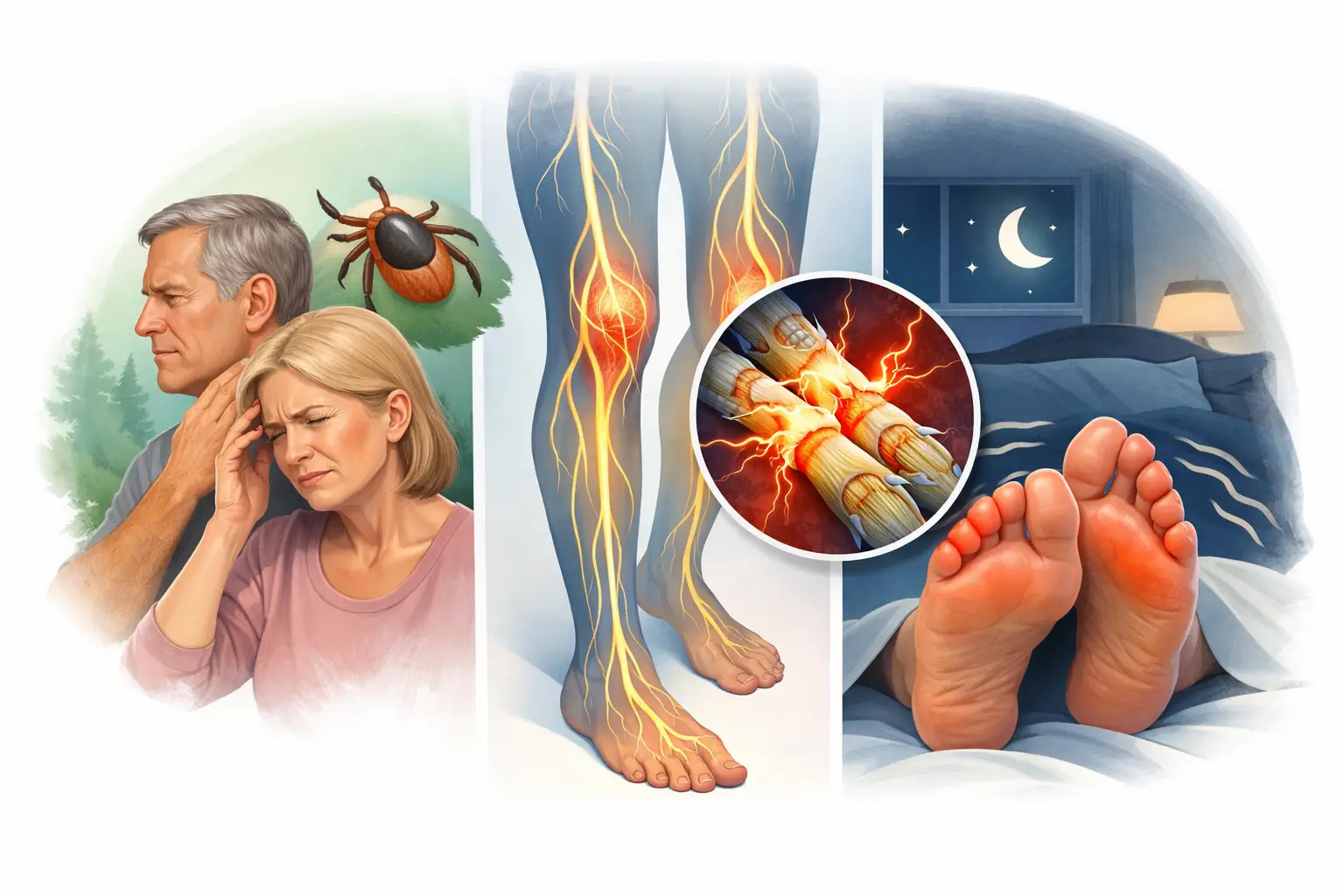
Lyme disease can sometimes affect the nervous system and may be associated with symptoms such as facial weakness, shooting nerve pain, numbness, tingling, burning sensations, or radicular pain. However, these symptoms are not specific to Lyme disease. Vitamin B12 deficiency, diabetes, thyroid disease, medication effects, alcohol-related nerve injury, spinal problems, kidney disease, and idiopathic neuropathy can cause similar symptoms. The most useful next step is a clinician-guided evaluation based on tick exposure, timing, rash or fever history, neurologic exam, Lyme testing when appropriate, and testing for more common neuropathy causes.
Burning feet, pins-and-needles, electric shock sensations, and numb patches can send people down a long list of possible causes. Lyme disease and neuropathy are one of the more confusing combinations because nerve symptoms may show up during or after infection, but they are not specific to Lyme alone. For adults trying to make sense of tingling or pain, that distinction matters.
Peripheral neuropathy is a broad term. It describes damage or dysfunction affecting peripheral nerves, which carry signals between the brain, spinal cord, skin, muscles, and internal organs. Lyme disease is an infection caused by Borrelia bacteria, usually transmitted through tick bites. In some people, Lyme can affect the nervous system. When that happens, symptoms may include facial weakness, shooting pain, numbness, tingling, or other abnormal nerve sensations.
The challenge is that these symptoms are common in many other conditions too. Vitamin B12 deficiency, diabetes, alcohol-related nerve injury, thyroid disease, medication side effects, spinal problems, and circulation issues can all produce similar complaints. That is why self-diagnosing Lyme from neuropathy symptoms alone is risky.
How Lyme disease can affect the nerves
Lyme disease does not cause the same pattern in every person. Some people develop the classic early signs, such as a rash, fever, fatigue, headache, or joint pain. Others never notice a tick bite or do not remember a rash. If the infection involves the nervous system, clinicians may refer to this as neurologic Lyme disease.
For a clinical overview of neurologic Lyme disease, see the CDC guide to neurologic Lyme disease.
Nerve-related symptoms can occur because the infection triggers inflammation in tissues that affect nerve signaling. In certain cases, Lyme has been associated with radiculopathy, which is pain, numbness, or weakness caused by irritated nerve roots. This can feel sharp, burning, or traveling, sometimes worse at night. Some people also develop cranial nerve involvement, especially facial nerve palsy.
Peripheral neuropathy linked to Lyme is discussed often, but the real picture is more nuanced than many headlines suggest. Lyme can be associated with nerve symptoms, yet not every patient with tingling hands or burning feet has Lyme-related nerve damage. In practice, the symptom pattern, timing, exposure history, exam findings, and lab work all help shape the answer.
Symptoms that may raise suspicion
When Lyme disease and neuropathy appear together, the symptom story matters as much as the symptom list. A clinician will usually look for timing, progression, and associated features rather than one isolated complaint.
Symptoms that may prompt further evaluation include numbness, tingling, burning pain, unusual skin sensitivity, facial drooping, neck stiffness, shooting limb pain, and weakness. Some people describe a crawling sensation, reduced reflexes, or pain that seems out of proportion to visible findings. Others mainly notice balance problems or clumsiness.
Even so, these are not Lyme-specific symptoms. For example, symmetrical burning in both feet often pushes clinicians to also consider diabetes, prediabetes, B12 deficiency, or idiopathic neuropathy. A one-sided facial droop with recent tick exposure may point more strongly toward Lyme, especially in regions where it is common. The details matter.
Important: New facial drooping, severe headache, stiff neck, fainting, chest symptoms, rapidly worsening weakness, or major balance changes should not be managed with supplements or online research alone.
These symptoms may need prompt medical evaluation, especially if they occur after possible tick exposure, rash, fever, joint swelling, or new neurologic complaints. Lyme disease is one possible explanation in the right context, but other neurologic, infectious, metabolic, and structural causes may also need to be considered.
Why diagnosis is often more complicated than people expect
Many patients assume testing will provide a clean yes-or-no answer. Lyme testing does not always work that way. Standard blood tests look for antibodies rather than the bacteria itself in most routine cases. That means timing matters. If testing is done very early, antibodies may not yet be detectable.
At the same time, a positive result does not automatically prove that current nerve symptoms are being caused by active Lyme disease. Past exposure, false positives in certain settings, and unrelated causes of neuropathy can muddy the picture. This is one reason experienced clinical judgment is so important.
A proper evaluation usually includes questions about tick exposure, travel or residence in higher-risk areas, rash history, joint symptoms, facial weakness, headaches, fever, and the timeline of nerve complaints. A neurological exam may be followed by blood work to check for more common neuropathy causes. Depending on the situation, this may include glucose markers, vitamin B12, thyroid studies, kidney function, and other labs.
For some patients, nerve conduction studies or electromyography may help clarify whether symptoms reflect peripheral nerve injury, nerve root involvement, or another neurological issue. In select cases involving suspected central nervous system involvement, spinal fluid testing may be considered. That level of workup depends on the clinical picture, not just internet checklists.
Testing Clues for Lyme Disease and Neuropathy
Testing depends on the pattern. Lyme testing may be appropriate when exposure history and symptoms fit, but clinicians often check other neuropathy causes at the same time.
| Test or Evaluation | What It May Help Assess | Important Limitation |
|---|---|---|
| Exposure and symptom timeline | Tick exposure, rash, fever, joint symptoms, facial palsy, shooting pain, or neurologic changes | Many people do not remember a tick bite, and symptoms can be nonspecific. |
| Lyme serologic testing | Antibody evidence that may support Lyme diagnosis in the right clinical context | Very early testing may be negative, and a positive result does not always prove current nerve symptoms are caused by active Lyme disease. |
| Neurologic exam | Facial weakness, reflexes, sensation, strength, gait, balance, and nerve-root patterns | Exam findings may need blood work, imaging, or nerve testing for context. |
| B12, glucose, thyroid, kidney, and medication review | Common non-Lyme causes of burning, tingling, numbness, and weakness | Normal results do not rule out every neuropathy type, but they help narrow the differential. |
| Nerve conduction studies and EMG | Peripheral neuropathy, radiculopathy, nerve-root involvement, or muscle-related findings | May not detect all small-fiber nerve problems. |
| Spinal fluid testing in select cases | Possible central nervous system involvement when symptoms and exam raise concern | Not needed for every person with tingling or burning feet. |
Research Snapshot: Lyme Disease and Neuropathy
Medical guidance describes neurologic Lyme disease as a possible complication of Lyme infection, but neuropathy-like symptoms require careful interpretation because many non-Lyme conditions can produce similar sensations.
| Research Finding | Clinical Relevance |
|---|---|
| Neurologic Lyme disease can involve the peripheral or central nervous system | Symptoms may include facial palsy, radiculopathy, meningitis-like features, shooting pain, numbness, or tingling in the right clinical context. |
| Neuropathy symptoms are not Lyme-specific | Burning feet, tingling, numbness, and weakness can also occur with B12 deficiency, diabetes, thyroid disease, kidney disease, alcohol exposure, medications, spine problems, and idiopathic neuropathy. |
| Testing must be interpreted with timing and exposure risk | Early antibody testing may be negative, while a positive result does not automatically prove that current nerve symptoms are due to active Lyme disease. |
| Most treated Lyme cases improve, but some symptoms can persist | Persistent fatigue, pain, or cognitive symptoms after treatment do not always mean ongoing infection and should be evaluated carefully. |
| More than one contributor can be present | A person may have Lyme exposure and also have B12 deficiency, diabetic neuropathy, medication effects, or spine-related nerve irritation. |
Editorial note: This snapshot summarizes broad medical education themes. It is not intended to diagnose Lyme disease, confirm the cause of neuropathy, or replace evaluation by a qualified healthcare professional.
Conditions that can look similar
One of the biggest pitfalls in this topic is assuming that neuropathy plus fatigue equals Lyme. In adults over 45, several conditions often deserve equal or greater attention.
Vitamin B12 deficiency is a major example. Low B12 can contribute to numbness, tingling, gait changes, weakness, cognitive changes, and anemia, although neurological symptoms may appear even before anemia becomes obvious. Diabetes and prediabetes are also common drivers of burning feet and distal numbness. Thyroid disease, excessive alcohol use, chemotherapy exposure, and chronic kidney disease can all affect nerve health.
Mechanical issues matter too. Spinal stenosis, pinched nerves, and degenerative disc disease may create pain, tingling, or weakness that feels neuropathic but stems from nerve compression rather than systemic nerve injury. Poor circulation can also confuse the picture, especially when leg discomfort occurs with walking or at night.
This is where evidence-informed consumer health guidance becomes especially valuable. Before focusing on any supplement or online theory, it makes sense to confirm what is actually causing the symptoms.
Lyme Neuropathy vs Other Common Causes of Nerve Symptoms
Burning, tingling, numbness, and shooting pain can come from several different conditions. The pattern, timing, exposure history, and test results help determine whether Lyme disease is likely or whether another cause deserves more attention.
| Possible Cause | Typical Clues | Why It Can Be Confusing | What May Help Clarify |
|---|---|---|---|
| Lyme-related neurologic involvement | Tick exposure, rash history, fever, joint symptoms, facial palsy, shooting limb pain, radicular pain, neck stiffness | Neurologic Lyme symptoms can overlap with other neuropathy and spine-related symptoms. | Exposure history, exam findings, appropriate Lyme testing, and evaluation for other causes. |
| Vitamin B12 deficiency | Numbness, tingling, burning feet, balance problems, fatigue, memory changes, anemia signs, metformin or acid-reducer use | B12 symptoms can feel neurologic and may appear without obvious anemia. | Serum B12, methylmalonic acid, homocysteine, CBC, diet and absorption review. |
| Diabetes or prediabetes | Burning feet, numb toes, symptoms starting in both feet, metabolic risk factors | Distal burning and tingling may be mistaken for infection-related neuropathy. | Glucose and A1C testing when appropriate. |
| Spine or nerve root compression | Pain traveling from back or neck, one-sided symptoms, weakness in a nerve-root pattern, symptoms triggered by posture | Radiculopathy can feel like neuropathy and may produce shooting or electric pain. | Neurologic exam, imaging when appropriate, EMG or nerve studies in selected cases. |
| Medication, alcohol, or toxin-related neuropathy | New medication timing, chemotherapy history, alcohol exposure, supplement overuse, toxin exposure | Symptoms may appear gradually and resemble other neuropathy patterns. | Medication, supplement, alcohol, and exposure review. |
| Idiopathic neuropathy | Persistent nerve symptoms with no confirmed cause after evaluation | The absence of a clear cause can lead people to over-focus on one possible explanation. | Follow-up, pattern tracking, repeat testing if symptoms change, and neurologist review when needed. |
What treatment and recovery may look like
If a clinician determines that Lyme disease is the likely cause, treatment typically centers on appropriate prescription antibiotics based on the stage and manifestations of illness. The exact regimen depends on the presentation. This is not an area for self-treatment with supplements alone.
What patients often want to know, though, is whether nerve symptoms will go away completely. Sometimes they improve gradually after treatment. Sometimes they take time, especially if inflammation or nerve irritation has been significant. And sometimes symptoms persist longer than expected, even when the infection itself has been addressed.
That does not always mean ongoing infection. Nerves recover slowly, and not all nerve symptoms are fully reversible once they have developed. In addition, a person may have more than one issue at the same time, such as Lyme exposure plus B12 deficiency or diabetic neuropathy. That is another reason follow-up matters.
Supportive care may include pain management, physical therapy, sleep support, treatment of nutritional deficiencies, and practical foot care if burning or numbness affects walking. For readers researching nerve-support products, it is reasonable to ask whether a formula contains ingredients with a plausible role in nerve function, such as vitamin B12, while keeping expectations realistic. A supplement may help correct a deficiency or support general nerve health, but it should not be presented as a cure for Lyme-related neurological symptoms.
What B12 Can and Cannot Do
Vitamin B12 can be important for nerve health, but it should be understood in the right context. It may help when deficiency is part of the problem, but it does not diagnose Lyme disease, treat Lyme infection, or replace medical evaluation.
- A documented or likely B12 deficiency is present.
- Low intake or absorption problems are contributing factors.
- A clinician includes B12 as part of a broader nerve-health evaluation.
- Treat Lyme infection itself.
- Replace antibiotics when antibiotics are indicated.
- Diagnose the cause of nerve symptoms.
- Reverse all nerve damage.
- Replace evaluation by a healthcare professional.
Practical takeaway: B12 is most relevant when deficiency, low intake, or absorption problems are part of the picture. It should be used as part of a clinician-guided plan, not as a substitute for Lyme evaluation, antibiotic treatment when indicated, or a broader neuropathy workup.
When to seek medical evaluation promptly
Some symptoms should not wait for routine internet research. New facial drooping, significant weakness, severe headache, stiff neck, worsening balance, chest symptoms, fainting, or rapidly progressive numbness deserve timely medical attention. The same is true if you have possible tick exposure followed by rash, fever, joint swelling, or new neurological complaints.
More subtle symptoms also warrant discussion if they persist. Burning feet at night, unexplained tingling in the hands, or numbness that slowly climbs upward may not be an emergency, but they are worth evaluating before assuming they are just part of aging.
A practical way to think about Lyme disease and neuropathy
The most useful mindset is cautious and specific. Lyme disease can contribute to neuropathic symptoms, but it is only one item on a fairly long list of possibilities. A believable explanation usually comes from the full pattern: exposure risk, symptom timing, physical findings, testing, and whether more common causes have been checked.
For adults sorting through nerve symptoms, the next best step is usually not guessing which supplement to buy first. It is getting a clear workup that includes both infectious and non-infectious causes, especially vitamin deficiencies, glucose issues, medication effects, and structural nerve problems. Once the cause is clearer, decisions about treatment and supportive care become much more grounded.
If your symptoms have made you wonder about Lyme, bring a simple timeline to your appointment – when the tingling started, whether it spread, any rash or tick exposure, and what else changed around the same time. That kind of detail often helps more than a long list of internet possibilities.
If you’re trying to understand what may be behind numbness, tingling, burning feet, or nerve pain, our guide to peripheral neuropathy causes and relief explains the most common causes and what may help support nerve health.
Frequently Asked Questions About Lyme Disease and Neuropathy
These answers are for education only and should not replace medical evaluation.
Can Lyme disease cause neuropathy symptoms?
Lyme disease can sometimes affect the nervous system and may be associated with nerve-related symptoms such as facial weakness, shooting pain, numbness, tingling, burning sensations, or radicular pain. However, these symptoms are not specific to Lyme disease and need clinical evaluation.
What does Lyme nerve pain feel like?
Some people describe sharp, shooting, burning, traveling, or electric-like pain. In Lyme-related radiculopathy, pain may follow a nerve-root pattern and can sometimes feel worse at night. The same sensations can also occur with spine problems, diabetes, B12 deficiency, or other neuropathies.
Can burning feet be a sign of Lyme disease?
Burning feet can occur with many conditions. Lyme disease is one possible cause in the right exposure and symptom context, but diabetes, prediabetes, B12 deficiency, thyroid disease, kidney disease, medication effects, alcohol exposure, small fiber neuropathy, and idiopathic neuropathy are often considered too.
How is Lyme-related neuropathy tested?
Evaluation may include exposure history, symptom timeline, neurologic exam, Lyme serologic testing when appropriate, and testing for other neuropathy causes. In some cases, nerve conduction studies, EMG, imaging, or spinal fluid testing may be considered depending on the clinical picture.
Can Lyme testing be negative if symptoms are early?
Yes. Standard Lyme blood tests usually look for antibodies, and antibodies may not be detectable very early. Timing, symptoms, exposure risk, and clinician judgment all matter when interpreting results.
Can B12 deficiency be mistaken for Lyme neuropathy?
It can be confused with it because B12 deficiency may cause numbness, tingling, burning sensations, balance problems, weakness, fatigue, and cognitive complaints. Testing B12 status may be important, especially when risk factors such as metformin use, acid-reducing medications, low animal-food intake, or absorption problems are present.
Do supplements treat Lyme neuropathy?
Supplements should not be used as a treatment for Lyme disease itself. If Lyme disease is diagnosed, treatment typically involves clinician-directed antibiotics. Supplements may have a role only when there is a specific deficiency, nutritional need, or supportive-care reason discussed with a healthcare professional.
When should Lyme and neuropathy symptoms be evaluated quickly?
Prompt evaluation is important for new facial drooping, severe headache, stiff neck, fainting, chest symptoms, rapidly worsening weakness, major balance changes, new neurologic symptoms after possible tick exposure, or rash and fever with nerve symptoms.
Medical Disclaimer:
This article is for educational purposes only and does not diagnose, treat, or replace medical care. Lyme disease and neuropathy symptoms can have multiple causes. Persistent, progressive, one-sided, or unexplained burning, tingling, numbness, weakness, facial symptoms, balance problems, severe headache, neck stiffness, heart symptoms, fever, rash after possible tick exposure, or neurologic symptoms after a tick bite should be discussed with a qualified healthcare professional.

- Can Low B12 Cause Dizziness? - July 9, 2026
- B12 Deficiency and Cracked Corners of the Mouth - July 9, 2026
- Can Low B12 Cause Dry Mouth? - July 8, 2026