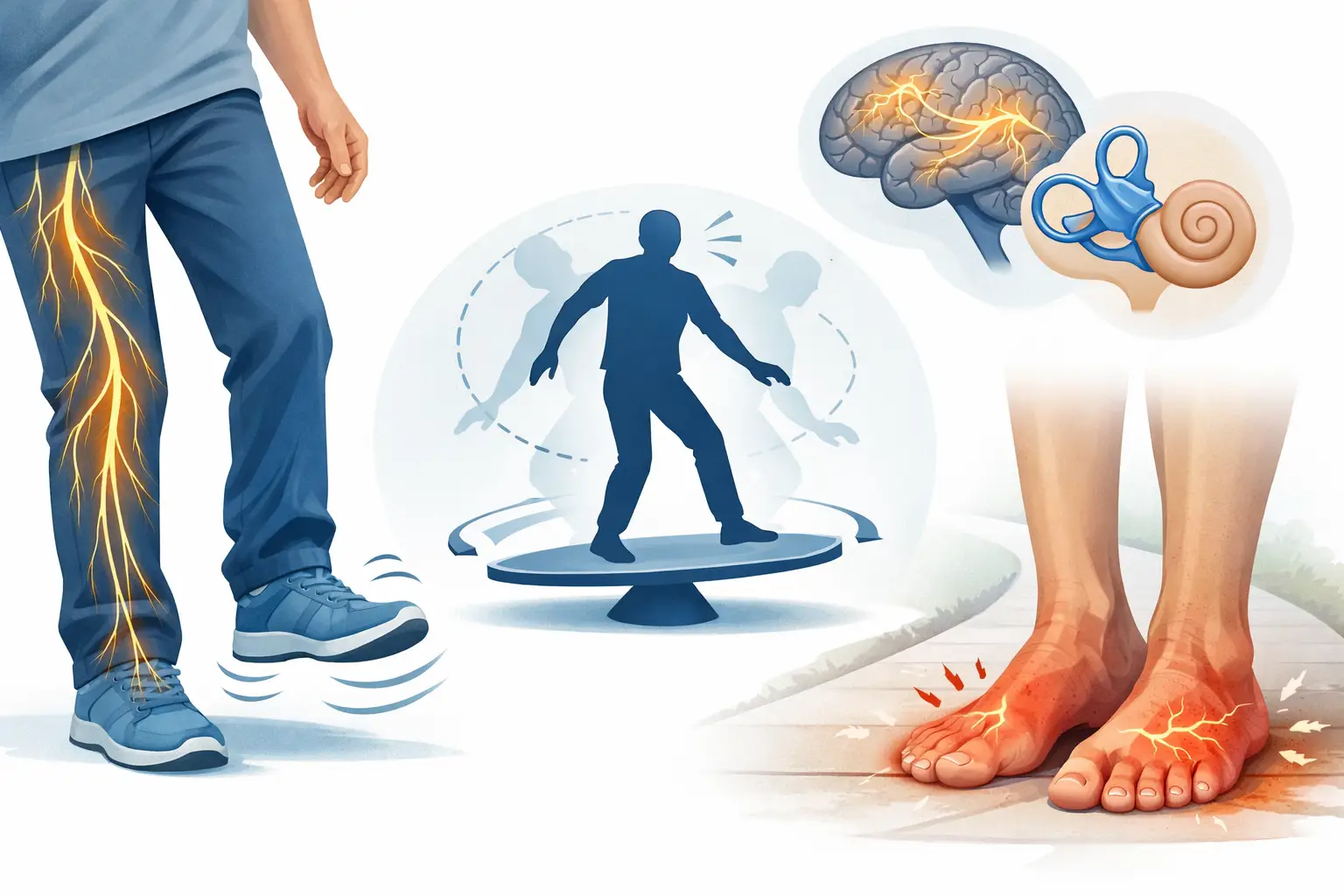
Peripheral neuropathy can affect balance and walking because nerves help the brain detect foot position, pressure, movement, and coordination. When sensory feedback becomes impaired, people may feel unstable, clumsy, weak, or less aware of where their feet are while walking, especially in darkness or on uneven surfaces.
A lot of people describe neuropathy the same way at first: numb feet, burning toes, and a strange sense that the floor does not feel the way it used to. What surprises many of them is how quickly those symptoms can turn into unsteady walking. Why Neuropathy Affects Balance and Walking comes down to one basic problem – your brain relies on accurate nerve signals from the feet and legs, and when those signals are reduced, delayed, or distorted, movement becomes less reliable.
That shift can be subtle in the beginning. You may notice that you catch your toe on a rug, feel less steady in the shower, or walk more carefully in the dark. For adults over 45, these changes matter because balance problems raise the risk of falls, limit confidence, and can make everyday activity harder long before pain becomes severe.
Key Takeaways
- Neuropathy affects balance because nerves provide constant feedback about foot position, pressure, and movement.
- Reduced sensation in the feet forces the body to rely more heavily on vision, especially while walking.
- Balance problems often become worse in darkness or on uneven surfaces because visual compensation becomes less effective.
- Muscle weakness, altered reflexes, and pain may further increase instability and fall risk.
- Vitamin B12 deficiency is one possible contributor, particularly in older adults or people taking certain medications long term.
Why neuropathy affects balance and walking
Walking looks automatic, but it is actually a highly coordinated process. Your body has to combine muscle strength, joint position, vision, inner ear input, and sensory feedback from the skin and nerves in your feet. Peripheral neuropathy can interfere with several parts of that system at once.
The most common issue is sensory loss. Healthy nerves send constant updates about pressure, vibration, and position. They tell your brain whether your heel has touched the floor, how much weight is on the ball of the foot, and whether the ankle is tilting. When neuropathy damages those nerves, the brain gets incomplete information. You may still be able to walk, but you are doing it with less feedback and less precision.
This is one reason people with neuropathy often say they feel like they are walking on cotton, sand, or thick socks. It is not just an odd sensation. It reflects reduced proprioception, which is your ability to sense where your body is in space. If you cannot clearly sense foot placement, balance becomes more dependent on vision. That is why many people feel less steady at night or on uneven ground.
Neuropathy can also affect motor nerves. These nerves help activate the muscles that lift the front of the foot, stabilize the ankle, and control push-off during each step. If motor involvement develops, walking may become slower, more cautious, or more irregular. Some people develop foot drop, where the front of the foot drags because it does not lift normally.
Pain plays a role too. Burning, stabbing, or electric sensations can change the way a person walks even when strength is fairly preserved. If stepping hurts, the body naturally shifts weight away from the painful area. Over time, that compensation can create a wider stance, shorter steps, and a more guarded gait.
What changes in the body make walking less stable
Balance problems in neuropathy are not caused by one single defect. They usually come from a combination of sensory loss, muscle changes, and altered reflexes.
When sensation in the soles of the feet declines, the body loses one of its most important contact points with the ground. Think of the feet as real-time sensors. They help detect whether the surface is firm, slippery, sloped, or uneven. If that information is dulled, the timing of each correction becomes less accurate.
Ankle reflexes may also become reduced. Those quick automatic responses help you recover from small shifts in posture. If they are slowed, the body may not correct itself as efficiently after a stumble or sudden movement.
Muscle weakness, when present, can further increase instability. The small muscles of the feet and lower legs help maintain alignment and control during standing and walking. Weakness in these areas may not be obvious at rest, but it often shows up during tasks like turning, climbing stairs, or walking heel-to-toe.
There is also a practical behavioral side. People who do not trust their footing often move differently. They may look down constantly, walk more slowly, avoid longer outings, or stop exercising. That caution is understandable, but reduced activity can gradually lead to deconditioning, which makes balance worse rather than better.
Common walking patterns seen with neuropathy
Common Balance and Walking Changes in Neuropathy
Different walking patterns may appear depending on which nerves are affected and how much sensory or motor function has changed.
| Walking Pattern | What It May Reflect | Common Clues |
|---|---|---|
| Slow, cautious gait | Reduced confidence and sensory feedback | Shorter steps and hesitation |
| Wide-based walking | Compensation for instability | Feet placed farther apart |
| Steppage gait | Weakness lifting the foot | High knee lifting to avoid toe dragging |
| Heavy foot placement | Reduced proprioception | Trying to “feel the floor” |
| Difficulty on uneven ground | Impaired sensory corrections | Grass, gravel, stairs become harder |
| Worsening balance in darkness | Greater dependence on visual input | Feeling unstable with eyes closed |
Not everyone with neuropathy walks the same way, and the pattern depends on which nerves are affected, how severe the damage is, and whether other issues such as arthritis or vision changes are involved. Still, a few patterns show up often.
A sensory gait is common in people with numbness and poor proprioception. Steps may be slower and heavier, almost as if the person is trying to feel the floor by placing the foot down more firmly. Many people widen their stance to create more stability.
Others develop a steppage gait if the muscles that lift the foot are weak. In that case, the knee lifts higher than usual to keep the toes from dragging. This can be tiring and increases the chance of tripping.
Some people mainly show a cautious gait. They take shorter steps, avoid quick turns, and hesitate on curbs or unfamiliar surfaces. This pattern often reflects a mix of mild sensory loss, pain, and fear of falling.
These changes are not always dramatic. In early neuropathy, the first sign may simply be that walking feels less automatic than it used to.
Why symptoms often feel worse in the dark or on uneven ground
A common clue in neuropathy is that balance gets worse when visual input is reduced. If you have to watch your feet more than before, your body may be compensating for poor sensory feedback from the legs.
In daylight on a flat surface, vision can help guide each step. In dim light, that backup system becomes less effective. The same problem shows up on grass, gravel, thick carpet, or broken pavement. Uneven surfaces require constant fine adjustments, and those adjustments depend heavily on intact nerve signaling.
This is also why some people feel much less steady when closing their eyes in the shower or standing still while dressing. They are not imagining it. Without strong sensory input from the feet, balance becomes more fragile when visual cues disappear.
Possible causes behind neuropathy-related balance problems
Neuropathy is not a single diagnosis. It is a broad term for nerve damage, and the cause matters because some contributors are treatable or manageable. Diabetes is one of the most recognized causes, but it is not the only one.
Vitamin B12 deficiency deserves attention, especially in older adults, people taking metformin or acid-reducing medications, and those with certain digestive conditions. Low B12 can contribute to numbness, tingling, weakness, and gait changes.
According to the NIH Office of Dietary Supplements, vitamin B12 plays an important role in neurological function and nervous system health.
The relationship is medically important because prolonged deficiency can affect both peripheral nerves and spinal cord pathways involved in position sense.
Other possible contributors include alcohol overuse, thyroid disorders, kidney disease, certain medications, autoimmune conditions, and nerve compression. In some cases, the cause remains unclear even after evaluation.
For a health-information site focused on evidence-informed supplement reviews, this is where caution matters. Nutritional support may be relevant if a true deficiency or inadequate intake is part of the picture, but supplements are not interchangeable with diagnosis. A person with new balance problems should not assume the issue is minor or self-treat based on internet advice alone.
When balance changes need prompt medical attention
Neuropathy symptoms can develop gradually, but some walking changes should be evaluated sooner rather than later. Sudden weakness, one-sided symptoms, rapidly worsening gait, bowel or bladder changes, severe back pain, or repeated falls call for prompt medical assessment.
Even slower-developing symptoms deserve attention if they interfere with daily life. If you feel unsteady on stairs, avoid leaving home because of fear of falling, or notice progressive numbness moving upward from the feet, that is worth discussing with a clinician. The goal is not only to identify neuropathy, but to look for causes that may require treatment or further testing.
Practical steps that may help reduce fall risk
The right strategy depends on the cause and severity, but a few principles are broadly useful. Supportive footwear with a stable sole can improve contact with the ground better than loose slippers or worn-out shoes. Good lighting, especially at night, matters more than many people realize. Removing tripping hazards at home can make a real difference.
Structured exercise is often helpful when chosen appropriately. Balance training, lower-body strengthening, and guided physical therapy can improve stability and confidence in many people with neuropathy. The key is matching the program to the individual. If numbness is significant, unsupervised exercises that challenge balance too aggressively may backfire.
If B12 status is a concern, laboratory testing and medical guidance are the sensible first steps. High-quality supplements may be appropriate in some situations, but realistic expectations are important. Improvement depends on the underlying cause, the degree of deficiency, and how long symptoms have been present.
Balance and walking problems are often the symptoms that make neuropathy feel real. Tingling can be easy to dismiss. Feeling unsafe on your feet is harder to ignore. That change happens because nerves do far more than carry pain – they help your body know where it is, how to step, and how to recover when movement is less than perfect. When those signals weaken, walking becomes less automatic, and paying attention early can make the next steps safer.
Frequently Asked Questions
Why does neuropathy affect balance?
Neuropathy can reduce sensation in the feet and legs, making it harder for the brain to detect position, movement, and pressure accurately during walking.
Why do balance problems feel worse in the dark?
Many people with neuropathy rely more heavily on vision to compensate for poor sensory feedback from the feet. In darkness, that visual compensation becomes less effective.
Can vitamin B12 deficiency affect walking?
Yes. Low vitamin B12 may contribute to numbness, weakness, balance changes, and gait instability in some adults.
What is foot drop in neuropathy?
Foot drop happens when the muscles that lift the front of the foot become weak, causing the toes to drag during walking.
When should balance problems be medically evaluated?
Repeated falls, rapidly worsening walking problems, sudden weakness, or symptoms affecting one side of the body deserve prompt medical evaluation.
Medical Disclaimer: The information provided in this article is for educational purposes only and is not intended as medical advice. Dietary supplements are not a replacement for professional medical diagnosis or treatment. Always consult with a qualified healthcare professional before starting any new supplement, especially if you have pre-existing medical conditions or are taking prescription medications. Individual results may vary.

- Can Low B12 Cause Dizziness? - July 9, 2026
- B12 Deficiency and Cracked Corners of the Mouth - July 9, 2026
- Can Low B12 Cause Dry Mouth? - July 8, 2026