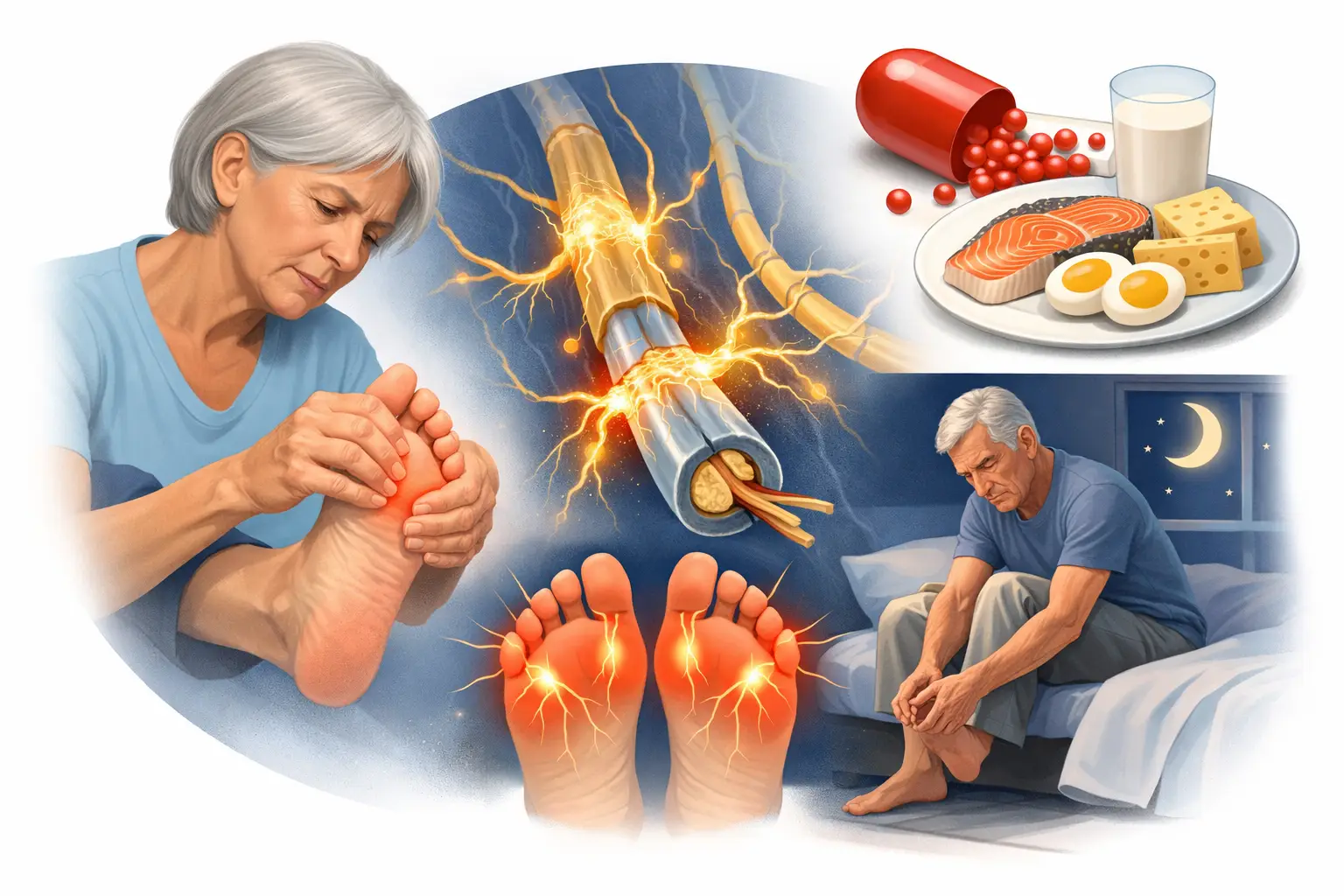
B12 deficiency neuropathy in older adults can cause tingling, numbness, burning feet, balance changes, reduced sensation, weakness, fatigue, memory changes, or anemia-related clues. It is often related to poor absorption rather than diet alone. Adults over 45, especially those using metformin, acid-reducing medications, or with digestive disorders, should ask a clinician about B12 testing if nerve symptoms are new, persistent, or worsening.
Burning feet, pins-and-needles, and numb toes are often blamed on aging, poor circulation, or “just neuropathy.” But vitamin B12 deficiency can be a real and sometimes overlooked contributor to neuropathy-like symptoms in older adults — and one that deserves prompt medical attention because delayed evaluation may make some nerve-related problems harder to improve, depending on the cause, duration, and severity.
Vitamin B12 is essential for nerve function, red blood cell formation, and DNA synthesis. When levels fall too low, the nervous system can be affected in ways that are subtle at first and disruptive later. For adults over 45, and especially seniors, this matters because B12 deficiency becomes more common with age for reasons that have less to do with diet alone and more to do with absorption.
Vitamin B12 is important for normal neurological function, red blood cell formation, and DNA synthesis, which is why low B12 may be relevant when older adults develop unexplained numbness, tingling, or balance changes.
Key Takeaways
- B12 deficiency neuropathy in older adults is often related to absorption, not just low intake or vegan diets.
- Symptoms can include burning feet, numb toes, tingling, balance changes, weakness, fatigue, sore tongue, or memory changes.
- A normal-looking blood count does not always rule out neurologic B12 problems, especially when symptoms and risk factors are present.
- Metformin, acid-reducing medications, pernicious anemia, gastric surgery, and digestive disorders can increase the risk of low B12 in older adults.
- Early testing matters, because B12-related nerve symptoms may improve with treatment, but recovery can be slow or incomplete if diagnosis is delayed.
Why older adults are at higher risk
Many people assume B12 deficiency only happens in strict vegans. While low intake can certainly contribute, older adults often develop deficiency because the body has a harder time extracting B12 from food. Stomach acid tends to decline with age, and certain digestive conditions can interfere with absorption. The vitamin must also bind to intrinsic factor, a protein made in the stomach, before it can be absorbed in the small intestine. Problems anywhere along that chain can reduce B12 status.
Common risk factors include long-term use of acid-reducing medications, metformin use, pernicious anemia, gastric surgery, inflammatory bowel conditions, and chronic low stomach acid. Dietary patterns still matter, but in older adults, poor absorption is frequently the bigger issue.
This is one reason B12 deficiency can be missed. A person may eat meat, eggs, or dairy regularly and still become deficient.
Risk factors for B12 deficiency neuropathy in older adults
| Risk Factor | Why It Matters | What to Ask About |
|---|---|---|
| Older age | Stomach acid may decline with age, making it harder to release B12 from food. | Ask whether B12 testing is appropriate if nerve symptoms, fatigue, or balance changes are present. |
| Metformin use | Long-term metformin use has been associated with lower B12 status in some patients. | Ask whether periodic B12 monitoring makes sense, especially with tingling or numbness. |
| Acid-reducing medications | PPIs and H2 blockers may reduce stomach acid needed to separate B12 from food. | Ask whether long-term use could affect B12 status. |
| Pernicious anemia | Intrinsic factor problems can prevent normal B12 absorption. | Ask about intrinsic factor or parietal cell antibody testing if suspected. |
| Gastric surgery or digestive disorders | Stomach or intestinal changes can reduce B12 absorption. | Ask whether oral high-dose B12 or injections may be more appropriate. |
| Vegan or very low animal-food diet | B12 is naturally found mainly in animal foods and fortified foods. | Ask whether supplementation and follow-up testing are needed. |
How B12 deficiency affects the nerves
B12 helps maintain myelin, the protective covering around nerves. When B12 is lacking, nerves may not transmit signals efficiently. Over time, this can lead to sensory changes, balance problems, weakness, or cognitive symptoms. The pattern often starts gradually and may begin in the feet before moving upward.
Neuropathy from B12 deficiency is not always dramatic in the beginning. Some people notice mild tingling at night, occasional burning soles, or a feeling that their socks are bunched up when they are not. Others describe reduced sensation, clumsiness, or trouble sensing the floor when walking.
Because these symptoms overlap with diabetic neuropathy, spinal problems, and circulation complaints, the cause may not be obvious without proper testing.
Symptoms of B12 deficiency neuropathy in older adults
The nerve-related symptoms can vary, but several patterns are especially common. Tingling and numbness in the feet or hands are classic signs. Burning pain, electric-shock sensations, and unusual sensitivity to touch can also occur. Some adults feel weakness in the legs or notice that stairs become harder to manage.
Balance changes deserve special attention. B12 deficiency can affect proprioception, which is the body’s ability to sense position and movement. That may show up as unsteadiness in the dark, a wider gait, or a tendency to stumble.
There may also be non-neurologic clues. Fatigue, pale skin, shortness of breath, glossitis, memory changes, mood changes, and anemia can appear alongside neuropathy – but not always. Some people have neurologic symptoms even when anemia is mild or absent.
That point matters. A normal-looking complete blood count does not automatically rule out a clinically meaningful B12 problem.
| Symptom or Clue | How It May Feel | Why It Matters in Older Adults |
|---|---|---|
| Tingling or pins-and-needles | Prickling, buzzing, crawling, or electric sensations in the feet or hands. | May be an early nerve-related clue, but it can overlap with diabetes, spine issues, or medication effects. |
| Numb toes or reduced sensation | Less ability to feel socks, shoes, floors, vibration, or touch. | Reduced sensation can increase fall risk and make foot injuries easier to miss. |
| Burning feet | Heat, stinging, burning soles, or painful sensitivity, often noticed at night. | Burning pain may come from several neuropathy causes, so B12 should be checked in context. |
| Balance changes | Feeling unsteady, especially in the dark, on stairs, or when walking on uneven surfaces. | B12 deficiency can affect proprioception, which helps the body sense position and movement. |
| Weakness or clumsiness | Leg heaviness, difficulty with stairs, stumbling, or less confidence walking. | Progressive weakness should be evaluated promptly and not managed with supplements alone. |
| Fatigue, memory changes, sore tongue, or anemia clues | Low energy, pale skin, shortness of breath, glossitis, mood changes, or cognitive complaints. | These clues can support B12 deficiency, but neurologic symptoms may occur even without obvious anemia. |
Why diagnosis is sometimes delayed
In real-world practice, B12 deficiency may be underrecognized because the symptoms develop slowly and mimic several other conditions. Older adults may attribute numbness to arthritis, back issues, or circulation. Clinicians may first evaluate diabetes, medication side effects, or lumbar spine disease, which is reasonable, but B12 can be missed if it is not specifically considered.
Testing also has nuance. A standard serum B12 level is useful, but it is not perfect. A borderline result may not reflect how well B12 is functioning at the tissue level. In some cases, clinicians also consider methylmalonic acid and homocysteine, which can rise when B12 is insufficient. If pernicious anemia is suspected, intrinsic factor or parietal cell antibody testing may be part of the workup.
This is where medical context matters. Low-normal lab values, symptoms, medication history, and blood count findings need to be interpreted together rather than in isolation.
B12 deficiency neuropathy vs normal aging
Tingling, numbness, burning feet, or balance changes should not automatically be treated as normal aging. While aging can bring changes in strength, circulation, vision, and mobility, progressive sensory loss or pins-and-needles sensations may point to a nerve problem that deserves evaluation.
B12 deficiency is especially important because it is a potentially correctable contributor. The challenge is that older adults may also have diabetes, spinal stenosis, medication side effects, thyroid disease, or circulation issues at the same time. That is why the safest approach is not to guess, but to combine symptoms, medication history, diet, and lab testing.
B12 Deficiency Neuropathy vs Diabetic Neuropathy
B12 deficiency neuropathy and diabetic neuropathy can look very similar in older adults. Both may cause burning feet, tingling, numbness, balance changes, or reduced sensation. The difference is the underlying cause, and testing is often needed because an older adult can have both conditions at the same time.
Practical takeaway: In older adults, burning feet, numb toes, and balance changes should not be automatically blamed on diabetes or aging. B12 deficiency and diabetic neuropathy can overlap, and the right treatment depends on identifying the real contributors.
What to ask a clinician about testing
If neuropathy symptoms are new, worsening, or unexplained, it is reasonable to ask whether B12 status has been evaluated thoroughly. Adults who use metformin, proton pump inhibitors, or H2 blockers long term may want to bring that history up directly. The same goes for prior gastric surgery, chronic digestive issues, or a known autoimmune history.
A thorough evaluation may include serum B12, methylmalonic acid, homocysteine, complete blood count, and sometimes folate or iron studies. Depending on symptoms, clinicians may also screen for diabetes, thyroid dysfunction, kidney disease, or other causes of neuropathy.
That broader view is important because neuropathy often has more than one contributing factor. An older adult can have mild diabetes, spinal stenosis, and low B12 at the same time.
Research Snapshot
| Research Finding | Clinical Relevance |
|---|---|
| Vitamin B12 deficiency can cause fatigue, neurological changes, megaloblastic anemia, and glossitis. | This supports checking B12 when older adults have both nerve symptoms and systemic clues such as fatigue or tongue changes. |
| Older adults may have reduced absorption of food-bound B12 due to changes in stomach acid and digestion. | This explains why deficiency can occur even when an older adult eats animal foods regularly. |
| Peripheral neuropathy can involve tingling, numbness, pain, weakness, and sensory changes. | This reinforces why B12 deficiency should be considered in older adults with burning feet, pins-and-needles, or numb toes. |
| Long-term metformin use has been associated with B12 deficiency in some patients. | This is clinically relevant because older adults with diabetes may have both diabetic neuropathy risk and B12 deficiency risk. |
Can the nerve damage improve?
The encouraging part is that B12 deficiency is a potentially correctable contributor to nerve-related symptoms when it is identified and treated appropriately. The less encouraging part is that nerve recovery can be slow, incomplete, or both, especially when symptoms have been present for a long time.
Some people may notice changes in energy or nerve symptoms after treatment, but the timeline varies. Sensory symptoms in the feet, such as numbness, tingling, or burning, may take months to improve. In more advanced cases, numbness, gait instability, or burning discomfort may persist even after B12 levels normalize. That does not mean treatment failed. It may mean the nerves need more time, or that some injury was not fully reversible.
Realistic expectations help. Correcting deficiency addresses an underlying problem, but it does not guarantee a quick or total resolution of every symptom.
Treatment usually starts with the cause
The right approach depends on why the deficiency developed. If intake is low, oral supplementation may be sufficient. If absorption is impaired, clinicians may recommend higher-dose oral B12 or intramuscular injections. In pernicious anemia or severe deficiency, injections are often used at least initially.
The form of B12 in supplements also gets attention from consumers. Cyanocobalamin is common, stable, and widely studied. Methylcobalamin is popular in nerve-health products and may appeal to shoppers looking for a more specialized option. From a practical standpoint, the best choice often depends less on marketing and more on dose, absorption, tolerance, cost, and clinician guidance.
For readers comparing products, quality matters more than flashy claims. A sensible B12 supplement should provide a clearly labeled dose, appropriate form, third-party quality standards when available, and straightforward ingredient disclosure. What it should not promise is to cure neuropathy, reverse nerve damage overnight, or replace medical evaluation.
Important: New or worsening nerve symptoms in older adults should not be dismissed as normal aging.
Burning feet, numb toes, pins-and-needles, weakness, falls, balance changes, confusion, or trouble walking can have several causes, including B12 deficiency, diabetes, thyroid disease, medication effects, vitamin B6 toxicity, spinal compression, circulation problems, or neurologic disease. Seek prompt medical evaluation if symptoms are rapidly worsening, one-sided, associated with weakness, causing falls, or linked with bladder or bowel changes.
When supplementation may not be enough
If symptoms are significant, new, asymmetric, or rapidly progressive, self-treating with an over-the-counter product is not enough. Neuropathy can also result from diabetes, alcohol use, medication effects, thyroid disease, nerve compression, autoimmune disorders, and other neurologic conditions. Severe balance changes, falls, weakness, bowel or bladder symptoms, or confusion deserve prompt medical assessment.
Even in milder cases, supplementation should be viewed as part of a broader plan. That plan may include identifying drug-related causes, treating anemia, improving nutrition, checking for folate or iron problems, and addressing fall risk.
Practical questions older adults often ask
One common question is whether a multivitamin provides enough B12. Sometimes it does, sometimes it does not. People with impaired absorption often need a much higher dose than a standard multivitamin supplies.
Another question is whether high B12 automatically means better nerve health. Not necessarily. More is not always better, and very high doses should have a clear reason behind them. The goal is correcting deficiency appropriately, not chasing the highest number on a label.
People also ask how long they need to continue treatment. That depends on the cause. If deficiency resulted from a temporary dietary gap, supplementation may be short term. If it stems from pernicious anemia, chronic medication use, or age-related malabsorption, ongoing treatment is more likely.
For adults comparing B12 supplement options, the most useful mindset is cautious and evidence-informed.
B12 deficiency neuropathy in older adults is important to consider when nerve symptoms are unexplained, especially when absorption problems, metformin use, or acid-reducing medications are part of the history.
A smart next step if symptoms sound familiar
If you are over 45 and dealing with tingling, numbness, burning feet, or unexplained balance changes, B12 deserves a place on the checklist. It is not the only cause of neuropathy, and it is not a diagnosis you should make by symptoms alone. But it is one of the more important reversible contributors to rule in or rule out.
The most helpful next step is simple: bring your symptoms, medication list, and supplement history to a qualified healthcare professional and ask whether B12 testing makes sense in your case. When nerve symptoms and vitamin status are evaluated early, the odds of meaningful improvement are generally better.
Vitamin B12 is important for normal neurological function , red blood cell formation, and DNA synthesis, which is why low B12 may be relevant when older adults develop unexplained numbness, tingling, or balance changes.
If you’re trying to understand what may be behind numbness, tingling, burning feet, or nerve pain, see our guide to peripheral neuropathy causes, warning signs, and evidence-informed next steps.
Frequently Asked Questions
What does B12 deficiency neuropathy feel like in older adults?
B12 deficiency neuropathy may feel like tingling, pins-and-needles, numb toes, burning feet, reduced sensation, clumsiness, or balance changes. Some people also notice fatigue, memory changes, sore tongue, pale skin, or anemia-related symptoms.
Why are older adults more likely to develop B12 deficiency?
Older adults may have more difficulty absorbing B12 from food because of lower stomach acid, digestive disorders, pernicious anemia, gastric surgery, or long-term medication use. Diet can matter, but absorption is often a major reason in this age group.
Can B12 deficiency neuropathy happen without anemia?
Yes. Some people can have neurologic symptoms from B12 deficiency even when anemia is mild or not obvious. A normal-looking complete blood count does not always rule out a clinically relevant B12 problem.
What tests help check for B12 deficiency neuropathy?
Clinicians may start with serum B12 and a complete blood count. If results are borderline or symptoms are concerning, methylmalonic acid, homocysteine, folate, iron studies, thyroid testing, diabetes screening, or antibody testing for pernicious anemia may be considered.
Can B12 nerve damage improve after treatment?
It can improve, especially if deficiency is identified and treated early. Some symptoms may improve within weeks, but numbness, burning, or balance changes often take months. Recovery may be incomplete if nerve damage was prolonged before treatment.
Do older adults need B12 injections?
Some older adults may need injections, especially if deficiency is severe, symptoms are neurologic, or absorption is impaired. Others may respond to high-dose oral B12. The best route depends on the cause, lab results, symptoms, and clinician guidance.
When should nerve symptoms in an older adult be evaluated urgently?
Seek prompt medical evaluation if numbness, tingling, or burning pain is rapidly worsening, one-sided, associated with weakness, causing falls, affecting walking, or linked with confusion, bladder changes, or bowel changes. These symptoms should not be managed with supplements alone.
Medical Disclaimer: The information provided in this article is for educational purposes only and is not intended as medical advice. Dietary supplements are not a replacement for professional medical diagnosis or treatment. Always consult with a qualified healthcare professional before starting any new supplement, especially if you have pre-existing medical conditions or are taking prescription medications. Individual results may vary.

- Can Low B12 Cause Dizziness? - July 9, 2026
- B12 Deficiency and Cracked Corners of the Mouth - July 9, 2026
- Can Low B12 Cause Dry Mouth? - July 8, 2026