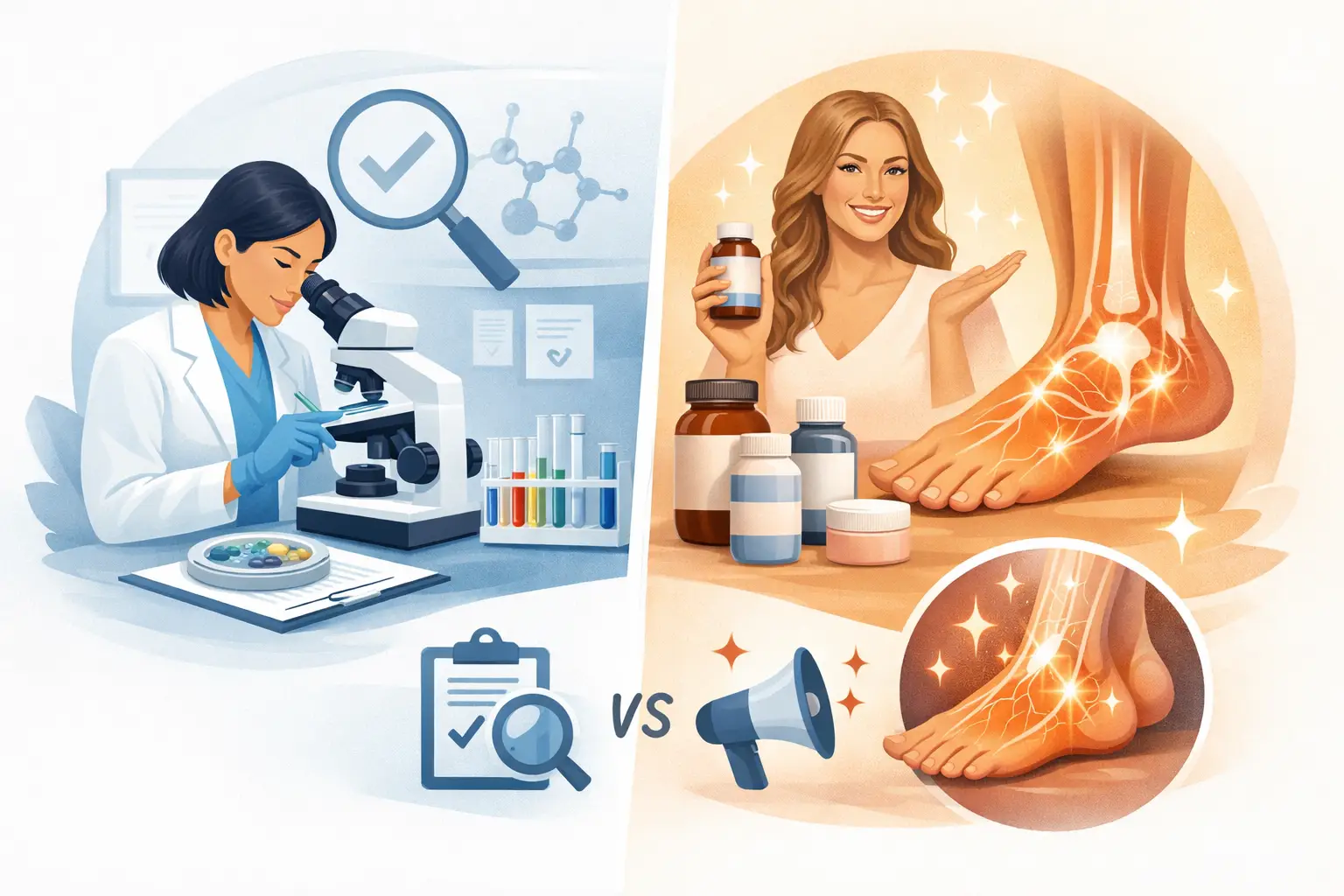
Third-party testing means an independent organization evaluates a supplement for factors such as identity, purity, potency, or contamination. Marketing claims, by contrast, are promotional statements designed to persuade consumers and do not automatically verify product quality or accuracy.
For consumers comparing supplements, independent testing may provide an additional layer of confidence regarding manufacturing standards and label consistency, while advertising language alone should not be treated as proof of effectiveness or safety.
A supplement label can sound convincing in under 10 seconds. “Clinically studied.” “Doctor formulated.” “Advanced nerve support.” For adults comparing products for tingling, numbness, or burning feet, the real question is simpler: in Third-Party Testing vs Marketing Claims, which one actually tells you something useful before you buy?
The short answer is that testing usually carries more weight than promotional language. Marketing claims are designed to persuade. Third-party testing is meant to verify. Those are not the same job, and confusing them is one reason many supplement shoppers end up paying for promises instead of product quality.
Why marketing claims sound stronger than they are
Most supplement shoppers are not looking for flashy branding. They want reassurance. If you are dealing with symptoms that may relate to nerve health, circulation, or possible nutrient gaps, it is natural to look for labels that seem confident and specific.
The problem is that many common phrases on supplement packaging are vague enough to sound scientific without proving very much. Terms like “premium,” “high potency,” and “pharmaceutical grade” can create an impression of quality, but they do not automatically confirm identity, purity, dosage accuracy, or contamination screening.
Even statements such as “lab tested” need context. Who performed the testing? Was it done by the manufacturer itself or by an independent accredited laboratory? What exactly was tested – only the raw ingredient, or the finished capsule you are buying? A claim can be technically true while still leaving out the detail that matters most.
This does not mean every marketing statement is misleading. Some are fair descriptions of a product’s intended use or formulation approach. But marketing language is not a substitute for verification, especially in categories where consumers are trying to compare methylcobalamin versus cyanocobalamin, active ingredients per capsule, or whether a product is free of heavy metals and microbes.
What third-party testing actually means
Third-party testing means an independent organization, not the brand selling the product, evaluates some aspect of the supplement. That outside review may check identity, potency, purity, contamination, or manufacturing quality. In plain language, it is one of the few ways to move from “the label says” to “someone else checked.”
That distinction matters because supplement quality problems are not always visible. A capsule can look normal and still contain less of an ingredient than the label states. It may contain more than listed, which also matters for certain nutrients. Or it may include contaminants that a shopper would never detect by appearance, smell, or price.
For a consumer researching B12 or broader nerve-support formulas, third-party testing can help answer practical questions. Does the product contain the amount of vitamin B12 promised on the label? Does it appear free from common contaminants within testing limits? Is there evidence the product was manufactured with quality controls that reduce batch-to-batch variation?
Still, this is where nuance matters. Third-party testing is not a magic seal that proves a supplement will help your symptoms. It does not establish that a formula is clinically effective for every person. It also does not guarantee that a blend makes sense medically. Testing can support confidence in product quality, but it does not replace ingredient review, dosage review, or a conversation with a qualified healthcare professional.
Third-Party Testing vs Marketing Claims in the real world
When comparing Third-Party Testing vs Marketing Claims, think of them as answers to two different questions. Marketing answers, “Why should this sound appealing?” Testing answers, “What has actually been checked?”
A bottle may say “supports healthy nerves” or “helps maintain energy metabolism.” Those statements may fit the regulatory framework for dietary supplements, but they are broad structure-function claims. They are not proof that the finished product has been independently verified for potency or screened for contaminants.
By contrast, a stronger quality signal would be a brand that clearly states the product was tested by an independent lab and specifies what was verified. For example, identity testing confirms the ingredient is what it claims to be. Potency testing evaluates whether the amount in the capsule matches the label. Purity testing looks for unwanted substances such as heavy metals, residual solvents, or microbial contamination.
The strongest brands tend to be specific. They do not hide behind attractive wording when clear documentation should exist. If a company highlights testing but provides no details at all, that is not the same as transparent quality assurance.
Third-Party Testing vs Marketing Claims
| Third-Party Testing | Marketing Claims |
|---|---|
| Independent verification | Promotional wording |
| Potency confirmation | Broad wellness promises |
| Purity and contaminant screening | Emotional benefit language |
| Specific quality standards | Vague “premium” terminology |
| Evidence-oriented transparency | Sales-oriented positioning |
What to look for on a supplement label
If you are shopping for vitamin B12 or multi-ingredient nerve-support products, the most useful approach is to slow down and read the package like an editor, not a marketer.
First, check the Supplement Facts panel. You want to know the exact form and amount of each active ingredient. With B12, for example, the form matters because labels may list methylcobalamin, cyanocobalamin, adenosylcobalamin, or hydroxocobalamin. A persuasive front label may emphasize benefit language while the more meaningful details sit on the side panel.
Next, look for manufacturing and testing information that is specific enough to evaluate. “Made in a GMP facility” can be helpful, but it is not identical to finished-product testing. Good manufacturing practices matter, yet they do not automatically prove that the final bottle in your hand was independently verified for potency and purity.
Then consider whether the brand discusses contaminants and allergens in plain language. This is especially relevant for older adults who may already be managing multiple health conditions, medications, or sensitivities. A label that tells you nothing beyond broad wellness claims is giving you less than you need.
Finally, treat proprietary blends carefully. A blend name can sound impressive while hiding the actual amount of each ingredient. From a review standpoint, that makes it harder to judge whether a formula is likely to be meaningful, overly aggressive, or simply underdosed.
Red flags that deserve a second look
Some labels work harder to impress than to inform. That does not automatically mean the product is poor, but it should lower your confidence until you find better evidence.
Be cautious when a brand relies heavily on terms like “miracle,” “breakthrough,” or claims that imply unusually rapid results. Adults with persistent numbness, burning sensations, or fatigue often want relief quickly, but exaggerated timelines are not a sign of better science.
It is also worth pausing when you see polished clinical language without supporting detail. “Scientifically proven” is not very meaningful if the brand does not identify the ingredient studied, the amount studied, or whether the research applies to the finished formula. The same issue appears with “doctor recommended” unless there is clear context.
Another common red flag is selective transparency. A company may boast about one attractive feature, such as methylated B12, while saying almost nothing about dose verification, capsule quality, third-party screening, or inactive ingredients.
Why this matters more for adults 45+
Older adults often approach supplements with a different set of concerns than younger shoppers. They may be comparing products while also thinking about medication interactions, digestive absorption, existing lab work, or whether symptoms could reflect something more serious than a simple nutrient issue.
That is why quality verification matters. If someone is evaluating a B12 supplement because of low intake, certain medication patterns, or concerns raised during routine care, getting the labeled ingredient in a reliable amount is not a trivial detail. It is part of making a careful, informed choice.
It is also why marketing should never replace medical judgment. Tingling, numbness, and burning feet can have multiple possible causes. A supplement may be appropriate in some situations and irrelevant in others. Better product testing improves confidence in what is inside the bottle, but it does not diagnose the reason symptoms are happening.
A practical standard for smarter supplement buying
A sensible consumer standard is this: let marketing catch your attention, but let verification earn your trust. If a product makes bold claims and offers little evidence of independent testing, treat it as unproven quality. If a brand provides clear ingredient information, realistic language, and meaningful testing detail, that is a better starting point for consideration.
At an editorial site focused on evidence-informed supplement reviews, including categories like B12 products, the most credible products are rarely the ones making the loudest promises. They are usually the ones that give shoppers enough information to evaluate quality without guessing.
If you remember one thing before your next purchase, make it this: a strong claim tells you what a company wants you to believe, but third-party testing helps show what the product can actually support on paper. That is not the whole decision, but it is one of the smartest places to start.
Medical Disclaimer: The information provided in this article is for educational purposes only and is not intended as medical advice. Dietary supplements are not a replacement for professional medical diagnosis or treatment. Always consult with a qualified healthcare professional before starting any new supplement, especially if you have pre-existing medical conditions or are taking prescription medications. Individual results may vary.

- Can Low B12 Cause Dizziness? - July 9, 2026
- B12 Deficiency and Cracked Corners of the Mouth - July 9, 2026
- Can Low B12 Cause Dry Mouth? - July 8, 2026