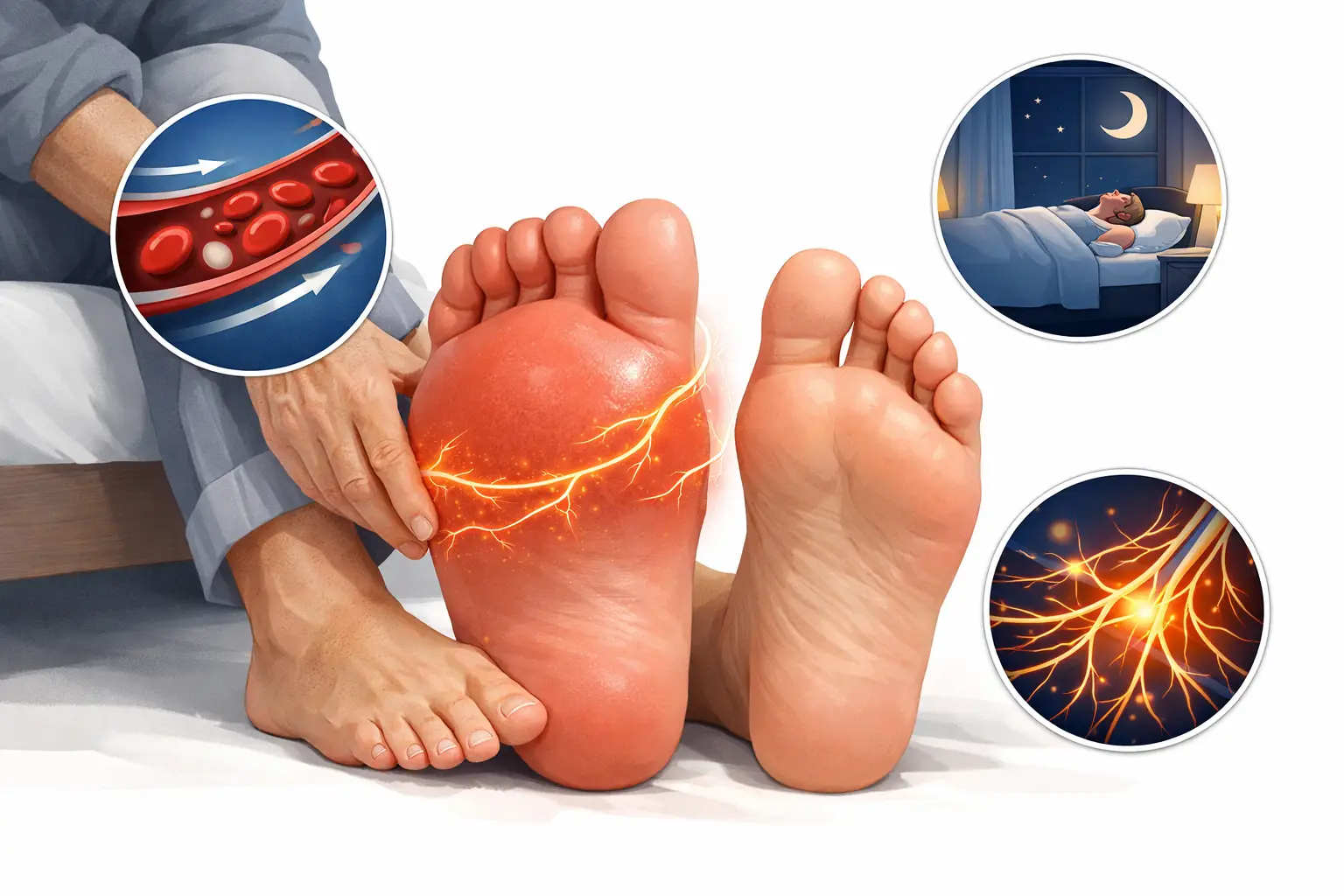
Your feet may feel swollen even when they look normal because the nerves, circulation, joints, skin, or soft tissues are sending altered signals to the brain. This can happen with paresthesia, peripheral neuropathy, nerve compression, diabetes, vitamin B12 deficiency, circulation changes, mild fluid retention, footwear pressure, arthritis, or anxiety-related body awareness. If the feeling is persistent, worsening, one-sided, painful, or paired with numbness, weakness, wounds, color changes, or shortness of breath, it should be discussed with a healthcare professional.
A tight, puffy, stretched feeling in your feet can be unsettling – especially when you look down and see no visible swelling at all. If you have been asking, why do my feet feel swollen when they are not, the answer often has less to do with fluid buildup and more to do with how your nerves, circulation, joints, or skin are sending signals.
This symptom is common in midlife and older adults, and it can mean different things depending on what else is happening. Some people notice tingling or burning. Others describe fullness, pressure, numbness, or the odd feeling that their socks are too tight even when they are not. The key is that the sensation is real, even if obvious swelling is not.
Why feet can feel swollen without looking swollen
Visible swelling usually means fluid has collected in the tissues. But the sensation of swelling can happen even when tissue size looks normal. That is because the brain does not measure swelling by sight alone. It interprets messages from nerves in the skin, muscles, joints, and blood vessels.
When those signals become irritated or distorted, your feet may feel enlarged, tight, heavy, or pressured. This is sometimes described as sensory misperception. In plain terms, your nervous system may be reporting “swollen” even when there is no measurable puffiness.
For adults over 45, this matters because several common age-related issues can change sensation in the feet. These include nerve irritation, reduced circulation, arthritis, back-related nerve compression, and metabolic issues such as diabetes or vitamin deficiencies.
Possible Causes of Feet Feeling Swollen Without Visible Swelling
| Possible Cause | Why It Can Feel Swollen | Clues to Notice |
|---|---|---|
| Peripheral neuropathy | Irritated nerves may misread pressure, position, or texture signals. | Burning, tingling, numbness, fullness, worse at night. |
| Vitamin B12 deficiency | Low B12 may affect nerve signaling and sensory perception. | Tingling, numbness, fatigue, balance issues, memory changes. |
| Diabetes or blood sugar problems | Blood sugar-related nerve irritation may create fullness, tightness, or altered sensation. | Symptoms starting in the feet, burning, numbness, slow-healing sores. |
| Nerve root compression | A lower-back nerve issue may refer pressure, fullness, buzzing, or tightness into the foot. | Back pain, sciatica, one-sided symptoms, posture-related changes. |
| Circulation changes | Reduced blood flow or venous pooling may create heaviness, pressure, or fullness. | Cold feet, color changes, cramping with walking, aching, heaviness. |
| Mild fluid retention | Subtle swelling may be hard to see but still feel tight or heavy. | Sock marks, puffy ankles, worse later in the day. |
| Arthritis or joint irritation | Inflamed joints or soft tissues may feel tight even without obvious swelling. | Stiffness, localized pain, worse after standing or walking. |
| Footwear or sock pressure | Shoes or socks may create pressure that feels like swelling. | Worse with certain shoes or socks, relief after removing them. |
| Anxiety or heightened body awareness | A reactive nervous system may amplify normal body sensations. | Comes and goes, worse during stress or rest, shifting sensations. |
This table is educational and does not diagnose the cause of a swollen feeling in the feet. Persistent, worsening, one-sided, painful, or circulation-related symptoms should be discussed with a healthcare professional.
Nerve problems are a common reason
One of the most common explanations is peripheral neuropathy, which means damage or irritation affecting nerves outside the brain and spinal cord. Neuropathy can cause burning, tingling, numbness, electrical sensations, or a sense of fullness and swelling that is not visible.
This happens because sensory nerves are not just responsible for pain. They also help the brain interpret pressure, temperature, position, and texture. When they misfire, the sensation can be misleading. A foot may feel thick, cushioned, constricted, or swollen despite looking unchanged.
Neuropathy has many possible causes. Diabetes is a well-known one, but it is not the only one. Low vitamin B12, alcohol overuse, certain medications, thyroid disorders, kidney problems, and nerve compression can also contribute. In some people, the cause is never clearly identified.
If the feeling is paired with numbness, burning at night, reduced balance, or sensitivity to bedsheets or socks, nerve-related causes move higher on the list.
Swollen Feeling vs Actual Swelling vs Sock Tightness
A swollen feeling in the feet is not always the same as visible swelling or sock pressure. The pattern can help separate possible causes.
If your feet feel swollen but look normal
If your feet feel swollen but look normal, the issue may involve nerve signaling, circulation changes, joint irritation, spinal nerve compression, or altered sensory perception.
If your feet are visibly swollen
If your feet are visibly swollen, with puffiness, tight skin, or deep indentations from socks, fluid retention, venous issues, medication effects, injury, or other medical causes may be more likely.
If your socks feel tight but your feet do not look swollen
If your socks feel tight but your feet do not look swollen, the cause may be sock elastic, foot shape changes, mild evening swelling, skin sensitivity, or nerve-related pressure sensitivity.
The key difference
The key difference is whether there is visible tissue swelling, a pressure sensation without swelling, or discomfort triggered mainly by socks, shoes, or fabric contact.
Could vitamin B12 deficiency cause a swollen feeling?
Yes, in some cases it could. Vitamin B12 plays an essential role in nerve health and the maintenance of the protective covering around nerves. When B12 levels are low, nerve signaling may become less reliable. That can lead to tingling, numbness, pins-and-needles sensations, burning feet, or altered perception – including feet that feel swollen when they are not.
Older adults are at higher risk for low B12 for several reasons. Absorption often declines with age. Long-term use of acid-reducing medications can interfere with absorption, and metformin use is also associated with lower B12 in some patients. Strict vegan diets, digestive disorders, and certain stomach or intestinal surgeries can add to the risk.
A B12 issue is not the only explanation, and supplements are not a cure-all. But if strange foot sensations are new, persistent, or paired with fatigue, memory changes, weakness, pale skin, or numbness in the hands, asking a clinician about B12 testing is reasonable.
Circulation can create a heavy or full sensation
Circulation problems do not always cause dramatic discoloration or obvious swelling. Reduced blood flow in the legs and feet can create feelings of heaviness, tightness, fatigue, cramping, or pressure. Some people interpret that sensation as swelling.
Poor circulation is more likely if symptoms worsen with walking and improve with rest, or if your feet often feel cold, pale, or weak. On the other hand, venous issues – where blood has trouble returning upward through the leg veins – may create aching, fullness, and mild swelling that is subtle enough to miss at first.
There is a trade-off here. Some circulation-related symptoms overlap with nerve symptoms, and self-diagnosis can be misleading. Burning and tingling may point more strongly toward nerves, while cramping with exertion may point more strongly toward blood flow. But many adults have more than one contributing factor.
Joint, tendon, and soft tissue issues can mimic swelling
Sometimes the feeling is mechanical rather than neurological. Arthritis in the foot or ankle, tendon irritation, plantar fascia strain, or changes in foot structure can create pressure and tightness that feels like swelling. Shoes may feel different even if your foot size has not changed.
This is especially common if the sensation is localized rather than spread across both feet. For example, a tight feeling around the ball of the foot could reflect inflammation or joint stress. Stiffness first thing in the morning or pain after standing can support that possibility.
Minor inflammation does not always create the kind of obvious puffiness people expect. Deep tissue irritation may be felt more than seen.
Back and nerve root problems can refer symptoms to the feet
Your feet may not be the true starting point. Nerves that supply the feet begin in the lower back. If one of those nerve roots is compressed or irritated – from spinal arthritis, disc problems, or narrowing around the nerves – the brain may register unusual foot sensations.
Some people describe this as fullness, thickness, buzzing, or the sense that a sock is bunched up under the foot. If you also have back pain, leg pain, sciatica, or symptoms that change with posture, a spinal source becomes more plausible.
This is one reason the question “why do my feet feel swollen when they are not” does not have a single answer. The same sensation can start in the feet, the legs, or the spine.
Skin sensitivity and sensory changes can also play a role
Dry skin, pressure sensitivity, mild inflammation, and changes in skin nerves can all alter how your feet feel. Even without major disease, aging can affect nerve density and circulation in the skin. That may make your feet more sensitive to temperature, sock seams, shoe pressure, and normal daily stress.
People sometimes notice this after long days on hard floors, changes in footwear, or periods of inactivity followed by more walking. The sensation may be temporary, but if it keeps returning, it is worth paying attention to patterns.
When the symptom is more concerning
A strange swollen feeling is not always urgent, but context matters. Seek prompt medical attention if the symptom comes with sudden one-sided swelling, severe pain, redness, warmth, chest pain, shortness of breath, new weakness, or inability to walk safely.
It is also wise to schedule a medical evaluation if the feeling is persistent, worsening, or associated with numbness, burning, balance problems, foot wounds, or changes in skin color. For adults 45 and older, symptoms that seem minor at first can sometimes be early clues to a larger issue worth catching sooner.
Important: Red Flags to Take Seriously
A swollen feeling without visible swelling is not always urgent, but some patterns need prompt medical attention.
- Seek prompt care if one foot or leg becomes suddenly swollen, painful, red, warm, pale, blue, or much colder than the other.
- Get urgent help if the sensation comes with chest pain, shortness of breath, fainting, confusion, facial drooping, or trouble speaking.
- Do not ignore new weakness, foot drop, frequent falls, severe balance problems, or rapidly worsening numbness.
- Foot wounds, ulcers, blackened skin, spreading redness, fever, or sores that are not healing should be evaluated quickly.
- If you have diabetes, known neuropathy, circulation problems, kidney disease, or a history of B12 deficiency, recurring foot symptoms deserve medical review.
What a clinician may look for
A good evaluation usually starts with pattern recognition. Is it one foot or both? Constant or intermittent? Worse at night, while walking, or after sitting? Is there numbness, pain, or visible color change? These details help narrow the cause.
Depending on your history, a clinician may examine circulation, reflexes, vibration sense, joint motion, footwear wear patterns, and the skin itself. Blood work may be considered to check blood sugar, vitamin B12, thyroid function, kidney function, or other metabolic factors. In some cases, imaging or nerve testing is appropriate.
This kind of stepwise approach is more useful than guessing based on one symptom alone.
Practical next steps at home
While you are figuring out the cause, a few practical measures may help reduce discomfort. Supportive footwear, avoiding long periods of standing still, and tracking when symptoms flare can provide useful information. If burning or tingling is part of the picture, note whether it is worse in the evening, after certain foods or alcohol, or with tight shoes.
It is also sensible to review your medication list and nutrition history with a healthcare professional, especially if you have risk factors for low vitamin B12, diabetes, or absorption problems. Nutrients may help support normal health when a true deficiency or inadequate intake is present, but persistent or unexplained foot sensations should be evaluated in context rather than treated as a supplement problem by default.
A foot that feels swollen without visible swelling is usually a clue, not a diagnosis. The most helpful next step is to treat the sensation as meaningful, pay attention to its pattern, and bring those details to a clinician who can sort out whether nerves, circulation, joints, the spine, or a vitamin issue is driving it.
Frequently Asked Questions
Why do my feet feel swollen when they are not?
Your feet may feel swollen even when they look normal because nerves, circulation, joints, skin, or soft tissues are sending altered signals to the brain. This may happen with neuropathy, nerve compression, vitamin B12 deficiency, diabetes, circulation changes, mild fluid retention, arthritis, footwear pressure, or anxiety-related body awareness.
Can neuropathy make feet feel swollen?
Yes. Neuropathy can cause altered sensations such as burning, tingling, numbness, fullness, pressure, or the feeling that the feet are swollen even when they do not look enlarged.
Can B12 deficiency make my feet feel swollen?
Vitamin B12 deficiency may affect nerve function and contribute to tingling, numbness, burning, balance problems, or altered foot sensations. A swollen feeling alone does not prove B12 deficiency, so testing is better than guessing.
Why do my feet feel tight but not swollen?
Feet may feel tight without visible swelling because of nerve signaling changes, mild evening fluid retention, tight socks or shoes, arthritis, tendon irritation, foot shape changes, or sensory misperception.
Can a pinched nerve make my foot feel swollen?
Yes. A compressed or irritated nerve in the lower back or leg can cause referred sensations in the foot, including fullness, tightness, buzzing, numbness, or a feeling like a sock is bunched under the foot.
Can circulation problems make feet feel swollen?
Yes. Circulation problems may create heaviness, pressure, tightness, aching, coldness, or cramping. If symptoms worsen with walking, improve with rest, or come with color changes or cold feet, circulation should be discussed with a clinician.
Are tight socks a sign of swollen feet?
Sometimes. Deep sock marks, puffiness, or tight skin may suggest visible swelling or fluid retention. But socks can also feel tight because of elastic pressure, foot shape changes, skin sensitivity, or nerve-related pressure sensitivity.
When should I see a doctor for feet that feel swollen?
See a healthcare professional if the swollen feeling is persistent, worsening, one-sided, painful, or comes with numbness, weakness, wounds, skin color changes, cold feet, shortness of breath, chest pain, trouble walking, or balance problems.
Medical Disclaimer:
This content is for educational purposes only and does not diagnose, treat, cure, or replace professional medical care. Vitamin B12 deficiency, neuropathy symptoms, nerve pain, numbness, tingling, burning feet, balance problems, fatigue, and related health concerns can have many possible causes, including diabetes, vitamin deficiencies, medication effects, alcohol exposure, autoimmune conditions, infections, circulation problems, gastrointestinal or absorption issues, spinal conditions, or nerve compression.
Information about supplements, nutrition, lifestyle, sleep, movement, testing, or symptom support should not be used as a substitute for evaluation by a qualified healthcare professional. Supplements may not be appropriate for everyone and may interact with medications or medical conditions.
New, worsening, spreading, severe, one-sided, or unexplained symptoms — including numbness, weakness, balance problems, falls, wounds, foot ulcers, skin color changes, severe pain, chest pain, shortness of breath, bowel or bladder changes, facial drooping, trouble speaking, confusion, or sudden neurologic symptoms — should be discussed with a qualified healthcare professional or emergency service promptly.

- Can Low B12 Cause Dizziness? - July 9, 2026
- B12 Deficiency and Cracked Corners of the Mouth - July 9, 2026
- Can Low B12 Cause Dry Mouth? - July 8, 2026