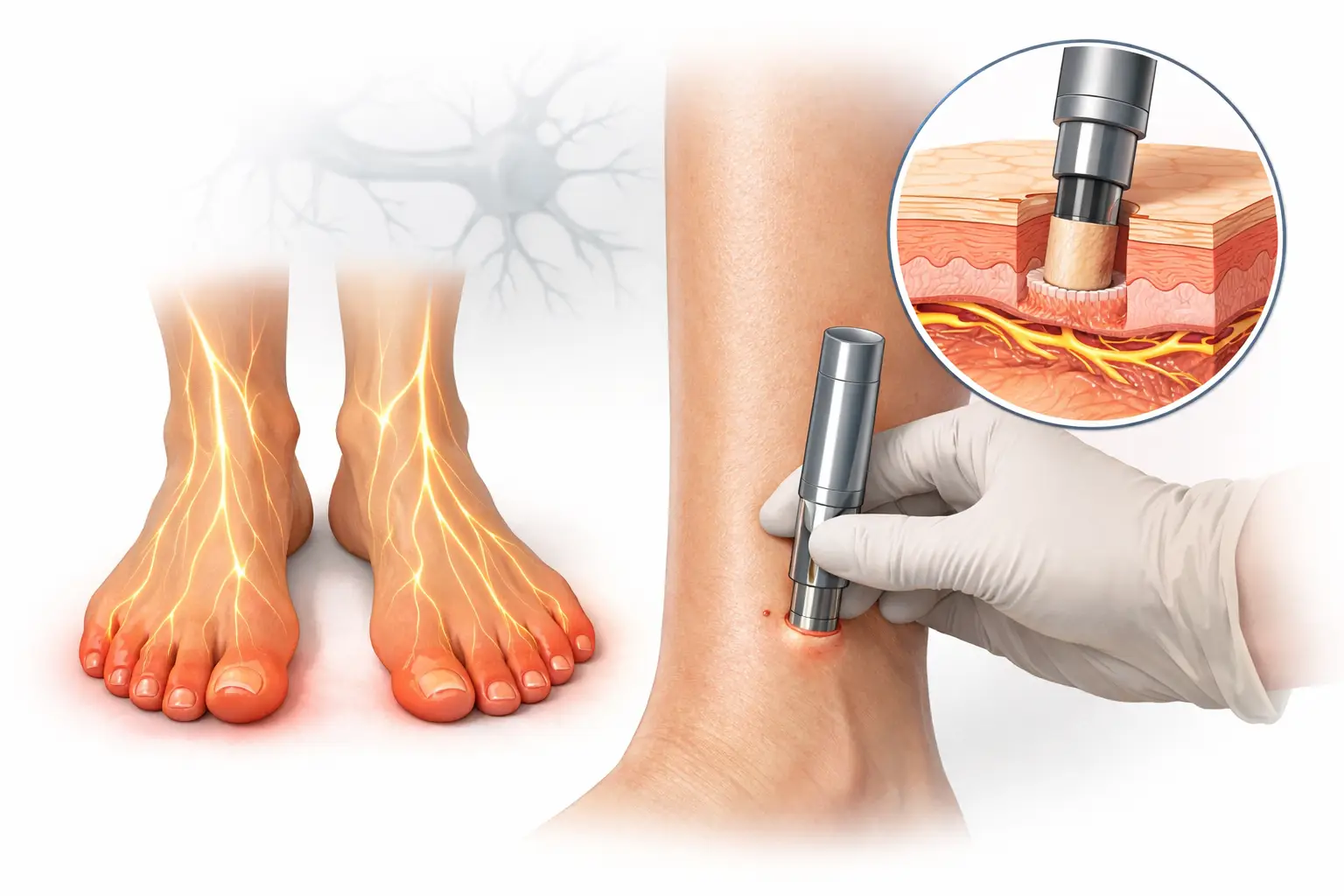
Quick Answer: A skin punch biopsy for small fiber neuropathy is a minor outpatient procedure that removes a tiny sample of skin, usually with a 3 mm punch, so a lab can measure intraepidermal nerve fiber density. Low nerve fiber density can support a diagnosis of small fiber neuropathy, especially when symptoms such as burning feet, painful tingling, temperature sensitivity, or electric-shock sensations persist despite a normal EMG or nerve conduction study. The test can help confirm small fiber damage, but it does not identify the underlying cause by itself.
Burning feet at night, painful tingling, electric-shock sensations, or a feeling that your skin is overly sensitive can point to nerve trouble even when routine nerve tests come back normal. That gap is exactly why skin punch biopsy for small fiber neuropathy has become an important diagnostic tool. It gives doctors a way to look for damage in the tiny nerve fibers that standard nerve conduction studies often miss.
What a skin punch biopsy actually checks
Small fiber neuropathy affects the thin nerve fibers responsible for pain, temperature, and some automatic body functions such as sweating and blood vessel control. These fibers are too small to assess well with the nerve conduction tests commonly used for large fiber neuropathy. A skin punch biopsy looks at the density of these small nerve fibers in the outer layers of the skin.
The sample is usually taken with a circular tool that removes a very small piece of skin, often from the lower leg and sometimes from the thigh or foot. A lab then stains the tissue and counts the nerve fibers crossing into the epidermis. If that density is lower than expected for age and sex, it may support a diagnosis of small fiber neuropathy.
This matters because many people with real neuropathy symptoms are told their EMG or nerve conduction study is normal. In the right clinical setting, a biopsy can help explain why.
Why doctors order skin punch biopsy for small fiber neuropathy
Doctors generally do not order this test for every person with numbness or burning. They use it when the symptom pattern suggests small fiber damage and other testing has not fully answered the question.
Common reasons include persistent burning pain in the feet, painful tingling, altered temperature sensation, unexplained allodynia where light touch hurts, or autonomic symptoms such as abnormal sweating or dizziness when standing. It may also be considered when someone has risk factors such as diabetes, prediabetes, vitamin deficiencies including low B12, autoimmune disease, certain infections, alcohol overuse, or medication-related nerve injury.
A biopsy is not a shortcut around a full evaluation. It works best as one piece of the diagnostic picture, alongside symptom history, neurologic exam, blood work, and sometimes autonomic testing.
How the procedure is done
For most patients, the procedure is brief and done in an outpatient setting. The area is cleaned, then numbed with a local anesthetic. Once the skin is numb, the clinician uses a small punch instrument, typically 3 mm, to collect the sample. A bandage is placed afterward, and stitches often are not needed.
The actual biopsy takes only a few minutes. The part that takes longer is the lab analysis. Results may come back in days or, depending on the lab, a few weeks.
Many adults worry that a nerve-related test will be painful or leave a noticeable scar. In practice, discomfort is usually mild after the numbing medicine wears off. Some people have tenderness, a small scab, or minor skin discoloration. A small scar is possible, especially if healing is slower due to age, diabetes, circulation problems, or certain medications.
Where the sample is taken
The most common site is the lower leg, often about 10 cm above the ankle. That location helps detect the length-dependent pattern seen in many neuropathies, where the longest nerves are affected first. In some cases, the doctor also takes a sample from the thigh or another site to compare patterns.
That comparison can help distinguish whether nerve loss is more widespread or follows a typical stocking distribution. The exact sites matter because the interpretation relies on validated reference ranges.
Skin biopsy results: normal vs abnormal
Skin biopsy results for small fiber neuropathy are usually interpreted by comparing the number of small nerve fibers in the skin sample with validated reference values for the biopsy site, age, and sex. The key measurement is called intraepidermal nerve fiber density.
An abnormal skin biopsy usually means the lab found reduced intraepidermal nerve fiber density compared with the expected reference range. In the right clinical setting, this can support a diagnosis of small fiber neuropathy.
A normal skin biopsy means the sampled area did not show measurable small fiber loss. However, a normal result does not always rule out early, patchy, or function-related nerve problems. Symptoms, physical exam findings, biopsy location, lab technique, and other tests still matter.
| Result Type | What It Usually Means | Important Limitation |
|---|---|---|
| Abnormal result | Reduced intraepidermal nerve fiber density compared with reference values. | Supports small fiber loss but does not identify the underlying cause. |
| Normal result | No measurable fiber loss was found in the sampled area. | Does not always rule out early, patchy, or function-related nerve problems. |
| Borderline or unclear result | Findings may be close to the lower limit of the reference range or difficult to interpret. | Clinical context and follow-up testing become especially important. |
What the results mean
A reduced intraepidermal nerve fiber density can provide objective evidence that small sensory nerve fibers are affected. However, the result does not explain the underlying cause. Diabetes, prediabetes, B12 deficiency, autoimmune disease, thyroid disease, kidney disease, toxins, medications, or inherited conditions may still need evaluation. A normal result should also be interpreted cautiously because symptoms may be early, patchy, or related to nerve function rather than obvious structural loss.
Important: A skin punch biopsy can support a diagnosis of small fiber neuropathy, but it should not be interpreted as a stand-alone diagnosis.
A low intraepidermal nerve fiber density may show that small nerve fibers are reduced, but it does not prove why the damage happened. Diabetes, prediabetes, vitamin B12 deficiency, autoimmune disease, thyroid disease, kidney disease, infections, toxins, medications, or inherited causes may still need to be evaluated. Seek prompt medical care if neuropathy symptoms appear suddenly, progress quickly, involve weakness, affect walking or balance, cause fainting, or occur with loss of bladder or bowel control.
What if the biopsy is normal?
This is where expectations need to stay realistic. A normal result may mean there is no measurable small fiber loss in the sampled area, or that the process is too early or uneven to detect. It may also push the evaluation in a different direction, such as spinal causes, circulation problems, medication side effects, entrapment neuropathies, or non-neurologic pain conditions.
For patients, the practical point is simple: biopsy results should be interpreted with your symptoms and exam, not read in isolation.
Strengths and limits of the test
The main strength of skin punch biopsy for small fiber neuropathy is that it provides objective tissue-based evidence. That can be especially valuable when symptoms are real but prior testing has been inconclusive. It is minimally invasive, generally well tolerated, and widely used in neuromuscular and neurology practice.
Its limits are just as important. It does not identify all neuropathy cases. It does not explain the root cause. It can be affected by where the sample is taken, how the lab processes it, and whether appropriate reference standards are used. And while the procedure is small, it is still a biopsy, which means there is some risk of minor bleeding, infection, delayed healing, or scarring.
There is also a practical issue many patients do not expect: insurance coverage and lab availability can vary. Some clinicians prefer to refer patients to centers that regularly perform and interpret these biopsies because quality control matters.
How accurate is skin punch biopsy for small fiber neuropathy?
Skin punch biopsy is considered a validated tool for measuring intraepidermal nerve fiber density, which can provide objective evidence of small fiber loss. It is especially useful when symptoms suggest small fiber neuropathy but EMG or nerve conduction studies are normal.
Its accuracy depends on several factors, including proper biopsy site selection, correct tissue handling, lab staining technique, validated reference ranges, and interpretation by a clinician familiar with the patient’s symptoms and exam findings.
The test is strongest when the clinical picture and biopsy result point in the same direction. For example, burning feet, painful tingling, temperature sensitivity, or allodynia combined with clearly reduced nerve fiber density may strongly support small fiber neuropathy.
However, skin biopsy is not perfect. A normal result may occur if symptoms are early, patchy, mainly functional rather than structural, or not located in the sampled area. An abnormal result also does not explain the cause of the neuropathy, so additional evaluation is often still needed.
Clinical takeaway: Skin biopsy is most informative when it answers a specific diagnostic question: “Is there objective evidence of small fiber loss?” It should be interpreted together with symptoms, neurologic exam, medical history, blood work, and, when needed, autonomic testing.
Research Snapshot
| Research Finding | Clinical Relevance |
|---|---|
| Guidelines support skin biopsy with intraepidermal nerve fiber density measurement as a useful diagnostic tool for suspected small fiber neuropathy. | This helps explain why a clinician may order the test when symptoms suggest small fiber involvement but EMG or nerve conduction studies are normal. |
| Small fiber neuropathy can cause burning, tingling, pain, temperature changes, and autonomic symptoms. | The symptom pattern matters because biopsy is most useful when ordered for the right clinical question. |
| Reduced intraepidermal nerve fiber density can support small fiber neuropathy but does not determine the underlying cause. | Patients usually still need evaluation for metabolic, nutritional, autoimmune, medication-related, infectious, or genetic contributors. |
| Vitamin B12 deficiency can cause neurological changes, and risk may be influenced by absorption problems, pernicious anemia, gastrointestinal surgery, and certain medications. | For a B12-focused site, this creates a relevant opportunity to explain why B12 testing may be part of a neuropathy workup without implying that all neuropathy is caused by B12 deficiency. |
How it compares with EMG and nerve conduction studies
| Test | What It Measures | Best Used When | Main Limitation |
|---|---|---|---|
| Skin punch biopsy | Intraepidermal nerve fiber density in a small skin sample | Burning, painful tingling, allodynia, or temperature symptoms with suspected small fiber neuropathy | Can support small fiber loss, but does not identify the cause by itself |
| EMG / nerve conduction study | Large nerve fiber and muscle electrical function | Weakness, reflex changes, numbness, balance issues, or suspected large fiber neuropathy | Can be normal in isolated small fiber neuropathy |
| Autonomic testing | Sweating, heart rate, blood pressure, and other autonomic nerve functions | Dizziness on standing, abnormal sweating, heat intolerance, or other autonomic symptoms | Does not always show structural nerve fiber loss |
| Blood work | Possible underlying causes such as glucose problems, B12 deficiency, thyroid disease, inflammation, kidney or liver disease | After symptoms suggest neuropathy or biopsy supports small fiber loss | May not prove whether symptoms are directly caused by the abnormal result |
One of the most confusing parts of neuropathy workups is hearing that test results are normal while symptoms continue. EMG and nerve conduction studies are useful tests, but they mainly assess larger nerve fibers. Small fibers behave differently and often escape detection on those studies.
That means a person can have a normal EMG and still have small fiber neuropathy. A skin biopsy may help fill that gap. On the other hand, if symptoms involve weakness, balance loss, reduced vibration sense, or absent reflexes, large fiber involvement may also be present, and EMG remains very relevant.
This is not an either-or decision. In many cases, the most accurate approach combines multiple tests based on the symptom pattern.
Causes doctors often investigate after an abnormal biopsy
When biopsy findings support small fiber neuropathy, the next step is usually searching for reversible or manageable contributors. Doctors often check blood sugar status, vitamin B12 and related markers, thyroid function, autoimmune markers, kidney and liver function, and medication history. Depending on the case, they may also consider celiac disease, monoclonal protein disorders, infections, or inherited neuropathy syndromes.
For adults over 45, this part is especially relevant because metabolic causes become more common with age. Low or borderline B12, glucose dysregulation, and medication effects can overlap with neuropathy symptoms. For patients, the key point is that B12 status can be relevant, but it should be reviewed alongside glucose status, thyroid function, medications, autoimmune markers, and the overall clinical picture.
Should you ask your doctor about this test?
If you have burning, stabbing, or temperature-related nerve symptoms and previous testing has been unrevealing, it is reasonable to ask whether small fiber neuropathy is part of the differential diagnosis. That does not mean everyone needs a biopsy. Sometimes the clinical picture is already clear enough to focus on finding the cause. In other cases, objective confirmation is useful before moving forward.
The decision often depends on how long symptoms have lasted, whether they are progressing, whether autonomic symptoms are present, and whether the result would change the next steps. If the answer would not alter management, some clinicians may prefer observation and lab work first. If the diagnosis remains uncertain, biopsy can be more valuable.
A good discussion with your doctor should cover what question the biopsy is meant to answer, what the lab can and cannot tell you, and how the result would guide further evaluation.
When symptoms are persistent and confusing, many people want one definitive test. Neuropathy rarely works that way. A skin punch biopsy can be very helpful, but its real value comes from fitting it into a careful, evidence-based workup that looks for causes worth addressing.
Editorial note: This article is for educational purposes only and should not replace medical evaluation. Skin biopsy results should be reviewed by a qualified clinician who can interpret the findings alongside symptoms, examination, medical history, and laboratory testing.
If you’re trying to understand what may be behind numbness, tingling, burning feet, or nerve pain, our guide to peripheral neuropathy causes and relief explains the most common causes and what may help support nerve health.
Frequently Asked Questions
What does a skin punch biopsy show in small fiber neuropathy?
A skin punch biopsy can show whether there is reduced intraepidermal nerve fiber density in the sampled skin. In the right clinical setting, low nerve fiber density can support a diagnosis of small fiber neuropathy, especially when symptoms suggest small fiber damage but routine nerve tests are normal.
What is the difference between a normal and abnormal skin biopsy result?
An abnormal result usually means the lab found reduced intraepidermal nerve fiber density compared with reference values for the biopsy site, age, and sex. A normal result means the sampled area did not show measurable fiber loss, but it does not always rule out early, patchy, or function-related small nerve fiber problems.
How accurate is skin punch biopsy for small fiber neuropathy?
Skin punch biopsy is a validated tool for measuring intraepidermal nerve fiber density, but its accuracy depends on correct biopsy site selection, tissue handling, lab staining technique, reference ranges, and clinical interpretation. It is most useful when symptoms, exam findings, and biopsy results point in the same direction.
Can you have small fiber neuropathy with a normal EMG?
Yes. EMG and nerve conduction studies mainly evaluate large nerve fibers and muscle electrical activity. Small fiber neuropathy can cause burning pain, painful tingling, allodynia, or temperature sensitivity even when EMG and nerve conduction results are normal.
Is a skin punch biopsy painful?
Most people feel brief stinging or burning when the local anesthetic is injected. Once the area is numb, the biopsy itself is usually well tolerated. Mild soreness, a small scab, bruising, skin discoloration, or a tiny scar can occur afterward.
Can a skin biopsy find the cause of neuropathy?
Usually, no. A skin biopsy can provide objective evidence of small fiber loss, but it does not usually identify why the nerve fibers are reduced. Doctors may still need to evaluate possible causes such as diabetes, prediabetes, vitamin B12 deficiency, thyroid disease, autoimmune disease, kidney disease, infections, medication effects, alcohol exposure, or inherited conditions.
Does a normal skin biopsy rule out small fiber neuropathy?
Not always. A normal biopsy means the sampled area did not show measurable nerve fiber loss, but symptoms may be early, patchy, mainly functional, or located outside the sampled site. Doctors may consider the full symptom pattern, exam findings, lab results, and sometimes autonomic testing before ruling out small fiber involvement.
When should you ask a doctor about skin punch biopsy?
It may be reasonable to ask about skin punch biopsy if you have persistent burning, stabbing, tingling, temperature-related pain, or painful sensitivity to light touch and routine testing has not explained the symptoms. The test is most useful when the result would help confirm small fiber involvement or guide the next steps in evaluation.
Medical Disclaimer: The information provided in this article is for educational purposes only and is not intended as medical advice. Dietary supplements are not a replacement for professional medical diagnosis or treatment. Always consult with a qualified healthcare professional before starting any new supplement, especially if you have pre-existing medical conditions or are taking prescription medications. Individual results may vary.

- Can Low B12 Cause Dizziness? - July 9, 2026
- B12 Deficiency and Cracked Corners of the Mouth - July 9, 2026
- Can Low B12 Cause Dry Mouth? - July 8, 2026