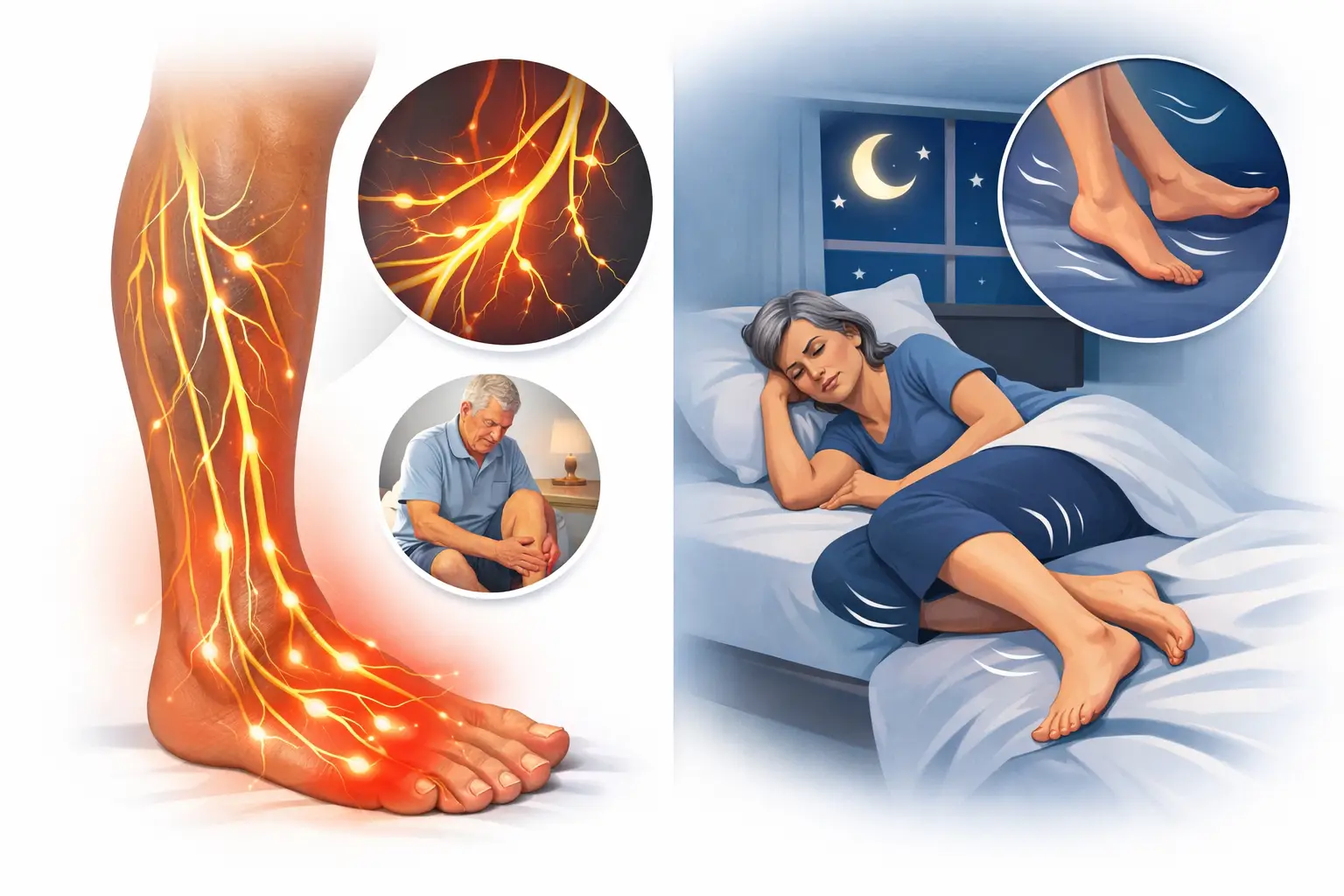
Neuropathy and restless legs syndrome are different conditions, although both may worsen at night and disrupt sleep. Neuropathy typically causes numbness, burning, tingling, or reduced sensation that does not reliably improve with movement, while restless legs syndrome creates a strong urge to move the legs that temporarily improves with walking or stretching.
Burning feet at night can send people down the wrong path fast. When symptoms show up after dark, many adults start comparing neuropathy vs restless legs, but these two problems are not the same and they do not always respond to the same self-care strategies.
The confusion is understandable. Both can disrupt sleep, both often affect the legs, and both may worsen when you are trying to rest. But the pattern of symptoms matters. So do the triggers, the underlying causes, and the next steps worth discussing with a clinician.
Key Takeaways
- Neuropathy and restless legs syndrome are not the same condition, even though both may affect sleep and nighttime comfort.
- Neuropathy often causes numbness, burning, tingling, or reduced sensation that may remain present even during movement.
- Restless legs syndrome creates a strong urge to move the legs, with temporary relief occurring during walking or stretching.
- Vitamin B12 deficiency is more strongly linked with neuropathy, while low iron stores are more commonly associated with restless legs syndrome.
- Persistent, worsening, one-sided, or weakness-related symptoms deserve medical evaluation rather than self-diagnosis alone.
Neuropathy vs restless legs: what is the difference?
Peripheral neuropathy is nerve damage or nerve dysfunction, usually involving the feet, legs, hands, or arms. The classic symptoms are numbness, tingling, burning, stabbing pain, electric-shock sensations, or reduced feeling. In many cases, the discomfort is present whether you are moving or not. Some people notice it more at night simply because there are fewer distractions.
Restless legs syndrome, often called RLS, is different. It is a neurologic sensory-motor condition marked by an urge to move the legs, often with uncomfortable sensations that are hard to describe. People may say their legs feel crawling, pulling, itching deep inside, jittery, or impossible to keep still. The defining feature is that movement usually brings at least temporary relief.
That difference is the first practical clue. Neuropathy often feels like damaged nerves. Restless legs feels like a strong need to move because staying still becomes intolerable.
How symptoms usually feel in real life
Neuropathy tends to follow a fairly recognizable pattern. Symptoms often start in the toes or soles and may gradually spread upward in a stocking-like distribution. People commonly report burning feet, pins and needles, numb patches, or sharp pain. Balance may worsen because the feet do not sense the ground normally. In some cases, light touch from bedsheets becomes irritating.
Restless legs is more about timing and relief with motion. Symptoms usually begin or intensify during rest, especially in the evening or at bedtime. Sitting through a movie, riding in a car, or lying down can trigger it. Walking, stretching, or moving the legs often helps, but only while the movement continues. Once the person settles again, the sensation may return.
The two can overlap in a frustrating way. A person with neuropathy may also develop restless legs syndrome, or they may describe nerve discomfort in language that sounds similar to RLS. That is one reason self-diagnosis is not always reliable.
What causes neuropathy?
Neuropathy vs Restless Legs: Common Symptom Differences
Although the symptoms may overlap, the way they behave often provides important clues.
| Feature | Peripheral Neuropathy | Restless Legs Syndrome |
|---|---|---|
| Main sensation | Burning, numbness, tingling, pain | Urge to move the legs |
| Relief with movement | Usually limited or inconsistent | Often improves temporarily |
| Timing | May happen anytime | Typically worse at night or during rest |
| Distribution | Often starts in the feet and spreads upward | Usually affects the legs more diffusely |
| Balance problems | More common | Less typical |
| Common associated issue | Vitamin B12 deficiency or diabetes | Low iron stores |
Neuropathy is a broad category, not one single disease. Diabetes is one of the most common causes, but it is far from the only one. Vitamin B12 deficiency deserves attention, particularly in adults over 45, people with digestive disorders, those taking certain medications such as metformin or acid-reducing drugs, and anyone eating a very low animal-product diet.
Other possible contributors include alcohol overuse, thyroid disease, kidney disease, certain chemotherapy drugs, autoimmune conditions, infections, and compression of nerves. Sometimes no clear cause is found.
This matters because the symptom is only part of the picture. If the problem is related to low B12, poor glucose control, medication effects, or another correctable issue, identifying that root cause may change the plan. That is very different from simply trying to calm nighttime discomfort.
What causes restless legs syndrome?
Restless legs syndrome has a different profile. It is linked to brain pathways involved in dopamine signaling and is often associated with low iron stores, even when standard hemoglobin levels look fairly normal. It can also run in families.
RLS may become more noticeable with age, pregnancy, kidney disease, neuropathy, or certain medications. Antihistamines, some antidepressants, and some anti-nausea drugs can make symptoms worse in susceptible people. Sleep deprivation can also create a vicious cycle: poor sleep worsens symptoms, and worsening symptoms lead to poorer sleep.
Unlike neuropathy, RLS is not defined by nerve damage in the feet. It is defined by the pattern: symptoms emerge at rest, worsen in the evening or night, and improve with movement.
When vitamin deficiencies enter the picture
For readers researching nerve health, vitamin status is a reasonable question, but it has to be approached carefully. Vitamin B12 deficiency is a well-known cause of neuropathy-like symptoms, including numbness, tingling, balance changes, and burning sensations. It can sometimes develop slowly and be missed until symptoms become more obvious.
The NIH Office of Dietary Supplements notes that vitamin B12 plays an important role in neurological function and nervous system health.
Low iron is more closely tied to restless legs syndrome. Ferritin, which reflects iron stores, is often part of the clinical workup when RLS is suspected. Folate, magnesium, and vitamin D are sometimes discussed in consumer health spaces, but the evidence is not equally strong across all of them, and low levels do not automatically explain symptoms.
That is where caution matters. A supplement may support a deficiency, but it should match the problem. Taking vitamin B12 for undiagnosed nighttime leg discomfort may make sense if there is actual deficiency risk, but it is not a universal answer for every case of restless legs. The same goes for iron. It should not be started casually in high doses without appropriate medical guidance, especially for older adults with other health conditions.
Clues that point more toward neuropathy
Some features make neuropathy more likely. Ongoing numbness, reduced sensation, burning in the feet, pain that does not reliably improve with walking, and symptoms that started in the toes and spread upward all fit the pattern. Trouble with balance, frequent tripping, or not feeling temperature properly also raise suspicion.
A history of diabetes, prediabetes, alcohol overuse, chemotherapy, or possible B12 deficiency adds more weight. If symptoms affect the hands as well as the feet, that also leans more toward a neuropathic process than classic restless legs syndrome.
Clues that point more toward restless legs
RLS becomes more likely when the main complaint is an almost irresistible need to move the legs. The sensation usually starts when the body is still, often late in the day, and gets better with walking, stretching, or rubbing the legs. People with RLS often pace at night, repeatedly shift in bed, or feel relief only while in motion.
Sleep disruption is common, and some people are told by their partners that they kick or twitch during sleep. That does not prove RLS by itself, but it often travels with it.
Why a proper evaluation matters
The biggest risk in the neuropathy vs restless legs conversation is assuming that all nighttime leg symptoms are harmless. They are not always urgent, but they are worth sorting out when persistent.
A clinician may ask about timing, triggers, medical history, medications, alcohol use, diet, and family history. Depending on the situation, testing may include blood glucose, vitamin B12, methylmalonic acid in selected cases, thyroid markers, kidney function, ferritin, and other labs. In suspected neuropathy, a neurological exam can reveal loss of sensation or reflex changes. Some patients may need nerve testing, though not everyone does.
This is especially important if symptoms are new, rapidly worsening, one-sided, or accompanied by weakness. Those details can point to conditions that need prompt medical attention.
Can supplements help?
Supplements have a role in some cases, but the role is narrower than marketing often suggests. If a person has confirmed or likely vitamin B12 deficiency, B12 replacement may support correction of that deficiency and may be part of a clinician-guided plan for nerve health. If low iron stores are contributing to restless legs, iron repletion may help when medically appropriate.
The key is matching the supplement to the problem and the evidence. Higher doses are not automatically better, and not every tingling or restless sensation is due to a nutrient gap. For adults comparing products, quality, dose, ingredient form, and third-party testing matter more than flashy promises on the label.
At an editorial site focused on evidence-informed supplement decisions, the practical takeaway is simple: start with symptom pattern, then look for likely causes, then consider targeted support. That order helps avoid wasted money and unrealistic expectations.
When to seek medical care sooner
Do not wait on an internet answer alone if you have weakness, foot ulcers, falls, severe pain, sudden onset symptoms, bowel or bladder changes, or symptoms affecting only one limb. Those situations need a more urgent medical assessment.
Even without red flags, ongoing nighttime leg symptoms deserve attention if they are disrupting sleep, interfering with daily function, or gradually spreading. Many people tolerate these symptoms for months because they assume it is normal aging. It is not.
If you are trying to sort out whether your symptoms sound more like nerve damage or an urge-to-move condition, focus less on where the discomfort is and more on how it behaves. That pattern often tells the real story and gives you a better starting point for the next conversation with your healthcare professional.
Frequently Asked Questions
How do I know if I have neuropathy or restless legs syndrome?
Neuropathy often causes numbness, burning, tingling, or reduced sensation that may not improve with movement. Restless legs syndrome mainly creates a strong urge to move the legs that temporarily improves during activity.
Can neuropathy and restless legs happen together?
Yes. Some people with peripheral neuropathy may also experience restless legs syndrome, which can make nighttime symptoms more confusing.
Can vitamin B12 deficiency cause symptoms similar to restless legs?
Vitamin B12 deficiency is more strongly associated with neuropathy-like symptoms such as tingling, numbness, burning sensations, and balance changes.
Does walking help neuropathy symptoms?
Movement may help some people temporarily, but neuropathy symptoms often remain present even while walking or stretching.
When should nighttime leg symptoms be medically evaluated?
Persistent, worsening, one-sided, weakness-related, or sleep-disrupting symptoms deserve medical evaluation, especially when numbness or balance problems are present.
Medical Disclaimer: The information provided in this article is for educational purposes only and is not intended as medical advice. Dietary supplements are not a replacement for professional medical diagnosis or treatment. Always consult with a qualified healthcare professional before starting any new supplement, especially if you have pre-existing medical conditions or are taking prescription medications. Individual results may vary.

- Can Low B12 Cause Dizziness? - July 9, 2026
- B12 Deficiency and Cracked Corners of the Mouth - July 9, 2026
- Can Low B12 Cause Dry Mouth? - July 8, 2026