Many supplement scams use fake reviews, exaggerated “miracle cure” claims, hidden subscriptions, manipulated before-and-after photos, and pressure tactics to push people into buying low-quality products. Legitimate supplements usually provide transparent ingredient lists, realistic expectations, scientific references, clear refund policies, and trustworthy company information.
- Watch for unrealistic “miracle cure” claims.
- Be cautious with proprietary blends and hidden doses.
- Check billing terms before buying any supplement.
- Look for transparent labeling and realistic health claims.
A supplement label says it is “doctor formulated,” “clinically proven,” and “selling out fast.” The formula looks impressive. The website looks polished. That still does not tell you whether it is worth your money. If you want to know how to spot supplement scams, start by ignoring the marketing gloss and reviewing the evidence, labeling, and seller behavior.
How to Spot Supplement Scams Before You Buy
Most bad supplement offers follow the same pattern. They promise unusually broad benefits, hide weak labeling behind buzzwords, and push urgency before you have time to verify anything. The goal is not to help you compare options. The goal is to close the sale before you ask basic questions.
How to spot supplement scams before you buy
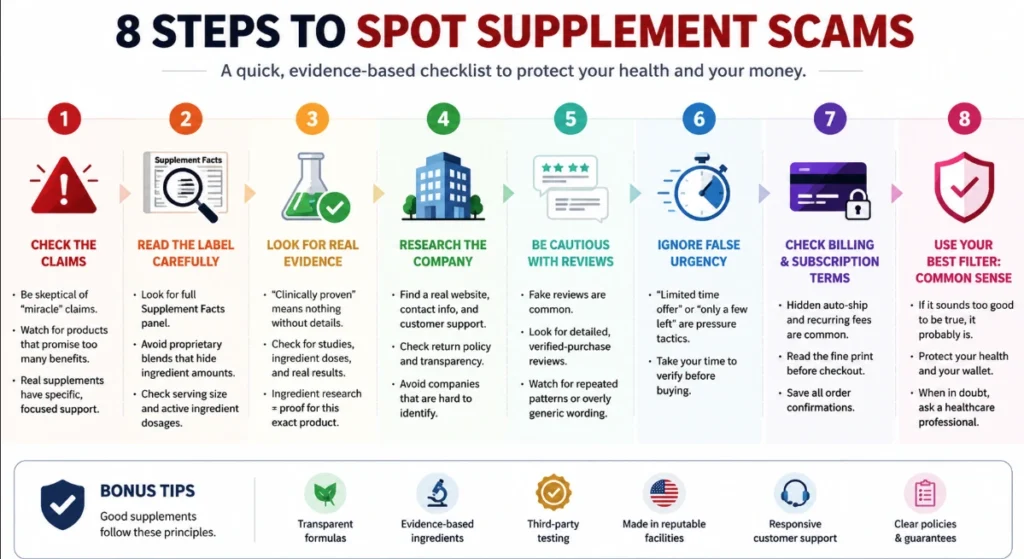
The fastest way to screen a supplement is to look at three things together: the claims, the formula, and the company. A legitimate product can still be underdosed or overpriced, but scam-like products usually fail on all three.
If a supplement claims to support weight management, hormone balance, joint comfort, brain health, immunity, sleep, and metabolism all at once, that is your first warning sign. Some ingredients do have multiple effects, but broad claims often signal a product designed by marketers, not by a serious formulation team. The more dramatic the promise, the more specific the proof should be.
The formula should also make practical sense. You want a full Supplement Facts panel, exact ingredient amounts, and a clear serving size. If the label hides behind a proprietary blend, you cannot tell whether the active ingredients are present at meaningful doses. That does not automatically make the product fraudulent, but it sharply reduces transparency. For a buyer trying to make an evidence-based decision, that is a problem.
Then look at the company itself. A real business should be easy to identify. There should be a visible website, customer support information, a return policy, and clear billing terms. If the checkout page feels more detailed than the product page, that is backwards. Good companies explain the product first and the payment terms clearly after.
Red flags that often signal a supplement scam
| Red Flag | What It May Mean | What to Check Instead |
|---|---|---|
| “Clinically proven” without details | The claim may be using scientific-sounding language without showing real product evidence. | Look for the specific study, ingredient dose, population studied, and whether the finished product was tested. |
| Proprietary blend | The label may hide how much of each ingredient is actually included. | Prefer formulas that list exact ingredient amounts and serving sizes clearly. |
| Countdown timers or “only a few left” | Urgency may be used to push a fast purchase before you verify the product. | Pause and review the label, return policy, billing terms, and company information. |
| Too many benefits from one formula | The product may be trying to appeal to every health concern instead of having a clear purpose. | Check whether the ingredients match the specific goal, such as nerve support, sleep, or vitamin deficiency. |
| Vague doctor or lab claims | “Doctor approved” or “lab tested” may not mean much without verification. | Look for who tested it, what was tested, and whether results are publicly available. |
| Hidden subscription terms | The real risk may be recurring billing, not just the supplement itself. | Check auto-ship enrollment, cancellation rules, refund policy, and total checkout cost. |
Some warning signs appear so often that they deserve immediate attention. The first is language that sounds scientific without being specific. Phrases like “research-backed,” “lab tested,” or “doctor approved” mean very little on their own. Which research? Tested for what? Approved by whom? Without details, these are marketing claims, not evidence.
The second is fake precision. You may see statements such as “boosts absorption by 312%” or “users reported 94% success.” Numbers can make weak claims sound credible. But unless the company shows where those numbers came from and how they were measured, they should not carry much weight.
The third is exaggerated scarcity. “Only 7 bottles left” is not proof of popularity. It is often a conversion tactic. The same goes for countdown timers that reset when you reload the page. These signals do not tell you anything about product quality.
A fourth red flag is a mismatch between the condition and the formula. If a joint support supplement contains a scattershot mix of trendy botanicals with no established role in joint comfort, that is a sign the formula was assembled to sound advanced rather than to perform well. Evidence-based supplements usually show a tighter relationship between ingredient choice and intended use.
Check the label like an analyst, not a shopper
The label tells you more than the headline ever will. Start with the active ingredients and their doses. An ingredient may have promising research, but the details matter. The form used, the daily amount, and the duration of use all affect whether the product is even positioned to work.
Take vitamin B12 as one example. Different forms exist, and different users may prefer different formulations depending on diet, age, and absorption concerns. The same general principle applies across categories. You should not assume an ingredient is useful just because you recognize the name. You need enough of the right form to match the intended purpose.
Be cautious with proprietary blends. They are legal, but they make comparison harder. If a blend contains ten ingredients in a small total amount, some of those ingredients are likely present at token levels. This is common in products that want to borrow credibility from popular ingredients without paying for meaningful doses.
Also watch for labels overloaded with extras. Coloring agents, sweeteners, fillers, and novelty add-ins do not make a supplement deceptive by default, but they can distract from a weak core formula. A good label is usually easier to evaluate because it is built around a clear purpose.
Evidence matters, but the kind of evidence matters more
One of the easiest ways to get misled is to confuse ingredient research with product proof. A company may cite studies on an herb, a vitamin, or a compound, but that does not prove the finished product has been studied. If the product combines many ingredients at unknown or lower doses, the cited evidence may not apply in a meaningful way.
That does not mean every trustworthy supplement needs its own clinical trial. Many do not. But the company should still show that the formula is based on plausible dosing and sensible ingredient selection. There is a big difference between “this ingredient has some evidence in a similar context” and “this exact product is clinically proven.” Scammy brands blur that line on purpose.
Customer reviews should also be read carefully. A page full of dramatic testimonials can be persuasive, but testimonials are not clinical validation. Look for review patterns instead of emotional stories. Are the reviews unusually generic? Do they all sound the same? Are there complaints about billing, shipping, or unauthorized charges? Those practical complaints often tell you more than the five-star praise.
Next step: If you want a safer comparison process, see our evidence-informed guide to the best supplements for neuropathy.
Pricing tricks and billing traps
A large share of supplement complaints have less to do with the capsule and more to do with the checkout. This is where many consumers lose money. A product can be mediocre, but the real scam behavior shows up in recurring charges, hard-to-cancel subscriptions, or hidden terms.
Before buying, check whether the advertised price applies only to bulk orders or auto-ship enrollment. Look for the actual cost per bottle, shipping charges, and cancellation rules. If you have to search through dense fine print to understand what you are agreeing to, stop there.
Free trial offers deserve special caution. In supplements, “free” often means you are entering a subscription with a short cancellation window. That does not make every trial dishonest, but it is a model that has been abused often enough to justify skepticism.
This guide is for readers comparing supplement offers online, especially products promoted for nerve support, neuropathy symptoms, vitamin deficiencies, weight loss, joint pain, sleep, or healthy aging.
How to spot supplement scams on marketplace listings and ads
Third-party marketplaces can be convenient, but they add another layer of risk. Product listings may be copied, altered, or sold by unauthorized resellers. The images may look identical to the brand site while the product source is not.
Pay attention to seller identity, batch consistency, and packaging complaints. If multiple buyers mention broken seals, changed label design, or unusual taste and smell, treat that seriously. Supplements are not the category where you want uncertainty about storage or handling.
Sponsored social ads require the same discipline. A polished video and a before-and-after montage are not product validation. In this space, aggressive ad creative often outperforms honest explanation, which is exactly why you should slow down when the promotion feels too persuasive.
A practical screening method you can use in five minutes
If you are trying to compare products quickly, use a simple screen. First, ask whether the claim is realistic for the category. Second, check whether the label gives exact doses and sensible forms. Third, verify that the company provides transparent support, returns, and billing terms. Fourth, look for evidence that matches the formula rather than just the headline ingredient.
If a product fails two or more of those checks, it is usually not worth further effort. You do not need absolute proof of fraud to move on. You just need enough reason to protect your time and money.
This is where a review-first approach helps. Sites that analyze ingredients, label logic, and practical value can reduce the noise. The goal is not to find a perfect supplement. The goal is to avoid poor bets and focus on products with transparent formulation and credible positioning.
A careful buyer is hard to manipulate. That is why the best defense against supplement scams is not cynicism. It is process. If a product cannot survive basic scrutiny on claims, formula, evidence, and billing, it does not deserve your trust – no matter how polished the sales page looks.
Medical Disclaimer: The information provided in this article is for educational purposes only and is not intended as medical advice. Dietary supplements are not a replacement for professional medical diagnosis or treatment. Always consult with a qualified healthcare professional before starting any new supplement, especially if you have pre-existing medical conditions or are taking prescription medications. Individual results may vary.
Frequently Asked Questions About Supplement Scams
Clear, practical answers to help you evaluate supplement claims, reviews, labels, and warning signs before you buy.
How can you tell if a supplement is a scam?
Common supplement scam warning signs include unrealistic health claims, vague phrases such as “clinically proven” without details, hidden proprietary blends, fake urgency, unclear company information, suspicious reviews, and hidden subscription or billing terms.
Are proprietary blends a red flag in supplements?
A proprietary blend is not automatically a scam, but it reduces transparency because it can hide the exact amount of each ingredient. For evidence-informed comparison, formulas with clearly listed ingredient amounts are usually easier to evaluate.
Can supplement reviews be fake?
Yes. Some supplement reviews may be fake, overly generic, repeated across websites, or written to create artificial trust. Look for detailed verified-purchase reviews, balanced feedback, and complaints about billing, shipping, or product quality.
What supplement claims should I be cautious about?
Be cautious with claims that a supplement can cure disease, reverse serious conditions, deliver dramatic results quickly, replace medical care, or provide broad benefits for many unrelated health problems without specific evidence.
What makes a supplement more trustworthy?
A more trustworthy supplement usually has clear Supplement Facts labeling, transparent ingredient amounts, realistic claims, visible company information, clear billing terms, responsive customer support, and evidence-informed formulation logic.

- Can Low B12 Cause Dizziness? - July 9, 2026
- B12 Deficiency and Cracked Corners of the Mouth - July 9, 2026
- Can Low B12 Cause Dry Mouth? - July 8, 2026