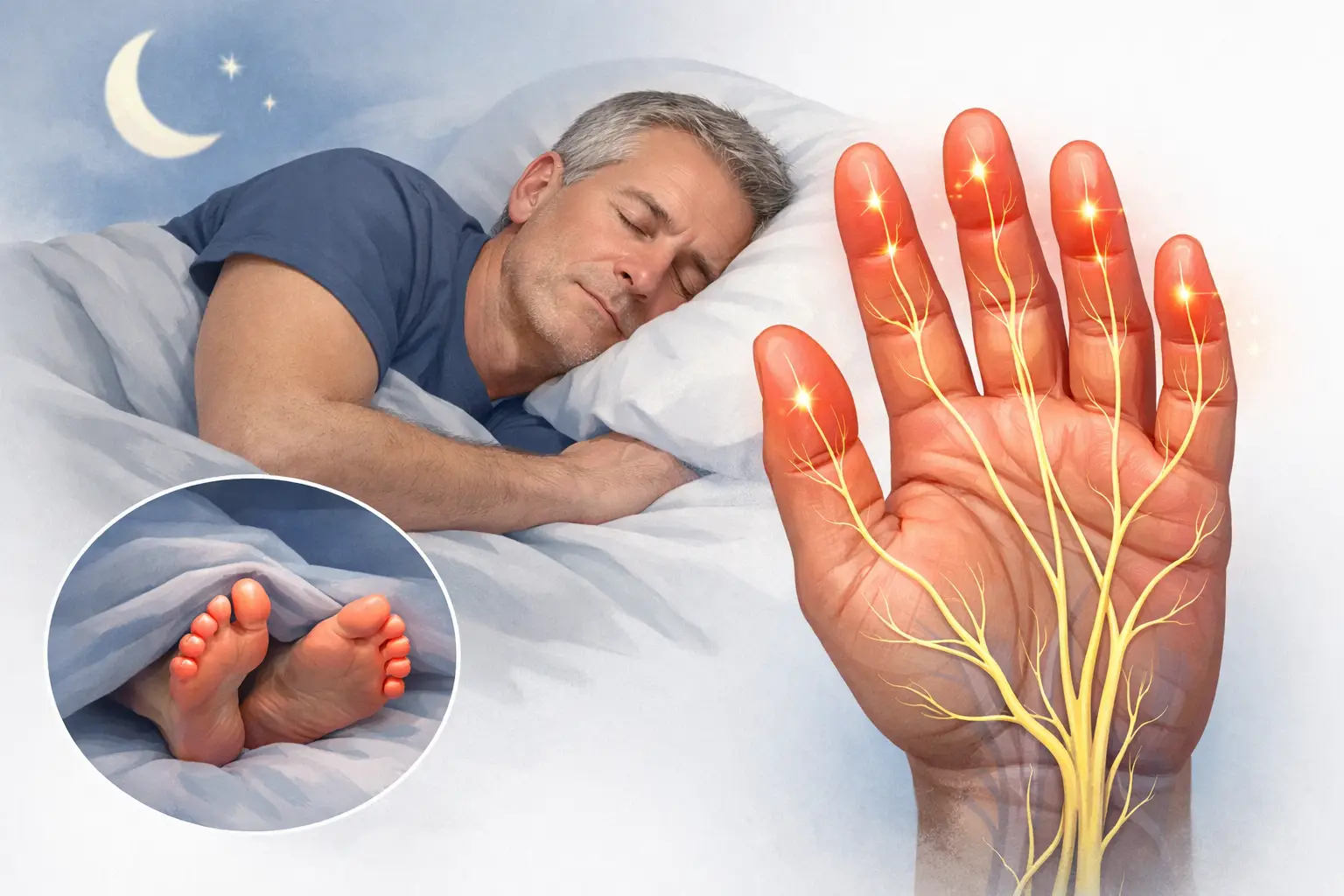
Fingers tingling when waking up is often caused by temporary nerve compression from sleeping position, especially at the wrist, elbow, or neck. However, repeated episodes may also be linked with carpal tunnel syndrome, cervical nerve irritation, peripheral neuropathy, diabetes, or vitamin B12 deficiency.
Waking up with a hand that feels prickly, numb, or “asleep” is common, especially after 45. When fingers tingle when waking up, the cause is often temporary pressure on a nerve or reduced blood flow from sleeping position. But if it keeps happening, lasts longer, or starts affecting grip and sensation during the day, it deserves a closer look.
This symptom sits at the intersection of nerves, circulation, joints, and nutrition. That is why the same feeling can come from something harmless, like sleeping on your wrist, or something that needs medical evaluation, like carpal tunnel syndrome, cervical nerve compression, diabetes-related nerve damage, or vitamin B12 deficiency. The key is not to panic, but not to brush it off if the pattern is becoming regular.
Editorially reviewed against guidance and educational materials from:
- PubMed-indexed research
- NIH (National Institutes of Health)
- NINDS (National Institute of Neurological Disorders and Stroke)
- Mayo Clinic
- Cleveland Clinic
This article was created for educational purposes and reflects an evidence-informed editorial review process focused on neuropathy symptoms, vitamin deficiencies, and nerve health support.
Why fingers tingle when waking up
Tingling usually happens when a nerve is compressed, irritated, or not getting normal signaling conditions. People often describe it as pins and needles, buzzing, numbness, or a swollen feeling even when the fingers look normal.
During sleep, posture is a major factor. Bent wrists, elbows tucked tightly, or sleeping with your head resting on your arm can temporarily compress nerves. Blood flow can also be reduced enough to create that familiar waking numbness. In many cases, shaking out the hand or changing position fixes it within a few minutes.
The question changes when the symptom becomes frequent. Repeated morning tingling may suggest an underlying issue that is being aggravated by sleep position rather than caused by it.
Key Takeaways
- Occasional morning tingling is commonly related to sleep position and temporary nerve compression.
- Carpal tunnel syndrome often affects the thumb, index, and middle fingers.
- Ring-finger and little-finger tingling may point more toward ulnar nerve irritation.
- Vitamin B12 deficiency, diabetes, thyroid disease, spinal issues, and medication effects may contribute to nerve-related symptoms.
- Weakness, grip loss, muscle wasting, facial symptoms, or rapidly worsening numbness deserve medical evaluation.
The most common causes
Carpal tunnel syndrome is one of the most common explanations, particularly if the thumb, index finger, middle finger, and part of the ring finger are involved. The median nerve passes through a narrow space in the wrist. If that tunnel becomes crowded from inflammation, repetitive hand use, arthritis-related changes, or fluid shifts, symptoms often show up at night and first thing in the morning.
Ulnar nerve compression is another possibility. This tends to affect the ring finger and little finger and may come from sleeping with the elbows bent for long periods. Some people notice it more after falling asleep in a recliner or with arms tucked in.
Cervical radiculopathy, which means irritation of a nerve root in the neck, can also cause tingling in the hand. In this case, there may also be neck pain, shoulder discomfort, or symptoms that travel down the arm. Morning symptoms can be worse if sleeping posture keeps the neck in an awkward position.
Peripheral neuropathy is a broader category that includes nerve damage linked to diabetes, alcohol overuse, certain medications, kidney disease, thyroid problems, and nutritional deficiencies. This often starts gradually and may affect both hands or both feet. If burning, numbness, or tingling is also happening in the feet, that pattern matters.
Vitamin B12 deficiency deserves special attention in older adults. B12 plays a critical role in nerve health and red blood cell formation. Low levels can contribute to numbness, tingling, balance changes, fatigue, and cognitive complaints. Not everyone with low B12 has obvious anemia, so the symptom picture can be subtle at first. Adults over 45 may be at higher risk if they take acid-reducing medications, follow restrictive diets, have digestive conditions that affect absorption, or have a history of low B12.
Arthritis and swelling in the hand or wrist can also narrow spaces where nerves travel. And in some cases, fluid retention from pregnancy, hormone changes, kidney issues, or certain medications can make nighttime nerve compression more likely.
Which fingers are tingling matters
What Different Finger Tingling Patterns May Suggest
The location of tingling in the hand can sometimes provide clues about which nerves may be involved.
| Tingling Pattern | Possible Nerve Involvement | Common Associations |
|---|---|---|
| Thumb, index, and middle fingers | Median nerve | Carpal tunnel syndrome |
| Ring finger and little finger | Ulnar nerve | Elbow compression or cubital tunnel syndrome |
| Whole hand tingling | Broader nerve involvement | Neuropathy or circulation issues |
| Symptoms traveling from neck to hand | Cervical nerve root irritation | Neck arthritis or disc problems |
| Both hands and feet involved | Peripheral nerves more broadly | Diabetes or vitamin deficiency |
| Occasional brief tingling after sleeping awkwardly | Temporary nerve compression | Sleep position-related symptoms |
The pattern in your hand can offer useful clues. Tingling in the thumb, index, and middle fingers points more toward the median nerve and carpal tunnel syndrome. Tingling in the ring and little fingers points more toward the ulnar nerve. Tingling in all fingers, or in both hands at once, raises a broader set of possibilities, including systemic causes like neuropathy, circulation issues, or nutritional deficiency.
That said, patterns are not perfect diagnostic tools. Some people have overlapping issues, such as mild carpal tunnel plus neck arthritis, or low B12 plus diabetes. Symptoms can blur together, especially over time.
When sleep position is the main reason
If the tingling happens only occasionally, resolves quickly after you move, and does not bother you during the day, sleep position is a reasonable first suspect. Side sleeping with the wrist bent, stomach sleeping with arms overhead, or curling the wrists inward can all provoke symptoms.
Simple changes may help. Try keeping the wrist in a more neutral position, avoid sleeping on the hand, and pay attention to whether one side is worse than the other. Some people benefit from a nighttime wrist brace if carpal tunnel is suspected, but braces are not a substitute for diagnosis if symptoms are persistent or progressive.
When tingling may point to a health issue
A recurring morning symptom is more concerning when it starts happening several times a week, wakes you from sleep, lasts beyond a few minutes, or is accompanied by weakness. Difficulty buttoning clothes, dropping objects, trouble opening jars, or losing hand coordination should not be ignored.
The same is true if the tingling is paired with burning feet, reduced balance, leg numbness, unusual fatigue, or memory complaints. Those combinations broaden the discussion beyond local wrist compression and may justify a review of blood sugar, thyroid function, medication effects, and vitamin status, including B12.
Circulation can play a role too, although true circulation-related hand tingling is often accompanied by color changes, cold fingers, or pain. If the fingers turn pale, blue, or unusually cold, that is a different conversation than classic pins and needles from nerve compression.
Could a vitamin deficiency be involved?
Yes, but this is where caution matters. Supplements are not a diagnosis. Tingling can be associated with low vitamin B12, but it can also come from many other conditions. A supplement should not be used as a shortcut for proper evaluation when symptoms are ongoing.
For readers researching nerve-health support, B12 is one of the better-known nutrients because it has a clear biological role in nerve function.
The NIH Office of Dietary Supplements explains that vitamin B12 plays an important role in neurological function and nervous system health.
Still, more is not always better. People with confirmed deficiency, borderline levels plus symptoms, or absorption risk factors are in a different category from someone taking high-dose B12 “just in case.”
If B12 is being considered, it makes sense to think in terms of evidence and fit. The form of B12, dose, and reason for use all matter. So does the bigger picture – medications, lab values, age-related absorption changes, and whether other deficiencies such as folate or low iron are also present. An evidence-based review approach, like the one used across VitB12Supplement.com, is most useful when it helps narrow informed questions for a clinician rather than replace one.
What you can do now
If your symptoms are mild and occasional, start by observing the pattern for one to two weeks. Notice which fingers are involved, whether one hand is worse, how long the tingling lasts, and whether neck position or wrist position seems to trigger it. That information can be surprisingly helpful.
Practical steps include adjusting sleeping posture, avoiding tightly bent wrists and elbows overnight, and reducing repetitive strain during the day if symptoms suggest carpal tunnel or ulnar nerve irritation. If hand-intensive hobbies or work have recently increased, that context matters.
You should also review the broader symptom picture. Are you also dealing with fatigue, burning feet, balance changes, leg tingling, or digestive issues? Are you taking metformin, acid reducers, or other medications that can affect nutrient absorption or nerve function? These details help separate a local compression issue from a more systemic one.
When to see a doctor
Seek medical evaluation if the tingling keeps returning, starts happening during the day, or is paired with weakness, pain, visible muscle loss, or loss of coordination. A doctor may consider carpal tunnel testing, a neck evaluation, blood work, or a neuropathy workup depending on your symptoms.
Prompt assessment is especially important if symptoms come on suddenly, affect one entire side of the body, occur with facial drooping or speech trouble, or are associated with severe weakness. That pattern is not typical simple morning tingling.
For adults over 45, the practical takeaway is this: occasional pins and needles after sleeping awkwardly are common. Repeated episodes are a signal to pay attention. The body often gives small warnings before a problem becomes harder to ignore, and morning hand tingling is one of those symptoms worth taking seriously without assuming the worst.
Frequently Asked Questions
Why do my fingers tingle when I wake up?
Temporary nerve compression from sleep position is one of the most common reasons, especially when the wrist, elbow, or neck stays bent for long periods overnight.
Can carpal tunnel syndrome cause morning hand tingling?
Yes. Carpal tunnel syndrome commonly causes tingling in the thumb, index finger, and middle finger, especially at night or in the morning.
Can vitamin B12 deficiency cause tingling in the hands?
Low vitamin B12 may contribute to tingling, numbness, balance changes, weakness, fatigue, and other neurologic symptoms in some adults.
When is finger tingling more concerning?
Symptoms that are frequent, prolonged, associated with weakness, grip loss, burning feet, balance problems, or daytime numbness deserve medical evaluation.
Can sleeping position alone cause tingling?
Yes. Sleeping with bent wrists, elbows tucked tightly, or pressure on the arm can temporarily compress nerves and trigger pins-and-needles sensations.
Medical Disclaimer: The information provided in this article is for educational purposes only and is not intended as medical advice. Dietary supplements are not a replacement for professional medical diagnosis or treatment. Always consult with a qualified healthcare professional before starting any new supplement, especially if you have pre-existing medical conditions or are taking prescription medications. Individual results may vary.

- Small Fiber Neuropathy Explained Clearly - May 29, 2026
- How Metformin Depletes Vitamin B12 for Nerves - May 29, 2026
- Chronic Kidney Disease and Peripheral Neuropathy - May 28, 2026