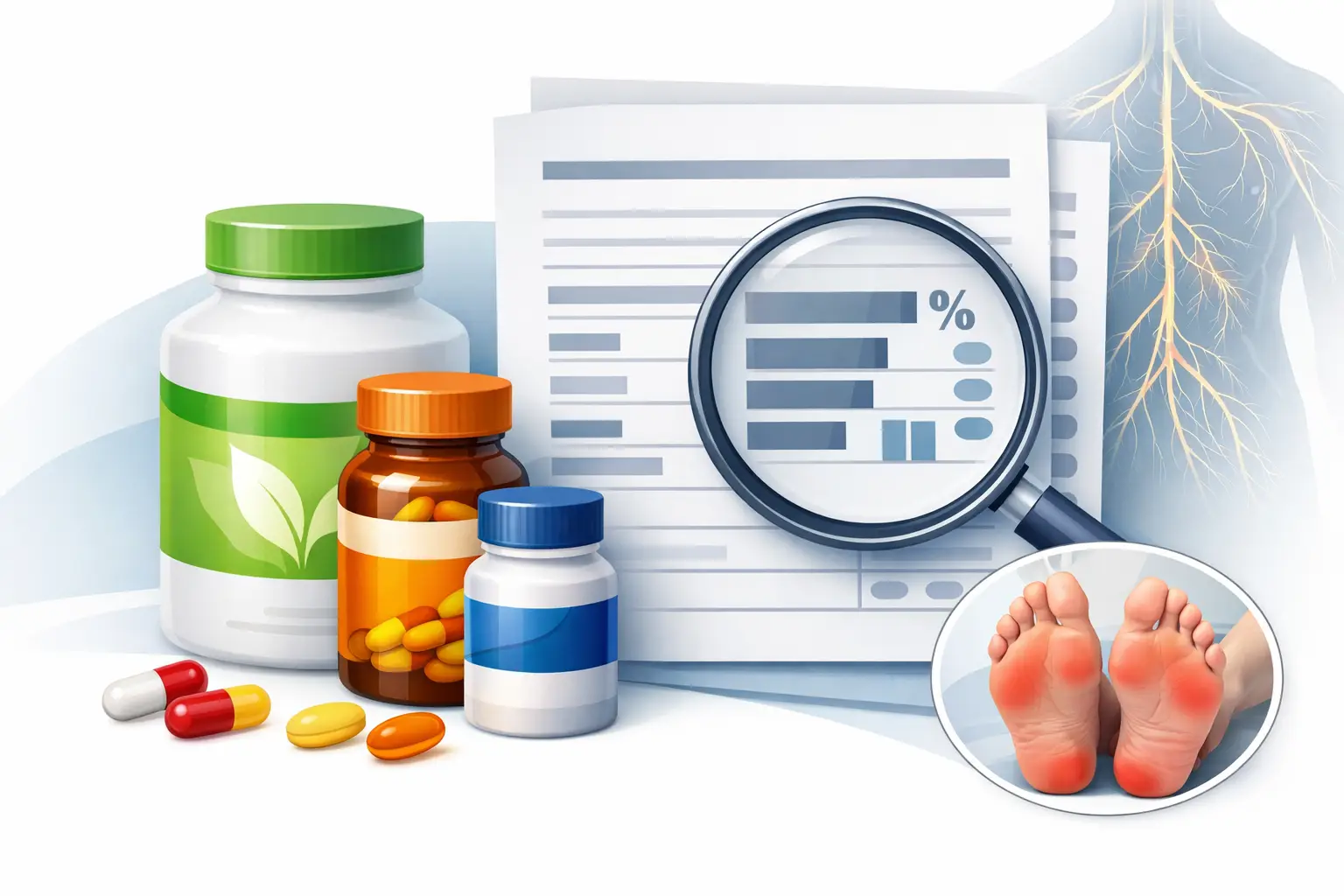
Daily Value (%DV) on supplement labels shows how much a serving contributes to the recommended daily intake for the average adult. It helps compare products, but it does not tell you what your body personally needs, absorbs well, or should take long term.
If you have ever picked up a bottle of vitamin B12, magnesium, or zinc and wondered whether 500% Daily Value is good, excessive, or just marketing, you are asking the right question. Understanding what daily value means on supplement labels can help you compare products more intelligently and avoid assuming that a bigger number automatically means a better supplement.
For adults over 45, this matters even more. Nutrient needs can shift with age, absorption may change, medications can affect vitamin status, and certain symptoms – such as fatigue, tingling, numbness, or balance issues – may lead people to look more closely at supplements. But the label can be confusing unless you know what the Daily Value is actually telling you.
Key Takeaways
- %DV helps compare supplement strength, but it is not personalized medical advice.
- A higher Daily Value does not automatically mean a supplement is better.
- Absorption, nutrient form, medications, and digestive health may matter more than the percentage alone.
- Vitamin B12 supplements often exceed 100% Daily Value because absorption efficiency varies.
- Iron, selenium, vitamin A, and high-dose B6 deserve more caution with excessive long-term intake.
What daily value means on supplement labels
Daily Value, often shown as %DV, is a reference number set by the FDA for many nutrients. It tells you how much a serving of a supplement contributes toward the total amount considered appropriate for most healthy adults on a daily basis.
The U.S. Food and Drug Administration (FDA) explains how Daily Value percentages are used on nutrition and supplement labels to help consumers compare nutrient amounts.
If a supplement label says vitamin C provides 100% Daily Value, that means one serving supplies the full reference amount for that nutrient for the average adult. If it says 50%, the serving provides half of that amount. If it says 500%, it provides five times that reference amount.
That sounds straightforward, but there is an important catch. Daily Value is a labeling tool, not a personalized prescription. It does not tell you what your body specifically needs, what you absorb well, or what is best for a certain symptom pattern, medical condition, or medication use.
Why %DV can be useful
The main value of %DV is comparison. It helps you look at two products side by side and understand their relative strength without having to memorize milligram or microgram targets for every nutrient.
For example, if one B12 supplement provides 100 mcg and another provides 1,000 mcg, the %DV makes the difference easier to recognize quickly. The same applies to vitamin D, folate, iron, calcium, and many others.
It can also help you spot formulas that are lightly dosed versus those that are highly concentrated. That matters because some consumers want a basic maintenance supplement, while others are intentionally choosing higher-potency products under medical guidance.
What %DV does not tell you
What Daily Value Can and Cannot Tell You
Daily Value percentages are useful, but they do not answer every important supplement question.
| What %DV Helps With | What %DV Does NOT Tell You |
|---|---|
| Comparing supplement strength | Whether the nutrient absorbs well |
| Spotting high-potency formulas | Whether the dose fits your personal needs |
| Understanding serving contribution | Whether medications affect absorption |
| Comparing nutrients side by side | Whether the nutrient form matters |
| Identifying underdosed products | Whether the supplement is clinically appropriate |
| Basic label comparison | Whether long-term intake is safe for you |
This is where many shoppers get tripped up. A high percentage does not automatically mean the product is more effective, safer, or better matched to your needs.
First, %DV does not account for bioavailability. Two supplements may list the same Daily Value percentage but use different forms of the nutrient, and those forms may differ in absorption or tolerability. Magnesium oxide and magnesium glycinate are a common example. The label may show magnesium amounts clearly, but the form still matters.
Second, %DV does not reflect your personal health status. Someone with low B12 due to poor absorption may need a different approach than someone who simply wants routine nutritional support. The label cannot tell you that.
Third, %DV does not tell you whether the dose is appropriate to take long term. Some nutrients have a fairly wide safety margin. Others can become problematic at high intakes, especially when multiple products are combined.
Why some supplements are far above 100% Daily Value
Many people assume anything over 100% must be too much. That is not always true, but it is worth evaluating carefully.
Some nutrients appear in supplements at levels far above Daily Value because absorption is limited or because manufacturers formulate them to account for variability in intake. Vitamin B12 is a good example. Many B12 products contain amounts that greatly exceed Daily Value, partly because only a small fraction may be absorbed through normal pathways, especially in certain older adults.
That does not mean every very high-dose product is necessary. It simply means the %DV for B12 can look dramatic without automatically signaling danger. Context matters.
By contrast, with nutrients such as iron, vitamin A, selenium, or vitamin B6, consistently high amounts may deserve a closer look, especially if you already get those nutrients from other supplements or fortified foods. More is not always better, and in some cases it can create avoidable risk.
Daily Value vs Recommended Dietary Allowance
These terms are related, but they are not identical. Daily Value is the number used on labels. Recommended Dietary Allowance, or RDA, is a nutrient intake target developed by scientific bodies based on age, sex, and life stage.
For many nutrients, the Daily Value is based broadly on established intake recommendations, but the label simplifies things into one standard reference for the general adult population. That makes labels easier to read, but it also means they are less individualized.
For a 45-year-old woman, a 70-year-old man, and a person with digestive absorption issues, the same %DV on a bottle may not carry the same practical meaning. That is why label reading is helpful, but not the whole story.
How to read a supplement label more intelligently
Start with the serving size. A label may look impressive until you notice that the listed amounts require two, three, or even six capsules per serving.
Then check the nutrient amount and the %DV together. Looking at both helps you understand not just the percentage, but the actual dose. This is especially important when comparing different nutrients measured in different units, such as mg, mcg, or IU.
Next, look at the nutrient form. For B12, for example, you may see cyanocobalamin, methylcobalamin, adenosylcobalamin, or hydroxocobalamin. The Daily Value percentage may be similar across products, but the form can still matter depending on the product goal and the individual using it.
Also pay attention to stacked formulas. A nerve support supplement might combine B12, B6, folate, alpha-lipoic acid, and other ingredients. In that setting, one nutrient may be extremely high even if the product is marketed around another benefit. This is one reason careful label review matters more than front-label claims.
When Daily Value can be misleading for older adults
For adults 45 and older, supplement labels can be especially tricky because real-world needs are often shaped by factors that %DV does not capture well.
Stomach acid changes, use of metformin or acid-reducing medications, dietary restrictions, and gastrointestinal conditions can all affect nutrient absorption. A label may say you are getting 100% or 1,000% Daily Value, but that still does not guarantee that your body is taking in or using that amount efficiently.
This is particularly relevant with vitamin B12. A supplement may show a very high %DV, but if someone has symptoms or risk factors for deficiency, the better question is not simply how high the label number is. The better question is whether the form, dose, and overall plan make sense for that person, ideally with lab context when appropriate.
Nutrients where caution matters most
Not every high %DV should raise concern, but some deserve more attention than others.
Iron can be useful when there is a documented need, yet unnecessary iron supplementation can be a poor fit for many adults and may cause side effects. Vitamin B6 is another one to watch, since prolonged intake at high levels can be a concern in some cases. Selenium and preformed vitamin A also deserve a careful look when doses climb.
Calcium and magnesium can be more complicated because the right amount depends partly on total diet, tolerability, and whether the product uses a form that absorbs well. A label gives you a starting point, not a final answer.
A practical way to use %DV when shopping
Use Daily Value as a screening tool, not a shortcut. It can help you rule out underdosed products, identify unusually high-potency formulas, and compare similar supplements quickly. That alone makes it useful.
But after that first screen, look deeper. Ask whether the form is appropriate, whether the dose makes sense for your goal, whether you are already getting the nutrient from another source, and whether your age, medications, or medical history change the picture.
At Authority-style review sites such as vitb12supplement.com, this is often where the real product analysis begins. The label tells part of the story, but not all of it.
A smart supplement decision usually comes down to balance. Daily Value helps you read the label, but good judgment comes from understanding the nutrient behind the number.
Frequently Asked Questions
What does %DV mean on a supplement label?
%DV stands for Daily Value and shows how much a serving contributes to the recommended daily intake for the average adult.
Is more than 100% Daily Value dangerous?
Not always. Some nutrients, such as vitamin B12, often appear far above 100% Daily Value because absorption varies. Others may deserve more caution at high doses.
Why can two supplements with the same %DV work differently?
The nutrient form, absorption, product quality, digestive health, and medication use may all influence how the body responds.
Why are vitamin B12 supplements often extremely high in %DV?
Vitamin B12 absorption can be limited in some adults, especially with aging, medication use, or digestive issues, so supplements often use higher doses.
Which nutrients deserve more caution at high doses?
Iron, selenium, vitamin A, and prolonged high-dose vitamin B6 supplementation deserve more careful evaluation in many adults.
Medical Disclaimer: The information provided in this article is for educational purposes only and is not intended as medical advice. Dietary supplements are not a replacement for professional medical diagnosis or treatment. Always consult with a qualified healthcare professional before starting any new supplement, especially if you have pre-existing medical conditions or are taking prescription medications. Individual results may vary.

- Can Low B12 Cause Dizziness? - July 9, 2026
- B12 Deficiency and Cracked Corners of the Mouth - July 9, 2026
- Can Low B12 Cause Dry Mouth? - July 8, 2026