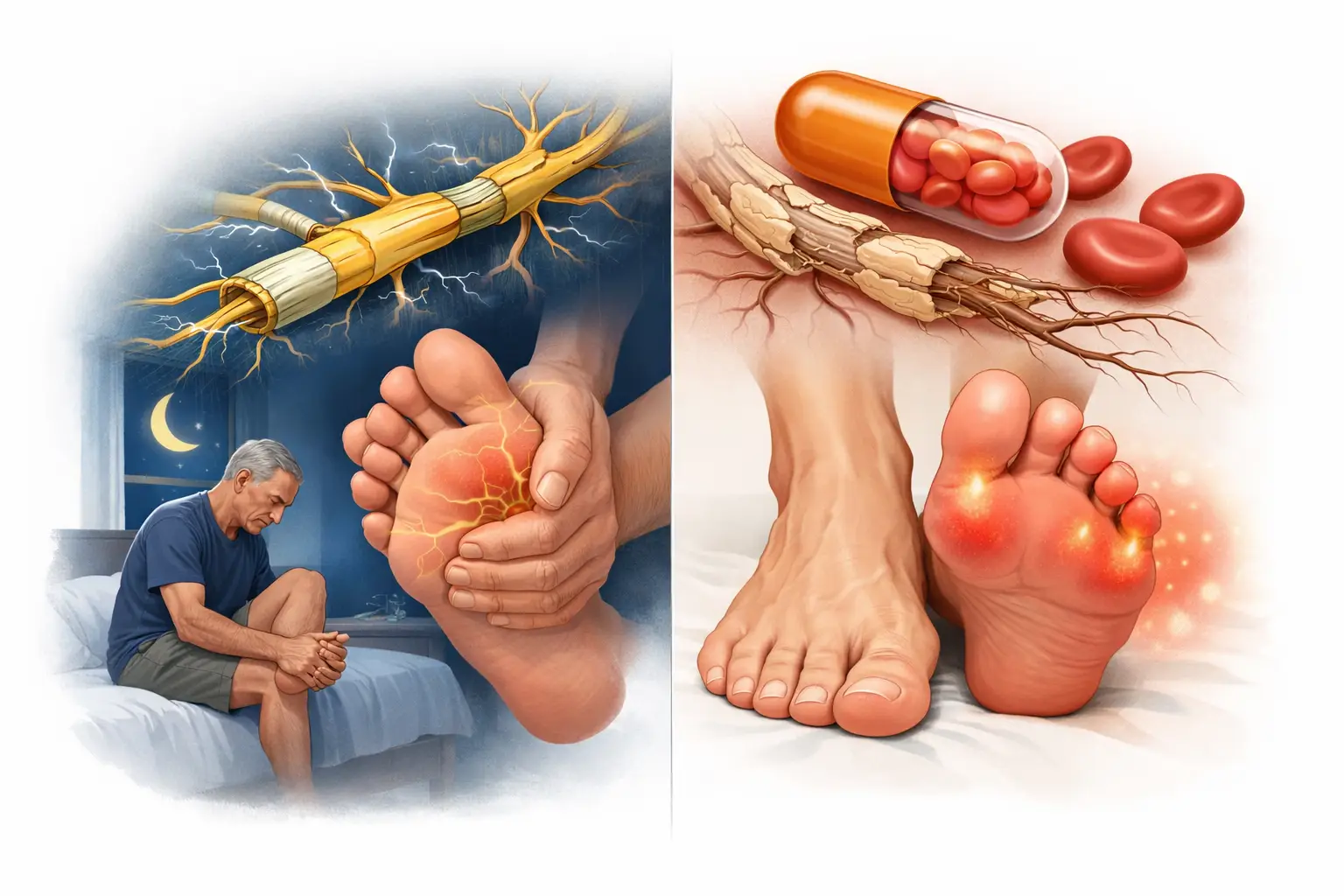
Charcot-Marie-Tooth disease and B12 neuropathy can both cause numb feet, tingling, weakness, foot problems, and balance changes, but they usually have different patterns. Charcot-Marie-Tooth is typically an inherited, slowly progressive nerve disorder that may cause high arches, hammertoes, foot drop, thin lower legs, reduced reflexes, and a long history of clumsiness or ankle problems. B12 neuropathy is usually acquired and may appear later in life with burning, tingling, numbness, gait changes, fatigue, memory issues, anemia signs, or risk factors such as poor absorption, low animal-food intake, metformin use, acid-reducing medications, or gastrointestinal disease. Testing, not guesswork, is needed to tell them apart.
Burning feet, numb toes, leg weakness, balance problems – these symptoms often get grouped under the broad label of neuropathy. But Charcot-Marie-Tooth vs B12 neuropathy is not a small distinction. One is usually an inherited nerve disorder that tends to develop gradually over years. The other may result from vitamin B12 deficiency and can sometimes improve if the deficiency is identified and corrected early.
For adults over 45, this difference matters because the symptoms can overlap enough to create confusion. A person with long-standing foot weakness and high arches may wonder if they have a vitamin problem. Someone with new tingling and gait changes may worry about a genetic disease when the issue is actually low B12. The goal is not self-diagnosis. It is understanding what patterns tend to point in one direction versus the other, so you can have a more informed conversation with a clinician.
Why Charcot-Marie-Tooth And B12 Neuropathy Get Confused
Both conditions affect peripheral nerves, especially in the feet and legs. That means both can cause numbness, tingling, reduced sensation, weakness, and balance trouble. In both cases, symptoms may begin distally – in the toes and feet first – and gradually move upward.
The confusion gets worse because neuropathy is not one disease. It is a descriptive term for nerve damage or dysfunction. Many people searching for answers start with symptoms rather than a diagnosis, and online information often lumps inherited neuropathies, nutritional deficiencies, diabetes-related nerve damage, and compression injuries into the same bucket.
Still, the pattern usually tells an important story. Charcot-Marie-Tooth disease, often shortened to CMT, tends to have a family pattern and a slow, lifelong course. B12 neuropathy is more often acquired later in life and may appear alongside fatigue, memory changes, anemia, or digestive risk factors such as poor absorption.
1. Pattern matters
CMT often has a long-standing pattern with foot structure changes, while B12 neuropathy is more often acquired later.
2. B12 can mimic serious neuropathy
Low B12 may cause numbness, tingling, burning sensations, balance problems, weakness, and cognitive complaints.
3. CMT is not fixed by B12 alone
Correcting a deficiency can support nerve health, but inherited neuropathy needs neurologic evaluation and long-term management.
4. Testing prevents guesswork
A clinician may use labs, neurologic exam, nerve conduction studies, EMG, and sometimes genetic testing.
What Charcot-Marie-Tooth Usually Looks Like
Charcot-Marie-Tooth refers to a group of inherited peripheral nerve disorders. Symptoms often begin in childhood, adolescence, or early adulthood, although some forms are mild enough that people are not diagnosed until later. The hallmark is slowly progressive weakness and muscle wasting, especially in the lower legs and feet.
For a medical overview of Charcot-Marie-Tooth disease, see the NINDS guide to Charcot-Marie-Tooth disease.
A classic CMT pattern includes frequent ankle sprains, foot drop, difficulty lifting the front of the foot, high arches, hammertoes, and thin lower legs. Some people describe their calves as having an “inverted champagne bottle” appearance because the lower leg muscles shrink over time. Hand weakness can also develop later.
Sensory symptoms happen too, but many patients notice the motor changes first. A person may say they have always been clumsy, had trouble running, or could never keep up physically. Reflexes are often reduced or absent. Family history can be a major clue, although not every patient knows their family history clearly.
Because CMT is genetic, vitamin supplementation does not address the root cause. That does not mean nutrition is irrelevant. General nerve health, mobility support, and deficiency correction still matter. But the central issue in CMT is inherited nerve dysfunction, not simply low nutrient intake.
What B12 Neuropathy Usually Looks Like
Vitamin B12 deficiency can affect the nerves, blood cells, and nervous system more broadly. Neuropathy from low B12 often causes tingling, pins-and-needles sensations, burning feet, numbness, sensory loss, and unsteady walking. Some people also report fatigue, weakness, brain fog, mood changes, or a sore tongue.
Unlike many inherited neuropathies, B12-related nerve symptoms may begin later in adulthood and can appear over months rather than decades. The presentation is not identical in every person. Some have anemia and obvious low-B12 symptoms. Others have neurological symptoms with little or no anemia.
Risk factors matter here. B12 deficiency is more likely in adults with pernicious anemia, older age, long-term metformin use, acid-reducing medications, gastrointestinal surgery, digestive disorders affecting absorption, low intake of animal foods, or heavy alcohol use. If neuropathy appears in someone with one or more of those risks, B12 status deserves attention.
A practical point for supplement shoppers: taking B12 on your own may make sense only after understanding why levels are low. If the problem is poor absorption, the form, dose, and route of replacement may matter. This is one reason evidence-informed evaluation is more useful than guesswork.
Charcot-Marie-Tooth vs B12 Neuropathy: The Biggest Differences
The cleanest distinction is this: CMT is usually inherited and structurally patterned, while B12 neuropathy is usually acquired and linked to deficiency.
CMT often shows longstanding foot deformities, progressive distal weakness, and a history that reaches back many years, sometimes to childhood. B12 neuropathy is more likely to present as newer numbness, tingling, burning, and gait instability in someone with nutritional or absorption risk factors. CMT often has clear motor involvement, such as foot drop or difficulty with ankle dorsiflexion, while B12 deficiency may produce more prominent sensory complaints early on.
That said, there is overlap. Severe B12 deficiency can also affect walking, proprioception, and leg strength. Mild CMT may be missed for years. Some patients with inherited neuropathy can also become B12 deficient later, which complicates the picture. One diagnosis does not fully rule out another.
Charcot-Marie-Tooth vs B12 Neuropathy: Key Differences
The most useful clue is often the pattern over time. CMT usually points toward a long-standing inherited neuropathy pattern, while B12 neuropathy more often points toward an acquired deficiency or absorption problem.
| Feature | Charcot-Marie-Tooth Disease | B12 Neuropathy | Why It Matters |
|---|---|---|---|
| Usual cause | Inherited peripheral nerve disorder | Acquired vitamin B12 deficiency or impaired B12 use | One points toward genetics; the other points toward nutritional status, absorption, medications, or autoimmune causes. |
| Typical timeline | Often begins in childhood, adolescence, or early adulthood, but mild cases may be noticed later | Often develops later in adulthood or over months to years | A lifelong pattern suggests something different from a newer symptom change. |
| Common foot clues | High arches, hammertoes, foot drop, frequent ankle sprains, thin lower legs | Burning feet, numb toes, tingling, reduced vibration or position sense, unsteady walking | Foot shape and long-term motor changes can point toward CMT; newer sensory symptoms may raise B12 concern. |
| Family history | Often present, though it may be unclear or unrecognized | Not usually inherited in the same way, though risk factors can run in families | Family history of foot deformities, braces, gait problems, or unexplained neuropathy can be an important clue. |
| Other associated clues | Long-standing clumsiness, reduced reflexes, distal weakness, hand weakness later | Fatigue, anemia signs, sore tongue, brain fog, memory changes, GI or medication risk factors | Whole-body clues can help separate inherited nerve disease from deficiency-related nerve dysfunction. |
| Testing direction | Neurologic exam, nerve conduction studies, EMG, genetic testing when appropriate | Serum B12, CBC, methylmalonic acid, homocysteine, folate, absorption and medication review | Different suspected causes require different testing pathways. |
Testing Clues Doctors Use
No symptom checklist can replace medical evaluation here. The workup often combines history, examination, and targeted testing.
For possible B12 neuropathy, clinicians may order serum B12 along with markers that can uncover functional deficiency, such as methylmalonic acid and sometimes homocysteine. A complete blood count may show macrocytic anemia, but a normal blood count does not rule out neurological involvement. If B12 is low, the next question is why – low intake, poor absorption, medication effect, or an autoimmune cause like pernicious anemia.
For possible CMT, the exam may reveal characteristic foot structure, distal weakness, muscle atrophy, reduced reflexes, and sensory loss. Nerve conduction studies and electromyography can help show whether the neuropathy is demyelinating or axonal. Genetic testing may confirm the diagnosis in many cases, especially when family history or electrodiagnostic patterns raise suspicion.
Imaging is not the main test for either condition, although it may be used to rule out spine-related causes of numbness or weakness. Good diagnosis usually comes from pattern recognition supported by the right lab and nerve tests.
Important: Foot drop, worsening leg weakness, frequent falls, rapidly progressive numbness, new hand weakness, or major balance changes should not be managed with supplements alone.
These symptoms may reflect inherited neuropathy, B12 deficiency, diabetes-related neuropathy, spine-related nerve compression, medication effects, or another neurologic condition. A clinician may need to review the symptom pattern, family history, neurologic exam, blood work, nerve conduction studies, EMG, and sometimes genetic testing.
Testing Clues: CMT vs B12 Neuropathy
The right tests depend on the pattern. Blood tests may help uncover B12 deficiency, while nerve studies and genetic testing may be more relevant when inherited neuropathy is suspected.
| Test or Evaluation | More Helpful For | What It May Clarify | Important Limitation |
|---|---|---|---|
| Neurologic exam | Both | Strength, reflexes, sensation, gait, foot structure, balance, and pattern of weakness | Exam findings often need lab or nerve testing support. |
| Serum B12 | B12 neuropathy | Whether B12 level is low or borderline | A single result may not fully explain symptoms. |
| Methylmalonic acid | B12 neuropathy | May help identify functional B12 deficiency | Must be interpreted in clinical context. |
| CBC and folate | B12 neuropathy | May reveal anemia patterns or overlapping deficiencies | Neurologic B12 symptoms may occur even without obvious anemia. |
| Nerve conduction study and EMG | CMT and other neuropathies | Whether neuropathy appears demyelinating, axonal, motor, sensory, or mixed | Does not replace clinical history or lab evaluation. |
| Genetic testing | CMT | May confirm a suspected inherited neuropathy | Not every genetic cause is found, and counseling may be helpful. |
Can B12 Deficiency and Charcot-Marie-Tooth Coexist?
Yes. A person can have an inherited neuropathy such as Charcot-Marie-Tooth disease and also develop vitamin B12 deficiency later in life. These are different issues, but they can overlap in symptoms and may make numbness, tingling, weakness, balance problems, or walking difficulty harder to interpret.
Why Coexistence Matters
If someone already has CMT, new or worsening symptoms should not automatically be blamed on the genetic condition. A correctable contributor, such as B12 deficiency, diabetes, thyroid disease, medication effects, or alcohol-related nerve injury, may also be present.
What May Raise Suspicion
A change from a long-stable pattern may deserve a fresh evaluation. Examples include new burning pain, faster progression, new balance changes, worsening numbness, fatigue, anemia signs, memory changes, or new risk factors for low B12 absorption.
Practical takeaway: CMT does not prevent someone from also having B12 deficiency. If symptoms change, worsen, or seem out of proportion, clinicians may still consider B12 testing, medication review, metabolic causes, and other treatable contributors.
When Low B12 Can Mimic Something More Serious
This is one of the most important reasons not to dismiss B12 deficiency. Low B12 can produce symptoms that feel alarming: numb feet, poor balance, leg weakness, gait changes, memory issues, and fatigue. In some people, these symptoms come on gradually enough that they are mistaken for aging, circulation problems, or an inherited neurological condition.
The good news is that B12 deficiency is a potentially correctable contributor to neuropathy. The less good news is that the window for full recovery is not always unlimited. Longer-standing nerve injury may improve only partially, which is why early evaluation matters.
This does not justify high-dose supplement use without context. It supports proper testing, especially in older adults and in people with clear deficiency risks. A careful, science-based approach is more useful than assuming every tingling foot problem is either genetic or nutritional.
Research Snapshot: Charcot-Marie-Tooth vs B12 Neuropathy
Research and medical education sources describe Charcot-Marie-Tooth disease and B12 neuropathy as different categories of peripheral nerve problems. CMT is usually inherited and slowly progressive, while B12 neuropathy is usually acquired and may be related to low intake, impaired absorption, medication effects, or other deficiency risks.
| Research Finding | Clinical Relevance |
|---|---|
| Charcot-Marie-Tooth is generally an inherited peripheral neuropathy | A long history of foot weakness, high arches, hammertoes, foot drop, reduced reflexes, family history, or slowly progressive lower-leg weakness may raise suspicion for CMT. |
| B12 deficiency can affect both blood and nerve function | B12 neuropathy may cause tingling, numbness, burning sensations, balance problems, gait changes, fatigue, cognitive complaints, or anemia-related symptoms. |
| Symptom overlap can lead to confusion | Both conditions may affect the feet and legs, so symptom pattern, age of onset, family history, foot structure, blood work, and nerve studies help guide the evaluation. |
| Testing pathways are different | Suspected B12 neuropathy may involve serum B12, methylmalonic acid, homocysteine, CBC, folate, and absorption review. Suspected CMT may involve neurologic exam, nerve conduction studies, EMG, and genetic testing when appropriate. |
| More than one factor can be present | A person with inherited neuropathy can also develop B12 deficiency later in life. Identifying correctable contributors is still important, even when a genetic neuropathy is suspected or confirmed. |
Editorial note: This snapshot summarizes broad research and medical education themes. It is not intended to diagnose the cause of neuropathy in any individual person or replace evaluation by a neurologist or qualified healthcare professional.
What This Means For Supplement Decisions
For readers of health and supplement reviews, the key takeaway is simple: a neuropathy symptom does not automatically mean you need a nerve support formula. If the problem is undiagnosed CMT, symptom management and specialist care may be more relevant than any over-the-counter product. If the issue is true B12 deficiency, the priority is confirming deficiency and correcting it appropriately.
This is where realistic expectations matter. Vitamin B12 is essential for nerve function, and correcting deficiency is medically important. But B12 is not a cure-all for every type of neuropathy. It is most relevant when deficiency or insufficiency is actually present, or when intake and absorption risks strongly suggest it may be.
Products marketed for nerve health vary widely in dose, ingredient quality, and clinical rationale. Ingredient reviews can help readers compare supplement claims, but neuropathy symptoms should still be evaluated medically before relying on over-the-counter products.
When To Seek Prompt Evaluation
If neuropathy symptoms are new, worsening, or affecting balance and walking, medical evaluation should move up the priority list. The same is true for foot drop, frequent falls, hand weakness, rapidly progressive numbness, or a strong family history of unexplained nerve disease. Those patterns deserve more than trial-and-error self-treatment.
For many readers, the best next step is not choosing between worst-case theories online. It is asking a focused question in the exam room: Could this be an inherited neuropathy, a B12 issue, or something else entirely? That question often leads to better testing, fewer assumptions, and a safer path forward.
If you’re trying to understand what may be behind numbness, tingling, burning feet, or nerve pain, see our guide to peripheral neuropathy causes, warning signs, and evidence-informed next steps.
Frequently Asked Questions About Charcot-Marie-Tooth vs B12 Neuropathy
These answers are for education only and should not replace evaluation by a qualified healthcare professional.
Can B12 deficiency mimic Charcot-Marie-Tooth disease?
B12 deficiency can mimic some neuropathy symptoms, such as numbness, tingling, burning feet, balance problems, and gait changes. However, classic CMT often has a long-standing inherited pattern with foot deformities, distal weakness, reduced reflexes, and sometimes family history. Testing is needed to separate the possibilities.
Does Charcot-Marie-Tooth cause high arches and foot drop?
It can. Many people with CMT develop high arches, hammertoes, ankle instability, foot drop, and weakness in the lower legs and feet. These signs are not diagnostic by themselves, but they can raise suspicion for an inherited neuropathy pattern.
Can B12 deficiency cause foot drop?
B12 deficiency can contribute to neurologic symptoms and gait problems, but foot drop has many possible causes, including inherited neuropathy, nerve compression, spine disease, diabetes-related neuropathy, and other neurologic conditions. New foot drop should be evaluated promptly.
How do doctors test for B12 neuropathy?
Doctors may start with serum B12 and a complete blood count. Depending on symptoms and results, they may also consider methylmalonic acid, homocysteine, folate, iron status, medication history, diet pattern, and absorption risk factors.
How do doctors test for Charcot-Marie-Tooth disease?
Evaluation may include a neurologic exam, family history, nerve conduction studies, EMG, and genetic testing when appropriate. Nerve studies can help show whether the neuropathy pattern is demyelinating or axonal.
Can taking B12 fix Charcot-Marie-Tooth disease?
B12 does not treat the genetic cause of Charcot-Marie-Tooth disease. If a person with CMT is also B12 deficient, correcting the deficiency may still be medically important, but it should not be expected to reverse inherited nerve dysfunction.
Can B12 neuropathy improve?
B12-related neuropathy may improve when deficiency is identified and corrected early, but recovery depends on severity, duration, cause, and whether nerve damage has become long-standing. Some symptoms may improve only partially.
When should neuropathy symptoms be evaluated quickly?
Prompt evaluation is important if symptoms are new, worsening, asymmetric, affecting walking, causing falls, associated with foot drop, or accompanied by progressive weakness, hand weakness, or major balance changes.
Medical Disclaimer:
This article is for educational purposes only and does not diagnose, treat, or replace medical care. Neuropathy symptoms can have many causes. Persistent, progressive, or unexplained numbness, tingling, weakness, balance problems, foot drop, frequent falls, hand weakness, or gait changes should be discussed with a qualified healthcare professional or neurologist.

- Can Low B12 Cause Dizziness? - July 9, 2026
- B12 Deficiency and Cracked Corners of the Mouth - July 9, 2026
- Can Low B12 Cause Dry Mouth? - July 8, 2026