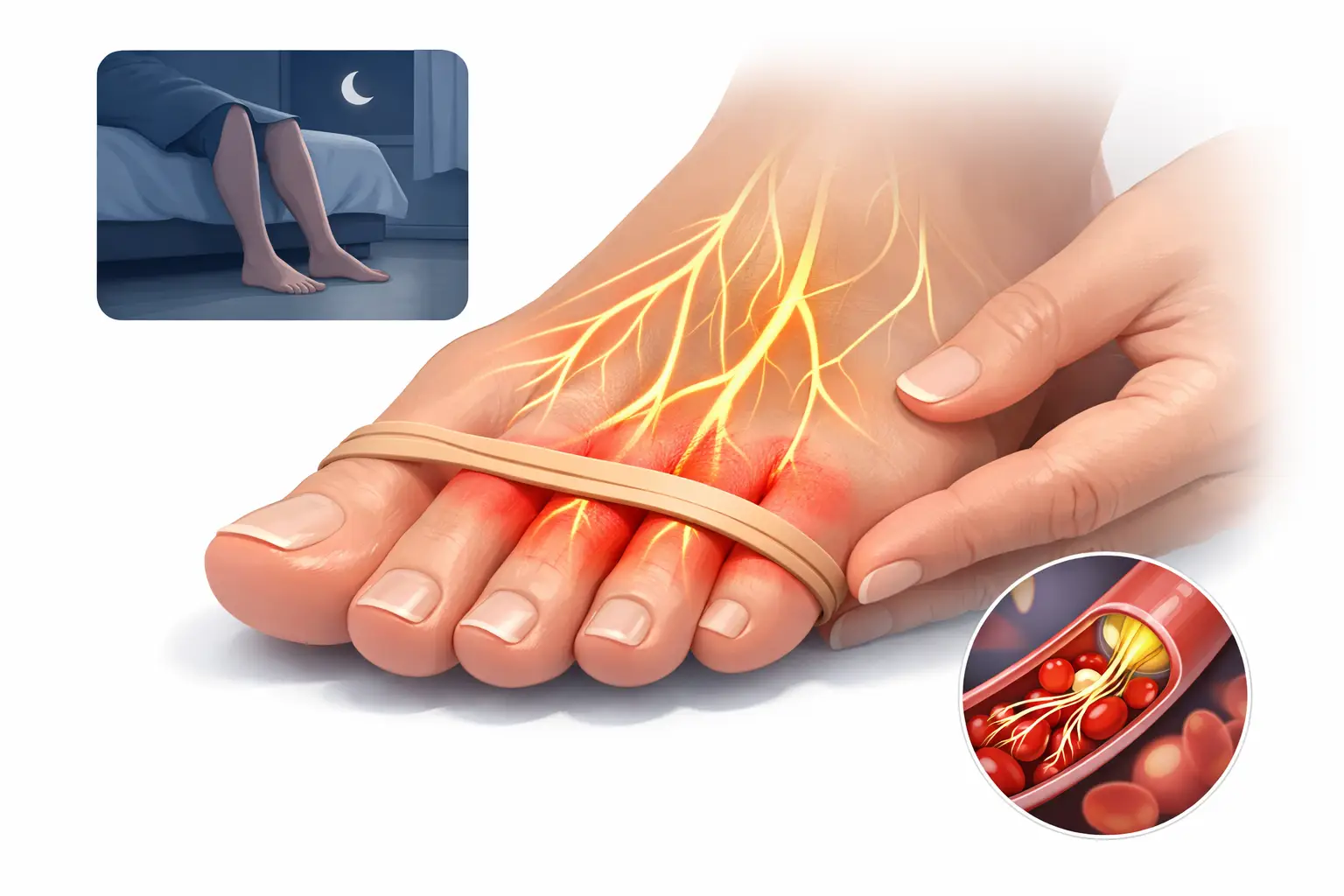
If your toes feel as if a tight elastic is wrapped around them, even when nothing is there, that rubber band feeling around toes is usually a sensory symptom rather than a skin problem. People often describe it as pressure, squeezing, tightness, or a strange band-like sensation across the front of the foot. It can come and go, or it can linger long enough to make walking feel distracting and mildly unsettling.
That sensation is not a diagnosis by itself. It is a clue. In adults over 45, it often raises questions about nerve irritation, circulation, swelling, footwear pressure, or less commonly structural foot problems. The useful next step is not guessing from one symptom alone, but noticing what else is happening with it.
What a rubber band feeling around toes can mean
When clinicians hear this description, they usually think first about altered nerve signaling. Nerves do not always create obvious numbness or sharp pain. Sometimes they produce odd sensory distortions – pressure, tightness, buzzing, crawling, or the sense that a sock is bunched under the foot when it is not. A band-like feeling around the toes fits that pattern.
Peripheral nerve irritation is one common explanation. This can happen when small nerves in the feet are compressed, inflamed, or not functioning normally. Some people also notice tingling, burning, reduced sensitivity, or symptoms that are worse at night. If the feeling is present in both feet and gradually spreading, that pattern often deserves a careful look at broader nerve health rather than just the toes themselves.
Swelling can create a similar experience. Even mild fluid retention in the forefoot may make the skin and soft tissue feel tight. In that case, shoes may feel snug later in the day, and the toes may look slightly puffy. The sensation can still be described as a rubber band around the toes, but the underlying issue is more mechanical than neurological.
Circulation issues are another possibility, though they do not always cause this exact symptom in isolation. Reduced blood flow more often leads to cold feet, cramping with activity, color changes, or slow wound healing. Still, some people with circulation problems describe foot tightness or unusual pressure, especially with walking.
Common causes doctors consider
A frequent cause is peripheral neuropathy, a broad term for damage or dysfunction affecting peripheral nerves. Neuropathy has many possible contributors, including diabetes, alcohol overuse, certain medications, thyroid problems, and nutrient deficiencies. Vitamin B12 is especially relevant because low B12 can affect nerve function and may contribute to numbness, tingling, or unusual foot sensations. That does not mean every person with toe tightness has a B12 issue, but it is one reasonable factor to ask about.
Footwear is a simpler explanation that should not be overlooked. Tight toe boxes, stiff shoes, compression from seams, or long hours standing in poorly fitted shoes can irritate nerves between the toes and across the forefoot. Some people notice the sensation mainly after work or after wearing specific shoes, and it improves when they go barefoot or switch footwear.
Morton’s neuroma is another possibility, especially if the feeling is centered between the toes or the ball of the foot. This involves thickening around a nerve, often causing burning, tingling, or the sense of a pebble in the shoe. Not everyone experiences classic pain. For some, it is more of a squeezing or wrapped sensation.
Arthritis and changes in foot structure can also play a role. Toe deformities, joint swelling, or altered walking mechanics may create pressure patterns that feel like constriction. This tends to be more likely when symptoms are localized to one area and paired with stiffness or visible shape changes in the foot.
When nerve health becomes a bigger concern
The rubber band feeling around toes matters more when it appears alongside numbness, burning, balance changes, or reduced ability to feel temperature. Those combinations suggest the symptom may be part of a larger nerve pattern rather than a local pressure issue.
A gradual onset in both feet is often more concerning for systemic causes. If the feeling starts in the toes and slowly moves upward, clinicians sometimes describe that as a length-dependent pattern, which is common in peripheral neuropathy. By contrast, a symptom that began suddenly in one foot after a change in shoes or after an injury points more toward local compression or inflammation.
B12 status is worth discussing if you also have fatigue, memory changes, weakness, mouth soreness, anemia, digestive issues, or a history of stomach surgery, long-term acid-reducing medication use, or plant-based eating without reliable supplementation. B12 deficiency can be subtle for a long time. In evidence-based supplement review, this is where caution matters – a supplement may help if low intake or poor absorption is part of the problem, but self-treating nerve symptoms without understanding the cause can delay useful medical evaluation.
What to notice before you call your doctor
A short symptom history can make the conversation much more productive. Pay attention to whether the feeling affects one foot or both, whether it is constant or intermittent, and whether it worsens with walking, standing, bedtime, or certain shoes. Also note any numbness, pain, burning, weakness, back pain, leg swelling, or changes in skin color.
This kind of detail helps narrow the possibilities. A one-sided symptom linked to activity may point toward local mechanical causes. A symmetrical symptom in both feet, especially with tingling or reduced sensation, tends to shift concern toward nerve-related causes.
It is also useful to think about timing. A sensation that came on over months is different from one that appeared overnight. Sudden onset, especially with weakness or major numbness, calls for more urgent assessment.
How the symptom is typically evaluated
A clinician will usually start with a physical exam of the feet and lower legs. That may include checking pulses, skin temperature, swelling, reflexes, and how well you sense touch or vibration. They may also ask about blood sugar, alcohol intake, medications, thyroid history, and nutritional factors.
Depending on the bigger picture, blood tests may be considered to look for common contributors such as diabetes or prediabetes, vitamin B12 deficiency, thyroid disorders, kidney issues, or other metabolic factors. If symptoms strongly suggest nerve dysfunction, some people are referred for additional neurologic evaluation. If the pain seems more structural or localized to the forefoot, foot imaging or podiatry assessment may be more relevant.
This is where realistic expectations matter. There is not one test that explains every odd toe sensation. Sometimes the answer is straightforward, such as shoe compression or swelling. In other cases, it takes a stepwise review of nerve, vascular, and metabolic factors.
What you can do now without overreaching
Start with pressure and fit. Shoes should have enough room in the toe box that your toes are not crowded. If symptoms worsen in a certain pair, stop wearing them for a week or two and see if the pattern changes. Mild swelling may improve with reducing prolonged standing, elevating the feet when practical, and reviewing sodium intake if fluid retention is an issue for you.
If you have diabetes, prediabetes, or known nerve concerns, this symptom is a good reason to tighten up routine follow-up rather than ignore it. Keeping blood sugar in range, reviewing medications, and checking for skin changes in the feet are sensible steps. If low B12 is a possibility, discuss testing before assuming a supplement is the answer. On a site focused on supplement science, that distinction matters. The best vitamin supplement is the one that matches a documented need, appropriate dose, and realistic goal.
Try not to mask a persistent symptom only with insoles, massage tools, or over-the-counter creams if the cause is unclear. Comfort strategies may help, but they should not replace evaluation when symptoms are progressing.
When to seek medical care sooner
Prompt medical attention is warranted if the toe tightness is new and severe, if you also have foot weakness, a foot drop, major numbness, severe pain, color change, or an ulcer, or if one foot suddenly becomes cold or pale. Those patterns are less likely to be minor shoe pressure.
You should also get checked if the sensation has been building over weeks to months, especially when it affects both feet or begins interfering with balance, sleep, or daily walking. Persistent sensory changes are often easier to evaluate early than after they have spread.
A rubber band sensation around the toes is easy to brush off because it sounds minor. But the body often starts with subtle signals. If this feeling keeps returning, treat it as useful information, not as something you have to simply put up with.
Frequently Asked Questions
Why do my toes feel like a rubber band is around them?
A rubber band feeling around the toes often comes from altered sensory signaling. Nerves may interpret pressure, tightness, or touch incorrectly, creating a band-like, squeezing, or wrapped sensation even when nothing is around the toes.
Can neuropathy cause a tight band feeling around the toes?
Yes. Peripheral neuropathy can cause unusual sensations such as tightness, burning, tingling, numbness, buzzing, or the feeling that something is wrapped around the toes or foot. This is more concerning when it affects both feet or gradually spreads.
Can vitamin B12 deficiency cause a rubber band feeling in the toes?
Vitamin B12 deficiency can affect nerve function and may contribute to tingling, numbness, burning, balance problems, or unusual foot sensations. A rubber band feeling alone does not prove B12 deficiency, so testing is better than guessing.
Can tight shoes cause a rubber band feeling around the toes?
Yes. Tight toe boxes, stiff shoes, seams, or long periods of standing in poorly fitted footwear can compress or irritate nerves in the forefoot. If the sensation improves after changing shoes, footwear pressure may be part of the cause.
Is a rubber band feeling around the toes a sign of Morton’s neuroma?
It can be. Morton’s neuroma may cause burning, tingling, pressure, or the feeling of a pebble, lump, or tightness near the ball of the foot or between the toes. A podiatrist or clinician can help determine whether a local nerve problem is involved.
Can swelling make my toes feel wrapped or tight?
Yes. Mild swelling or fluid retention in the forefoot can make the toes feel tight, stretched, or compressed. This is more likely if shoes feel snug later in the day, the toes look puffy, or socks leave deeper marks.
Can circulation problems cause tightness around the toes?
Circulation problems can sometimes cause tightness, pressure, coldness, cramping, color changes, or slow-healing wounds. If the sensation comes with cold, pale, blue, painful, or weak feet, circulation should be evaluated promptly.
When should I see a doctor for a rubber band feeling around my toes?
See a healthcare professional if the feeling is persistent, worsening, spreading, one-sided, or associated with numbness, burning, weakness, balance problems, back pain, swelling, wounds, skin color changes, or trouble walking.
Medical Disclaimer:
This content is for educational purposes only and does not diagnose, treat, cure, or replace professional medical care. Vitamin B12 deficiency, neuropathy symptoms, nerve pain, numbness, tingling, burning feet, balance problems, fatigue, and related health concerns can have many possible causes, including diabetes, vitamin deficiencies, medication effects, alcohol exposure, autoimmune conditions, infections, circulation problems, gastrointestinal or absorption issues, spinal conditions, or nerve compression.
Information about supplements, nutrition, lifestyle, sleep, movement, testing, or symptom support should not be used as a substitute for evaluation by a qualified healthcare professional. Supplements may not be appropriate for everyone and may interact with medications or medical conditions.
New, worsening, spreading, severe, one-sided, or unexplained symptoms — including numbness, weakness, balance problems, falls, wounds, foot ulcers, skin color changes, severe pain, chest pain, shortness of breath, bowel or bladder changes, facial drooping, trouble speaking, confusion, or sudden neurologic symptoms — should be discussed with a qualified healthcare professional or emergency service promptly.

- Can Low B12 Cause Dizziness? - July 9, 2026
- B12 Deficiency and Cracked Corners of the Mouth - July 9, 2026
- Can Low B12 Cause Dry Mouth? - July 8, 2026