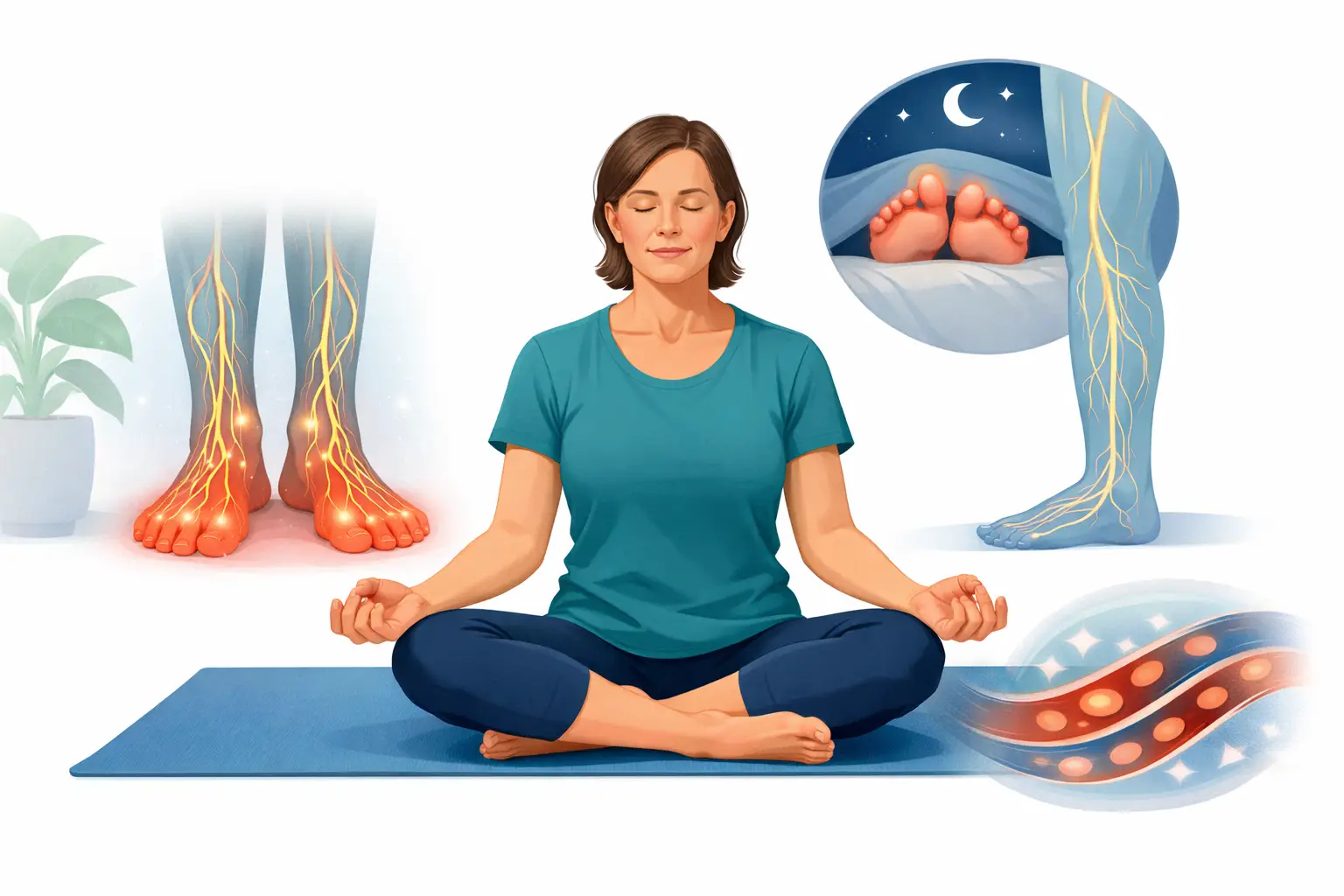
Yoga may be helpful for some people with mild to moderate, stable peripheral neuropathy when it is gentle, supported, and adapted for balance problems. Chair yoga, restorative yoga, and slow beginner-friendly hatha yoga are usually safer starting points than hot yoga, power yoga, or fast vinyasa. Yoga should not be used as a cure for neuropathy or as a substitute for medical evaluation, especially if symptoms are new, worsening, one-sided, or associated with weakness, foot ulcers, dizziness, or walking difficulty.
Burning feet, pins-and-needles, and a growing sense that your balance is not what it used to be can make exercise feel risky instead of helpful. That is why many adults start looking into yoga for peripheral neuropathy – not as a cure, but as a gentler way to move when walking, strength work, or longer workouts feel difficult.
Yoga is often discussed as if it were one thing, but it is really a broad category. A slow chair-based class, a restorative routine on the floor, and an advanced balance-heavy flow place very different demands on the body. For people with neuropathy symptoms, that difference matters. The goal is not to force flexibility or push through numbness. The goal is safer movement, better body awareness, and a realistic way to stay active.
Key Takeaways
1. Choose Support First
Chair yoga, wall support, and slow transitions are usually safer than balance-heavy flows.
2. Yoga Is Supportive
Yoga may help with mobility, confidence, posture, and body awareness, but it does not treat every cause of neuropathy.
3. Symptoms Guide Intensity
Worsening burning, sharp pain, cramping, instability, or new weakness are signs to stop and reassess.
4. Red Flags Matter
Rapid progression, one-sided symptoms, falls, ulcers, dizziness, or bowel/bladder changes require medical advice before yoga.
5. The Cause Still Matters
Yoga may support movement and confidence, but diabetes, B12 deficiency, medication effects, alcohol exposure, autoimmune disease, or nerve compression require different evaluation and management.
What yoga can and cannot do for peripheral neuropathy
Peripheral neuropathy is a symptom pattern, not a single disease. It can be linked with diabetes, vitamin deficiencies such as low B12, alcohol use, certain medications, autoimmune conditions, nerve compression, and other causes. Depending on the source, symptoms may include numbness, tingling, burning pain, altered temperature sensation, muscle weakness, and trouble with coordination.
Yoga does not correct every underlying cause of nerve symptoms. If neuropathy is related to a reversible issue such as a nutritional deficiency, the deficiency itself still needs medical evaluation and proper treatment. If symptoms are progressing, affecting walking, or involving sudden weakness, yoga is not the first step. Medical assessment comes first.
What yoga may offer is more practical than dramatic. Some people find it helps reduce stiffness, improve ankle and hip mobility, support posture, and make balance deficits easier to notice and work around. Breathing practices and slower movement may also help people who tense up when symptoms flare. That can matter because chronic discomfort often leads to guarded movement, less activity, and even more instability over time.
The evidence is not strong enough to say yoga directly improves nerve function in a predictable way for every patient. Still, there is a reasonable case for yoga as a supportive activity when symptoms are stable, the routine is modified, and safety comes first.
Why gentle movement may help
One challenge with neuropathy is that the brain may get incomplete or distorted information from the feet and legs. When that happens, balance becomes less automatic. Gentle yoga can help by slowing movement down enough for you to pay attention to weight shifting, foot placement, and posture.
That does not mean standing on one leg in the middle of the room. In fact, for many adults with neuropathy, the safest starting point is seated or supported practice. A chair, wall, countertop, or bed can turn yoga from a fall risk into a manageable form of movement.
Another possible benefit is circulation support through regular muscle activity. It is important to be careful with this point. Yoga is not a treatment for vascular disease, and numb feet should never be assumed to be a circulation problem without medical evaluation. But regular movement does help joints stay mobile and muscles stay engaged, which can support general physical function.
Best types of yoga for peripheral neuropathy
The best yoga for peripheral neuropathy is usually the least flashy kind. Slow, controlled forms tend to be more appropriate than fast sequences with frequent position changes.
Chair yoga is often the easiest place to begin. It reduces the chance of falling, allows better control, and makes it easier to stop if symptoms increase. Gentle hatha yoga can also work well if the class is beginner-friendly and the instructor is comfortable offering modifications.
Restorative yoga may suit people whose symptoms include pain, fatigue, or poor sleep. It uses supported positions and longer holds, which can make movement feel less threatening. That said, very long holds are not ideal for everyone. If a position increases tingling, burning, or pressure in a limb, it should be changed.
More demanding styles such as hot yoga, power yoga, or fast vinyasa are usually a poor fit, especially for adults with numbness in the feet, reduced balance, or heat sensitivity. Heated rooms can also be problematic for people who do not sense temperature normally or who have medical issues that make overheating a concern.
| Type of Yoga | Potential Fit for Neuropathy | Why It May Help | Safety Notes |
|---|---|---|---|
| Chair yoga | Often the best starting point | Reduces fall risk while allowing gentle mobility, breathing, posture work, and controlled leg movement. | Use a stable chair without wheels; keep feet supported and avoid slippery surfaces. |
| Gentle hatha yoga | May be appropriate if beginner-friendly | Can support flexibility, slower movement, posture awareness, and supported balance practice. | Choose classes that allow wall, chair, or countertop support. |
| Restorative yoga | Useful for pain, fatigue, or stress sensitivity | Uses props and supported positions that may feel less threatening for people with discomfort. | Avoid very long holds if they increase tingling, pressure, numbness, or burning. |
| Fast vinyasa or power yoga | Usually not ideal early on | Frequent transitions and balance demands may exceed what numb or painful feet can safely manage. | Avoid if you have poor balance, recent falls, severe numbness, or weakness. |
| Hot yoga | Often a poor fit | Heat may increase dizziness, fatigue, dehydration risk, or discomfort in people with altered sensation. | Avoid if you have heat sensitivity, cardiovascular concerns, diabetic foot issues, or reduced temperature sensation. |
Poses that are often safer and more practical
The most useful yoga positions for neuropathy are usually the ones that improve mobility and awareness without challenging balance too aggressively. Seated ankle circles, gentle calf stretches, seated marching, cat-cow at a chair or on the floor, supported mountain pose at a wall, and seated forward folds are common examples.
A supported heel-to-toe stance near a counter can help some people practice balance in a controlled way. Supine positions, such as lying on the back with knees bent, may also feel reassuring for those who are unsteady on their feet.
What tends to be less helpful early on are poses that require quick transitions, prolonged standing on one leg, deep toe loading, or strong pressure on numb areas. A pose that looks simple to someone without neuropathy can feel disorienting if the feet do not reliably sense the floor.
Pain matters here. Mild stretching discomfort is one thing. Sharp pain, cramping, worsening burning, or a sense that a joint is unstable are signs to stop.
6 Safe Yoga Poses for Peripheral Neuropathy
The safest yoga poses for peripheral neuropathy are usually slow, supported, and easy to stop. The goal is not to force flexibility or test your balance. The goal is to move gently while reducing fall risk and paying attention to how your feet, legs, and body respond.
1. Seated Mountain Pose
Why it may help: This pose supports posture, breathing, and body awareness without challenging balance.
How to do it: Sit on a stable chair with both feet flat on the floor. Lengthen your spine, relax your shoulders, and breathe slowly for 5–8 breaths.
Safety note: Avoid closing your eyes if dizziness, poor balance, or unsteadiness is present.
2. Chair Cat-Cow
Why it may help: Chair cat-cow supports gentle spine mobility and relaxed breathing without requiring floor movement.
How to do it: Sit tall with your hands on your thighs. Inhale while gently lifting your chest. Exhale while rounding your upper back slightly. Repeat 5–8 times.
Safety note: Keep the movement small if neck pain, dizziness, or back pain occurs.
3. Seated Ankle Circles
Why it may help: Seated ankle circles support foot and ankle mobility without adding standing balance risk.
How to do it: Sit with both feet supported. If it feels safe, lift one foot slightly and slowly circle the ankle 5 times in each direction. Repeat on the other side.
Safety note: Stop if you notice cramping, sharp pain, worsening numbness, or increased burning.
4. Supported Heel-to-Toe Rocking
Why it may help: This movement supports gentle balance awareness, ankle movement, and controlled weight shifting.
How to do it: Stand behind a stable chair or near a wall. Hold support with both hands. Slowly rock from your heels toward your toes without lifting too high. Repeat 5–10 times.
Safety note: Skip this movement if your balance is poor, dizziness is present, or foot sensation is severely reduced.
5. Seated Forward Fold With Support
Why it may help: A supported seated forward fold may encourage relaxation and provide a mild stretch through the back of the body.
How to do it: Sit on a chair with both feet grounded. Hinge slightly forward from your hips, rest your hands on your thighs or a pillow, and hold for 3–5 slow breaths.
Safety note: Avoid deep folding if you have dizziness, back pain, blood pressure concerns, or worsening symptoms.
6. Supported Tree Pose
Why it may help: Supported tree pose can help with balance awareness while keeping external support available.
How to do it: Stand near a wall or chair. Keep one hand supported. Place one foot lightly against the opposite ankle or calf. Hold for 5–10 seconds, then switch sides.
Safety note: Keep your toes on the floor if needed. Do not attempt unsupported balance if numbness, dizziness, weakness, or fall risk is present.
Yoga Poses to Avoid or Modify With Peripheral Neuropathy
Some yoga poses and styles may be too risky for people with numb feet, burning pain, poor balance, reduced temperature sensation, dizziness, or weakness. The safest approach is to modify early rather than wait until symptoms worsen or a fall occurs.
| Pose or Style | Why It May Be Risky | Safer Alternative |
|---|---|---|
| Hot yoga | Heat may be unsafe with reduced sensation, dizziness, diabetes, dehydration risk, or heat sensitivity. | Gentle room-temperature yoga. |
| Headstand or shoulder stand | These poses may increase fall risk and place stress on the neck, shoulders, and blood-pressure regulation. | Seated breathing, supported mountain pose, or other grounded poses. |
| Deep balance poses | Numb feet, poor balance, or delayed sensation can make it harder to correct position before a fall. | Chair-supported balance or wall-supported weight shifting. |
| Long kneeling poses | Prolonged pressure on numb feet, ankles, or knees may go unnoticed and irritate sensitive areas. | Seated chair modifications or supported floor positions with padding. |
| Aggressive stretching | Reduced sensation may make it harder to notice strain, overstretching, or joint stress. | Mild stretching with clear feedback and short holds. |
| Barefoot practice on hard floors | Pressure, slipping, or skin irritation may go unnoticed when foot sensation is reduced. | Cushioned mat, grip socks, or supportive shoes if they improve stability. |
Risks and red flags to take seriously
Yoga is often marketed as low risk, but neuropathy changes that equation. Reduced sensation can make it harder to notice when you are overstretching, placing too much pressure on the foot, or losing balance before a fall happens.
For that reason, footwear and surface choice matter more than many people realize. Some adults do better barefoot because they can better sense the floor. Others feel safer in grippy socks or supportive shoes, especially if the soles of the feet are painful or very numb. There is no universal rule. The safer option is the one that improves stability without causing slipping.
You should be especially cautious if you have foot ulcers, open skin, major deformity, severe weakness, or dizziness. In those cases, unsupervised yoga may not be appropriate until a clinician has assessed the problem.
Seek medical advice promptly if neuropathy symptoms are new, rapidly worsening, asymmetrical, associated with bowel or bladder changes, or accompanied by significant weakness. Those patterns need evaluation, not a home stretching routine.
Important: When Yoga Is Not the First Step
Do not start or continue unsupervised yoga if neuropathy symptoms are rapidly worsening, mostly on one side, linked with new weakness, causing falls, or accompanied by bowel or bladder changes. People with foot ulcers, open skin, severe numbness, major foot deformity, dizziness, or unstable joints should speak with a healthcare professional before attempting standing poses. Yoga may support movement and confidence, but it cannot diagnose or treat the underlying cause of nerve symptoms.
How to start a yoga routine when you have neuropathy
Start smaller than you think you need to. Ten minutes of consistent, comfortable practice is more useful than an ambitious session that leaves you sore or frightened to try again.
A reasonable starting plan is two to four sessions per week using chair-supported or floor-based movements. Focus first on breathing, posture, ankle mobility, gentle hamstring and calf work, and basic weight shifting with hand support. If that goes well over several weeks, you can add a bit more standing work.
A qualified instructor can help, but not every yoga class is appropriate. Look for beginner, gentle, chair, or therapeutic options. It helps to tell the instructor in advance that you have numbness, tingling, burning feet, or balance concerns. A good instructor will not push you into poses that feel unsafe.
Home practice can work too, especially for adults who prefer privacy or need to move at their own pace. If you practice at home, make the environment safer by clearing clutter, using a stable chair, and avoiding dim lighting. A wall nearby is useful for support during standing poses.
Research Snapshot: Yoga and Peripheral Neuropathy
Research on yoga specifically for peripheral neuropathy is still limited, but studies on exercise, balance training, strength work, and rehabilitation suggest that carefully adapted movement may support function and fall-risk reduction in some people. The key point is that yoga should be modified for safety and should not replace evaluation of the underlying cause of neuropathy.
| Research Finding | Clinical Relevance |
|---|---|
| Strength and balance training may improve lower-body strength, balance, and fall-related outcomes in older adults at risk, including people with diabetic peripheral neuropathy. | Yoga routines for neuropathy should prioritize supported balance, slow weight shifting, and controlled lower-body movement rather than flexibility extremes. |
| Physical rehabilitation appears useful for balance in diabetic peripheral neuropathy, but not every intervention produces the same results. | A gentle yoga plan should be individualized and adjusted based on numbness, pain, weakness, falls history, and foot health. |
| Yoga is generally considered safe when practiced properly under qualified guidance, but sprains, strains, and lower-limb injuries can occur. | People with neuropathy should use props, avoid risky transitions, and stop if symptoms worsen during or after practice. |
| Vitamin B12 deficiency can contribute to neurological symptoms and requires appropriate evaluation and treatment. | Yoga may support movement, but it should not delay testing or treatment when neuropathy may be related to B12 deficiency or another medical cause. |
Where supplements and underlying causes fit in
This distinction matters: movement support and root-cause evaluation are not the same thing. If peripheral neuropathy is related to low vitamin B12, poor blood sugar control, medication effects, or another medical issue, those factors need targeted attention.
That does not mean every supplement marketed for nerve health is a smart buy. Adults 45+ are often exposed to broad claims that blend symptom relief, circulation support, and nerve repair into one vague promise. A better approach is to understand the likely cause of symptoms first and then discuss appropriate testing or supplementation with a healthcare professional. In the case of B12, for example, supplementation can be important when deficiency is confirmed or strongly suspected, but the right dose and form depend on the person and the reason for the deficiency.
Yoga fits best as part of a broader support plan, not as a substitute for diagnosis.
Is yoga worth trying?
For many adults with mild to moderate, stable symptoms, yes – with modifications. Yoga is unlikely to be a miracle fix for numbness or burning pain, but it can be a practical way to maintain movement, work on balance, and reduce the fear that often comes with unsteady walking.
The key is choosing the right version. Gentle, supported yoga respects the reality of neuropathy. Aggressive stretching and balance challenges usually do not. If a routine helps you move more confidently, sleep a little better, or feel less stiff when you get up in the morning, that is a meaningful result.
The smartest next step is simple: treat yoga like a tool, not a promise. Start carefully, pay attention to symptom changes, and if you have not yet explored why the neuropathy is happening, bring that question to your clinician before you build your routine around any one approach.
If you’re trying to understand what may be behind numbness, tingling, burning feet, or nerve pain, see our guide to peripheral neuropathy causes, warning signs, and evidence-informed next steps.
Frequently Asked Questions
Can yoga cure peripheral neuropathy?
No. Yoga should not be described as a cure for peripheral neuropathy. It may help some people stay active, improve mobility, practice safer balance, and reduce fear around movement, but the underlying cause of neuropathy still needs appropriate medical evaluation.
What type of yoga is best for peripheral neuropathy?
Chair yoga, restorative yoga, and gentle beginner-friendly hatha yoga are often the safest starting points. The best choice is usually slow, supported, and easy to modify, especially if numbness or poor balance affects the feet and legs.
Is chair yoga safer for neuropathy?
Chair yoga can be safer for many adults with neuropathy because it reduces the need to balance unsupported. A stable chair, clear floor space, good lighting, and slow movements can make practice more manageable.
Which yoga poses should people with neuropathy avoid?
People with neuropathy should be cautious with unsupported one-leg poses, fast transitions, deep toe-loading positions, hot yoga, and poses that place strong pressure on numb or painful areas. Any pose that worsens burning, tingling, cramping, or instability should be stopped or modified.
Can yoga make neuropathy symptoms worse?
It can if the routine is too intense, balance-heavy, hot, or held for too long in positions that compress nerves or irritate painful areas. Worsening symptoms during or after practice are a sign to stop, reduce intensity, and consider medical or physical therapy guidance.
Should I do yoga barefoot if I have numb feet?
There is no universal rule. Some people feel more stable barefoot, while others need grippy socks or supportive shoes because of pain, numbness, or foot structure. The safest option is the one that improves stability and does not increase slipping, pressure, or discomfort.
When should I ask a doctor before trying yoga?
Ask a healthcare professional first if symptoms are new, rapidly worsening, mostly on one side, causing falls, associated with significant weakness, or accompanied by foot ulcers, open skin, dizziness, bowel or bladder changes, or major walking difficulty.
Medical Disclaimer:
This article is for educational purposes only and does not diagnose, treat, or replace medical care. Peripheral neuropathy symptoms can have many causes, including diabetes, vitamin deficiencies, medication effects, alcohol exposure, autoimmune disease, infections, circulation problems, spinal conditions, or nerve compression. Yoga and exercise may not be safe for everyone, especially people with severe numbness, poor balance, recent falls, wounds, foot ulcers, poor circulation, dizziness, weakness, chest pain, shortness of breath, or reduced sensation. New, worsening, spreading, severe, one-sided, or unexplained numbness, weakness, balance problems, skin color changes, wounds, severe pain, bowel or bladder changes, facial drooping, trouble speaking, or sudden neurologic symptoms should be discussed with a qualified healthcare professional or emergency service promptly.

- Can Low B12 Cause Dizziness? - July 9, 2026
- B12 Deficiency and Cracked Corners of the Mouth - July 9, 2026
- Can Low B12 Cause Dry Mouth? - July 8, 2026