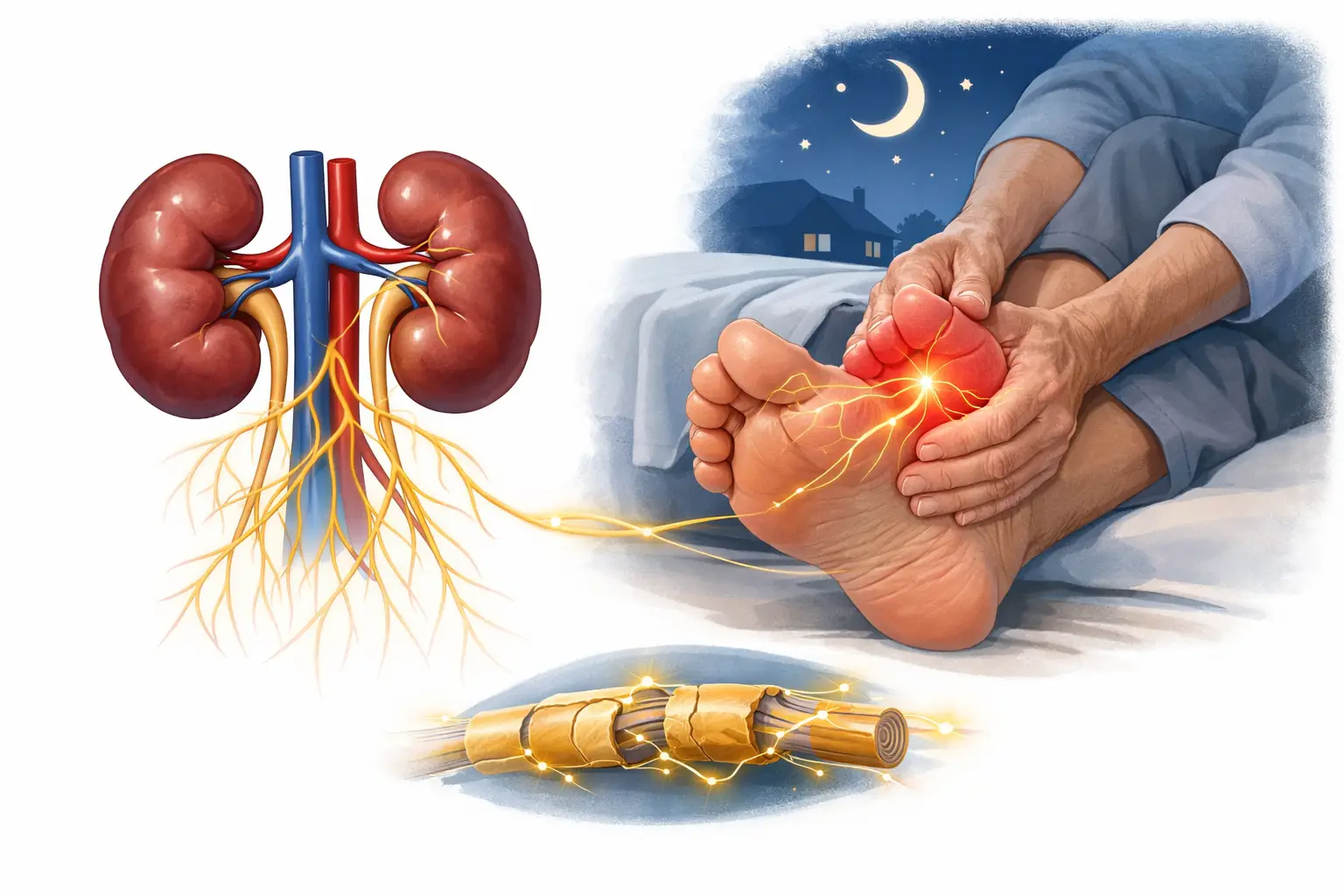
Quick Answer
Chronic kidney disease (CKD) can contribute to peripheral neuropathy, particularly as kidney function declines. Symptoms may include burning feet, numbness, tingling, balance problems, muscle weakness, and reduced sensation in the hands or feet due to nerve damage associated with metabolic and waste-product buildup.
Burning feet, numb toes, and pins-and-needles sensations are often blamed on aging or poor circulation. But in some adults, especially those already managing kidney problems, the connection is more specific. Chronic Kidney Disease and Peripheral Neuropathy: What You Should Understand starts with one key fact – declining kidney function can affect far more than the kidneys alone, including the nerves that carry sensation to the hands and feet.
This matters because neuropathy symptoms are easy to dismiss at first. A little tingling after sitting too long may not seem urgent. Over time, though, persistent nerve symptoms can interfere with walking, sleep, balance, and daily comfort. For adults 45 and older, understanding whether kidney disease may be contributing can help frame smarter questions for a clinician and avoid guessing based on supplement marketing or internet advice.
Key Takeaways
- Chronic kidney disease can contribute to peripheral nerve damage.
- Burning feet, tingling, numbness, and balance problems are common neuropathy symptoms.
- Symptoms often begin in the feet before affecting the hands.
- Vitamin B12 deficiency may coexist with kidney disease and worsen nerve symptoms.
- Not all neuropathy in CKD is caused solely by kidney dysfunction.
- Medical evaluation is important to identify the underlying contributors.
How chronic kidney disease can affect nerves
Chronic kidney disease, or CKD, develops when the kidneys gradually lose their ability to filter waste and maintain normal fluid, mineral, and metabolic balance. When kidney function declines enough, waste products can build up in the blood. That altered internal environment may place stress on nerves, particularly the long nerves that travel to the lower legs and feet.
Peripheral neuropathy is a broad term for nerve damage outside the brain and spinal cord. In CKD, the pattern often involves the feet first, then sometimes the hands later. This length-dependent pattern is common in many neuropathies because the longest nerves are often the most vulnerable.
Researchers have long recognized so-called uremic neuropathy, a form of nerve dysfunction associated with advanced kidney impairment. Symptoms tend to become more likely as kidney disease progresses, but there is not always a clean line where nerve symptoms suddenly begin. Some people have mild sensory changes earlier, while others do not notice problems until kidney disease is more advanced.
Symptoms of peripheral neuropathy in CKD
| Symptom | How It May Present |
|---|---|
| Burning feet | Hot, painful sensation often worse at night |
| Tingling | Pins-and-needles feeling in toes or feet |
| Numbness | Reduced ability to feel touch or pressure |
| Balance problems | Difficulty walking on uneven surfaces |
| Weakness | Trouble climbing stairs or maintaining stability |
| Loss of sensation | Injuries or pressure may go unnoticed |
The symptoms can overlap with many other conditions, which is one reason self-diagnosis is risky. Still, some patterns are worth recognizing.
Common complaints include burning in the feet, tingling, numbness, unusual sensitivity to touch, stabbing discomfort, or a sensation that socks are bunched up when they are not. Some people describe restless, electric, or crawling feelings in the lower legs, especially at night. Others notice weakness, reduced ankle reflexes, cramping, or balance problems when walking on uneven ground.
Neuropathy does not always start as pain. In fact, loss of sensation can be just as important. When the feet become less sensitive, small injuries may go unnoticed. That can increase the risk of skin breakdown, falls, and walking instability.
Why the connection is not always straightforward
When readers search for Chronic Kidney Disease and Peripheral Neuropathy, they often want a simple answer: does CKD cause neuropathy or not? The careful answer is yes, it can, but CKD is not the only possible explanation.
Many adults with kidney disease also have diabetes, prediabetes, vascular disease, thyroid issues, alcohol-related nerve injury, medication side effects, or vitamin deficiencies. Any of these can contribute to numbness and tingling. Sometimes more than one factor is involved at the same time.
That overlap matters because the management approach depends on the real driver. A person with CKD and low vitamin B12 may need a very different evaluation than someone whose symptoms are mainly related to diabetic nerve damage or spinal nerve compression. The label peripheral neuropathy describes the problem broadly, but not the root cause.
Important
Many adults with chronic kidney disease have more than one risk factor for neuropathy. Diabetes, vitamin deficiencies, thyroid disorders, medication effects, and circulation issues may all contribute simultaneously.
Vitamin status, CKD, and neuropathy symptoms
Vitamin questions come up often, and for good reason. Certain vitamin deficiencies, especially vitamin B12 deficiency, can contribute to numbness, tingling, gait problems, and cognitive changes. Adults over 45 may already be at higher risk if they use acid-reducing medications, take metformin, have digestive disorders, or eat a highly restricted diet.
According to the National Institute of Diabetes and Digestive and Kidney Diseases (NIDDK), chronic kidney disease can affect multiple body systems and may contribute to complications beyond the kidneys, including nerve-related problems in some patients.
CKD adds another layer of complexity. Dietary restrictions, appetite changes, inflammation, and medication burden can all affect nutritional status. At the same time, taking supplements without guidance is not automatically safe in kidney disease. Some nutrients can accumulate or interact with a person’s overall care plan.
Vitamin B12 is often discussed in nerve-health conversations because it supports normal nerve function, but that does not mean every case of neuropathy is caused by low B12 or that every supplement marketed for nerves is appropriate. The practical takeaway is simple: if neuropathy symptoms are present, it is reasonable to ask whether B12 and other relevant labs have actually been checked, rather than assuming.
Which symptoms deserve faster medical attention
Not every tingling sensation is an emergency, but some situations should move up the priority list. Progressive numbness, new weakness, repeated tripping, foot wounds you cannot feel, rapidly worsening burning pain, or symptoms that spread quickly deserve prompt evaluation. The same is true if neuropathy symptoms come with major swelling, shortness of breath, confusion, severe fatigue, or a noticeable change in urination, since those may point to worsening kidney-related issues or another serious problem.
A clinician may review kidney function, blood sugar, vitamin levels, thyroid markers, medication history, and neurological findings. In some cases, nerve conduction testing is used, especially when the diagnosis is unclear or symptoms do not fit a typical pattern.
What people with CKD should ask about neuropathy
A useful appointment usually starts with specifics. Vague descriptions such as my feet feel weird are common, but detail helps. Is the sensation burning, tingling, numbness, pressure, or pain? Is it worse at night? Is it symmetrical? Did it start in the toes? Is there weakness or only altered sensation?
From there, practical questions matter. Ask whether the symptoms could be related to kidney disease itself, whether diabetes or prediabetes may be involved, whether B12 or other nutritional factors should be reviewed, and whether any current medications can worsen nerve symptoms. If balance is changing, mention that clearly. Falls matter just as much as pain.
For supplement shoppers, this is also where caution is warranted. Products marketed for neuropathy often combine B vitamins, alpha-lipoic acid, herbal extracts, or other compounds in high doses. That does not make them automatically unsuitable, but people with CKD should be especially careful about ingredient burden, dose stacking, and the assumption that more is better. In a kidney-compromised setting, the right question is not what is the strongest formula, but what is appropriate for this person’s labs, medications, and clinical picture.
Lifestyle support without overpromising
Supportive habits can still matter even when neuropathy has a medical cause. Good foot care is a practical example. Daily skin checks, properly fitted shoes, and avoiding barefoot walking can reduce complications when sensation is reduced. Gentle activity may help circulation, mobility, and overall function, although exercise plans need to fit the person’s kidney status and comorbidities.
Sleep quality also deserves attention. Neuropathy symptoms often feel worse at night, and poor sleep can amplify discomfort perception. Some people benefit from keeping track of symptom timing, triggers, and associated swelling or cramping, which gives clinicians better information than memory alone.
Diet is more complicated in CKD than in the general population. Advice that seems healthy online may not fit someone who has potassium, phosphorus, protein, or fluid restrictions. That is another reason broad supplement or nutrition claims can be misleading in this group.
Realistic expectations about improvement
One of the hardest parts of neuropathy is uncertainty. People naturally want to know whether the numbness will go away. The honest answer depends on the cause, the severity, and how long symptoms have been present.
If a reversible contributor such as a vitamin deficiency or medication issue is identified early, improvement may be possible, though it can take time. If neuropathy is tied to longstanding metabolic stress or advanced kidney disease, full reversal may be less likely. In that setting, the focus often shifts toward identifying contributing factors, protecting function, and reducing symptom burden rather than expecting a quick fix.
That may sound unsatisfying, but it is more useful than exaggerated promises. Adults researching nerve-health products are often exposed to claims that imply a capsule can repair years of nerve injury. A more evidence-informed view is that targeted nutrition may support normal nerve function in some situations, but it should be guided by the person’s underlying cause and kidney status.
The most important takeaway on chronic kidney disease and peripheral neuropathy
Chronic kidney disease and peripheral neuropathy can be related, especially as kidney function declines, but the overlap is rarely as simple as one symptom, one cause, one supplement. Burning feet or numbness in a person with CKD deserves a careful look at kidney status, blood sugar, vitamin issues, medications, and other common contributors. For readers trying to make sense of symptoms, the most useful next step is not chasing the loudest claim online – it is bringing a clear symptom history and smart questions to a qualified healthcare professional.
Frequently Asked Questions
Can chronic kidney disease cause peripheral neuropathy?
Yes. As kidney function declines, metabolic changes and toxin buildup may contribute to peripheral nerve damage.
What does kidney-related neuropathy feel like?
Symptoms may include burning feet, numbness, tingling, balance problems, muscle weakness, and altered sensation.
Can vitamin B12 deficiency worsen neuropathy symptoms?
Yes. Vitamin B12 deficiency can contribute to nerve dysfunction and may overlap with kidney-related neuropathy symptoms.
Do all people with CKD develop neuropathy?
No. Risk generally increases as kidney disease progresses, but many individuals never develop significant neuropathy symptoms.
When should neuropathy symptoms be evaluated?
Seek evaluation if symptoms are worsening, causing falls, reducing sensation, interfering with walking, or affecting daily activities.
Medical Disclaimer: The information provided in this article is for educational purposes only and is not intended as medical advice. Dietary supplements are not a replacement for professional medical diagnosis or treatment. Always consult with a qualified healthcare professional before starting any new supplement, especially if you have pre-existing medical conditions or are taking prescription medications. Individual results may vary.

- Can Low B12 Cause Dizziness? - July 9, 2026
- B12 Deficiency and Cracked Corners of the Mouth - July 9, 2026
- Can Low B12 Cause Dry Mouth? - July 8, 2026