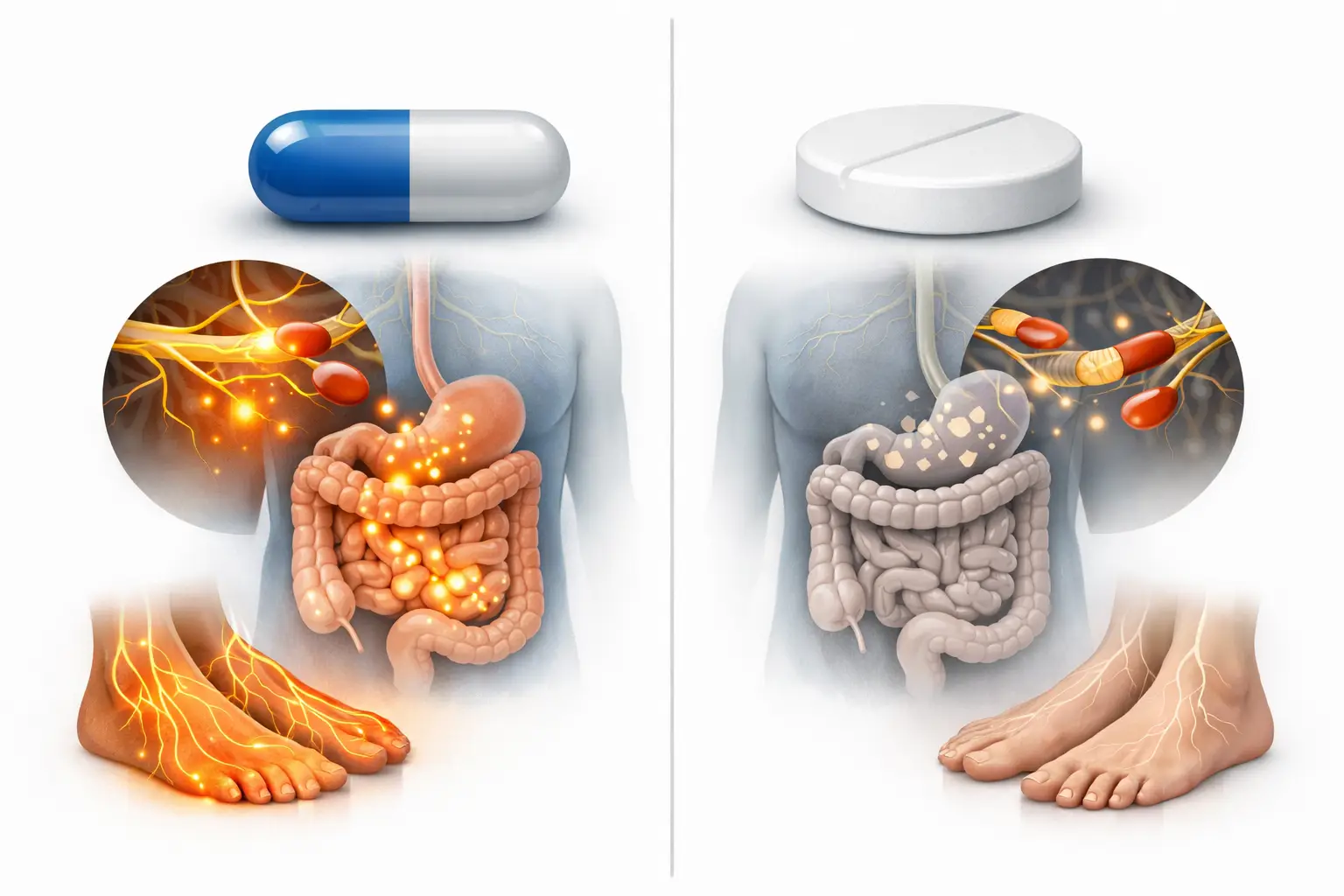
Capsules often dissolve faster than tablets, but faster breakdown does not automatically mean better absorption. Ingredient form, digestive health, manufacturing quality, dosage, and consistency of use usually matter more than whether a supplement comes as a capsule or tablet.
You can stand in the supplement aisle looking at two bottles with the same ingredient and still face a real question: does the form matter? When people search capsules vs tablets absorption, they are usually trying to answer something practical – which one is more likely to work, feel gentler on the stomach, and be worth the money.
That question matters even more for adults over 45, especially if digestion has changed, medications are part of the picture, or a nutrient like vitamin B12 is being taken for energy, nerve health support, or deficiency risk. The short answer is that capsules are not automatically better than tablets, and tablets are not automatically worse. Absorption depends on the ingredient itself, how the product is made, and what is happening in your digestive tract.
Key Takeaways
- Capsules may dissolve faster, but better absorption is not guaranteed.
- Ingredient form and digestive health often matter more than dosage form alone.
- Softgels may work well for fat-soluble nutrients like vitamin D and CoQ10.
- Adults over 45 may experience absorption changes related to stomach acid, medications, or digestive function.
- Consistency, product quality, and tolerability usually matter more than marketing claims about capsules vs tablets.
Capsules vs tablets absorption: what actually affects it
A supplement has to do more than contain an ingredient on the label. First, it must break apart. Then the active ingredient has to dissolve, survive the digestive environment, and pass through the gut in a form your body can use. That means dosage form is only one piece of a larger process.
Capsules often dissolve faster because the outer shell is designed to break down relatively quickly in the stomach. This can create the impression that they are always absorbed better. In some cases, that is true. A capsule filled with powder or liquid may release its contents more readily than a hard-compressed tablet.
But faster disintegration is not the same as better absorption. If the ingredient is poorly absorbed to begin with, a capsule will not magically fix that. On the other hand, a well-made tablet with effective disintegration and high-quality raw materials may perform just as well as, or sometimes better than, a lower-quality capsule.
For most common vitamins and minerals, the biggest determinants are the chemical form of the nutrient, dose, excipients, coatings, and your own digestive function. That is why two products with the same front-label promise can behave differently.
Why capsules may absorb faster
Capsules vs Tablets: Practical Differences
The best supplement form often depends more on the formulation and the person taking it than on marketing claims alone.
| Feature | Capsules | Tablets |
|---|---|---|
| Disintegration speed | Often faster | May vary depending on compression |
| Swallowing comfort | Often easier for many adults | Large tablets may feel harder to swallow |
| Dose capacity | May require multiple capsules | Can often fit larger doses |
| Special coatings | Less common | Enteric and delayed-release options available |
| Cost | Often more expensive | Usually more affordable |
| Absorption potential | Can be excellent | Can also be excellent if well formulated |
Capsules tend to have a practical advantage in disintegration. The shell, often made from gelatin or plant-based materials, can dissolve quickly once it reaches stomach fluid. After that, the powder or liquid inside becomes available for digestion.
This may be helpful for people who have trouble with dense tablets or who notice that some tablets feel like they sit heavily in the stomach. It can also be useful when a supplement includes ingredients that are sensitive to heavy compression. In those cases, a capsule may protect ingredient quality and release the contents more efficiently.
There is also a comfort factor. Many adults find capsules easier to swallow than large chalky tablets. That does not change absorption directly, but it can improve consistency. And consistency matters more than small theoretical differences in delivery form.
Still, capsules have limitations. Some are moisture-sensitive. Others contain fewer milligrams than a tablet can fit, which means you may need to take more capsules to reach the same dose. In addition, not every capsule is free from unnecessary fillers, and not every capsule shell is ideal for every digestive system.
Why tablets can still perform well
Tablets are often viewed as the cheaper, less sophisticated option, but that is too simplistic. A well-manufactured tablet can be highly stable, precise in dose, and effective in delivery.
Tablets can also be designed with specific release patterns. Some are made to dissolve quickly. Others are enteric-coated to bypass the stomach and dissolve later in the digestive tract. That may be useful for ingredients that irritate the stomach or break down too easily in acid.
The main concern with tablets is disintegration. If a tablet is compressed too hard, uses poor-quality binders, or has a coating that delays breakdown too much, the ingredient may not become available when it should. This is one reason some people feel they do better with capsules. They may not be reacting to the nutrient itself so much as to the tablet’s formulation.
Price can also influence perception. Tablets are often less expensive to produce, which can be a legitimate benefit for long-term use. For someone taking a supplement daily, affordability supports adherence. And a supplement taken regularly in a good form usually beats a theoretically superior option that is too costly or unpleasant to continue.
Capsules vs tablets absorption for vitamin B12 and other common nutrients
For vitamin B12, the capsule-versus-tablet question is only part of the story. B12 absorption is already complex because it depends on stomach acid, intrinsic factor, intestinal health, age, and sometimes medication use. In adults over 45, these factors often matter more than whether the supplement comes as a capsule or tablet.
The NIH Office of Dietary Supplements explains how vitamin B12 absorption works and why factors like age, digestion, and medication use may influence nutrient status.
If the B12 product dissolves properly and contains a usable form such as methylcobalamin or cyanocobalamin, either dosage form may work. A sublingual tablet or lozenge is sometimes marketed as clearly superior, but evidence does not consistently show major advantages over oral forms when the dose is adequate. For many people, the body still processes much of it through normal gastrointestinal absorption.
With minerals such as magnesium, iron, calcium, and zinc, tolerance may matter as much as absorption. Some tablet forms are large and harder to take. Some capsules are easier on the stomach. But the mineral salt form often matters more – for example, citrate versus oxide, or bisglycinate versus sulfate.
Fat-soluble nutrients like vitamin D, vitamin K, and CoQ10 may absorb better in oil-based softgels because they are delivered in a fat-containing medium. In those cases, comparing a softgel capsule to a dry tablet is not just about the shell. It is about the entire delivery system.
The factors that often matter more than dosage form
If you want a realistic answer to capsules vs tablets absorption, focus first on the full formulation. Ingredient form is a major one. Methylcobalamin and cyanocobalamin each have different handling in the body, but either can be effective depending on the person and the dose. Magnesium glycinate behaves differently from magnesium oxide. Curcumin with an absorption enhancer behaves differently from plain curcumin powder.
Stomach acid also matters. Reduced stomach acid is more common with age and can be affected by acid-reducing medications. That can make it harder to break down certain supplements or absorb specific nutrients efficiently. In that setting, a quickly dissolving capsule may help a little, but it does not solve every absorption problem.
Timing with meals can change things as well. Some nutrients absorb better with food, especially fats. Others may be better tolerated with a meal even if food does not dramatically increase uptake. If a supplement causes nausea on an empty stomach, the best form is the one you can take comfortably and consistently.
Quality control may be the biggest overlooked issue. A supplement that has been poorly manufactured, contaminated, underdosed, or inadequately tested is a bad choice whether it is a capsule or tablet. This is where an evidence-informed review process matters more than marketing language on the bottle.
When capsules may be the better choice
Capsules may make more sense if you struggle to swallow large tablets, notice stomach discomfort from compressed pills, or want a product with fewer binders and compression agents. They can also be a practical option for powders, probiotic blends, and ingredients that are difficult to compress into a stable tablet.
Adults taking several supplements often prefer capsules simply because they tend to go down more easily. If that helps you stay on schedule, it is a meaningful advantage.
When tablets may be the better choice
Tablets can be a smart choice when cost matters, when the formula requires a higher dose in one unit, or when the product uses a specialized coating for stability or delayed release. They also tend to have a longer shelf life in some formulations.
If you tolerate tablets well and the manufacturer has a strong quality reputation, there is no reason to assume you are settling for an inferior option.
How to choose without overthinking it
Start with the nutrient, not the dosage form. Ask whether the ingredient form is well studied, whether the dose is appropriate, and whether the manufacturer is transparent about testing and formulation. Then consider your own experience – swallowing comfort, digestion, medication use, and whether you are likely to take it regularly.
If you have a history of low stomach acid, digestive issues, unexplained deficiency, or poor response to supplements, it makes sense to discuss that with a healthcare professional. A form that looks good on paper may not match your physiology.
For most people, the best answer is not that capsules always absorb better or tablets always absorb worse. It is that a high-quality product in a form you can tolerate and use consistently is usually the better decision. That may sound less dramatic than marketing claims, but it is closer to how supplement outcomes work in real life.
A good supplement should fit your body, your routine, and your actual needs – not just win a label comparison.
Frequently Asked Questions
Do capsules absorb better than tablets?
Not always. Capsules may dissolve faster, but overall absorption depends more on ingredient form, digestive health, manufacturing quality, and dosage.
Why do some people prefer capsules?
Many adults find capsules easier to swallow and gentler on the stomach, especially when compared with large compressed tablets.
Can tablets still absorb well?
Yes. A well-made tablet with proper disintegration and quality ingredients may absorb just as effectively as many capsules.
Does age affect supplement absorption?
Yes. Aging, digestive conditions, reduced stomach acid, and certain medications may affect nutrient absorption in adults over 45.
Does vitamin B12 absorption depend only on capsules vs tablets?
No. Vitamin B12 absorption also depends on stomach acid, intrinsic factor, intestinal health, dosage, and the chemical form of the vitamin.
Medical Disclaimer: The information provided in this article is for educational purposes only and is not intended as medical advice. Dietary supplements are not a replacement for professional medical diagnosis or treatment. Always consult with a qualified healthcare professional before starting any new supplement, especially if you have pre-existing medical conditions or are taking prescription medications. Individual results may vary.

- Can Low B12 Cause Dizziness? - July 9, 2026
- B12 Deficiency and Cracked Corners of the Mouth - July 9, 2026
- Can Low B12 Cause Dry Mouth? - July 8, 2026