Quick Answer:
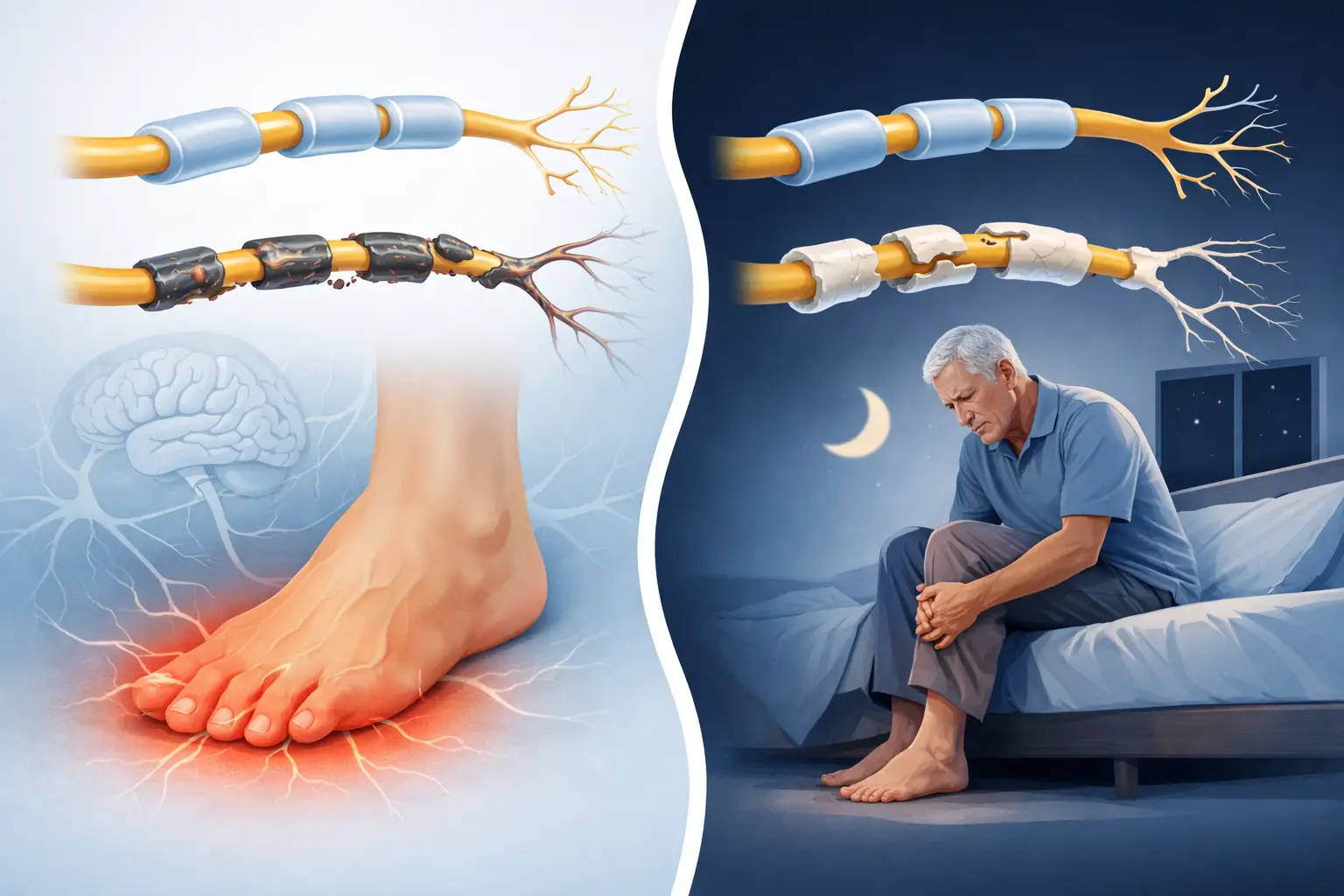
Axonal degeneration and demyelination are two different patterns of nerve injury. Axonal degeneration affects the nerve fiber itself, while demyelination affects the protective myelin sheath surrounding the nerve. The distinction matters because it can influence symptoms, possible causes, recovery expectations, and treatment decisions.
When a nerve test shows damage, one of the most important questions is whether the problem is axonal degeneration vs demyelination. That distinction is not just technical wording on an EMG or nerve conduction report. It can change how symptoms develop, what causes are considered, how recovery is judged, and which next steps make sense.
For adults dealing with numbness, tingling, burning feet, weakness, or balance changes, these terms often come up after a neurology visit. They can sound abstract, but the idea is straightforward. A nerve has an inner wire-like core called the axon, and many nerves also have an outer insulating layer called myelin. Damage can affect either part, and the pattern matters.
What axonal degeneration vs demyelination means
Axonal degeneration means the axon itself is injured. Think of the axon as the part of the nerve that carries the electrical signal from one point to another. If that inner structure is damaged, the nerve may still be present, but it cannot transmit signals normally because the core pathway has broken down.
Demyelination means the myelin sheath is damaged instead. Myelin acts like insulation around the nerve. When it is thinned, inflamed, or lost, signals may still travel, but they move more slowly or get blocked along the way. In some cases, the axon underneath remains relatively preserved. In others, long-standing demyelination can eventually lead to secondary axonal injury.
This is why the comparison matters. Axonal injury often reflects actual loss of nerve fibers. Demyelination often reflects a conduction problem first, although it may become more serious over time if the cause continues.
Key Takeaways
- Axonal degeneration damages the nerve fiber itself.
- Demyelination damages the nerve’s insulating myelin sheath.
- EMG and nerve conduction studies help distinguish between the two patterns.
- Axonal injuries often recover more slowly because nerve regrowth takes time.
- Demyelinating conditions may improve faster if the underlying cause is treated early.
- Vitamin B12 deficiency is one possible contributor to axonal nerve injury.
Why the difference matters in real life
Patients usually do not feel “axonal” or “demyelinating” damage directly. They feel symptoms. But the pattern behind those symptoms can help explain why one person has mostly numbness and burning, while another has marked weakness, loss of reflexes, or rapidly changing function.
In broad terms, axonal neuropathies often develop more gradually and may be common in metabolic, nutritional, toxic, or length-dependent nerve injury. Demyelinating neuropathies may raise different questions, including immune-mediated causes, inherited disorders, or pressure-related nerve problems. There is overlap, and no symptom pattern is perfect, but specialists pay close attention to this distinction because it guides the workup.
It also shapes expectations. Axonal damage can take longer to improve because the nerve may need to regrow, and regeneration is slow. Demyelination may improve faster if the underlying cause is identified and addressed early, since remyelination can occur. That said, recovery depends on severity, duration, age, overall health, and whether the cause is still active.
How symptoms can differ
Axonal Degeneration vs Demyelination
| Feature | Axonal Degeneration | Demyelination |
|---|---|---|
| Main Structure Affected | Nerve fiber (axon) | Myelin sheath |
| Signal Problem | Reduced signal strength | Slowed or blocked signal transmission |
| Common Symptoms | Burning, numbness, tingling | Weakness, reduced reflexes, numbness |
| Recovery Pattern | Often slower | May improve faster if treated early |
| EMG/NCS Findings | Reduced amplitudes | Slowed conduction velocity |
Axonal degeneration commonly causes sensory symptoms first, especially in the feet. People may notice tingling, reduced sensation, burning, pins-and-needles feelings, or a sense that socks are bunched up under the toes. If the process worsens, weakness can appear, usually starting distally in the feet or lower legs.
Demyelination can also cause numbness and tingling, but it more often raises concern when weakness is prominent, reflexes are reduced, or symptoms progress in a way that seems out of proportion to simple sensory loss. Some demyelinating disorders affect both sensation and strength in a more diffuse or fluctuating way.
Still, symptom overlap is substantial. A person with axonal neuropathy can have weakness. A person with demyelination can have pain. This is one reason self-diagnosis is unreliable. The label comes from examination findings and electrodiagnostic testing, not symptoms alone.
What causes axonal degeneration?
Axonal degeneration is commonly seen in peripheral neuropathy linked to diabetes, alcohol-related nerve injury, certain medications, toxin exposure, kidney disease, and some vitamin deficiencies. Vitamin B12 deficiency deserves special attention because it can affect nerve function in ways that may overlap with other neurologic problems, especially in adults over 45.
Low B12 does not automatically mean severe nerve damage, and supplementation is not a cure-all. But if deficiency is present, it is important to identify and correct it under medical guidance. The longer a true deficiency goes untreated, the greater the chance that nerve symptoms may persist.
Other nutritional issues can also contribute, including low copper in specific situations, while excess vitamin B6 from supplements can itself cause neuropathy. This is one reason evidence-based supplement review matters. More is not always better, and nerve symptoms should never be managed by guesswork alone.
What causes demyelination?
Demyelination has a different set of common suspects. It may occur in immune-mediated neuropathies, certain hereditary nerve disorders, and focal entrapment or compression syndromes where myelin is affected by repeated pressure. Some inflammatory neuropathies are acute, while others are chronic and slower moving.
This does not mean every demyelinating pattern is an emergency, but it does mean clinicians usually take it seriously. If weakness is progressing, walking is becoming harder, or symptoms are spreading quickly, prompt medical assessment is important.
In some people, the pattern is mixed. A report may describe both axonal loss and demyelinating features. That usually means the nerve is under enough stress that multiple parts of its structure are affected, which can complicate both diagnosis and recovery.
⚠ Important
Rapidly worsening weakness, difficulty walking, loss of reflexes, sudden balance problems, or symptoms that spread quickly should not be ignored. These patterns may suggest a more significant neurologic process and deserve prompt medical evaluation.
How doctors tell the difference
The main tools are the neurologic exam, nerve conduction studies, and electromyography, often shortened to EMG. These tests do not just confirm that a neuropathy exists. They help characterize the type of damage.
In axonal loss, nerve conduction amplitudes are often reduced because fewer functioning nerve fibers remain to carry the signal. In demyelination, conduction velocity tends to slow, distal latencies may be prolonged, and conduction block or temporal dispersion may appear. Those details are technical, but the takeaway is simple: axonal damage reduces signal strength, while demyelination slows or interrupts signal transmission.
Blood work may also be used to look for contributors such as diabetes, thyroid disease, B12 deficiency, inflammatory markers, kidney problems, or paraproteinemia. In select cases, imaging, lumbar puncture, or genetic testing may be considered. The pattern on testing helps decide which of those steps is reasonable.
What this means for recovery
Many patients want to know which is worse. There is no universal answer, but axonal degeneration is often harder to reverse once significant fiber loss has occurred. Nerves can regenerate, but slowly, and not always completely. Improvement may take months, and sometimes the goal is stabilization rather than full recovery.
Demyelination may offer more room for functional improvement if the underlying driver is treated and the axon remains intact. But severe or repeated demyelination can still lead to lasting deficits. Timing matters. So does cause.
That is why realistic expectations are important. If symptoms have been present for a long time, even a correct diagnosis and a thoughtful plan may not lead to rapid changes. Good care often focuses on identifying contributors early, protecting function, reducing avoidable nerve stress, and monitoring whether the condition is stable, improving, or progressing.
Where supplements fit – and where they do not
For a site focused on vitamin and capsule-based health products, this is where readers need a careful line between useful and misleading information. Supplements may support nerve health in specific situations, particularly when a documented deficiency or inadequate intake is part of the picture. Vitamin B12 is the clearest example when testing confirms low levels or deficiency risk.
But supplements do not diagnose whether damage is axonal or demyelinating, and they should not be presented as a way to reverse neurologic disease. If numbness, weakness, gait change, or rapidly worsening symptoms are present, medical evaluation comes first. A supplement can be appropriate within a broader plan, but it is not a substitute for figuring out what type of nerve injury is happening.
Consumers should also be wary of broad nerve-health formulas that combine high doses of multiple ingredients without a clear rationale. Some are reasonable. Others are built more for marketing than physiology. Adults comparing options should look for transparent dosing, appropriate forms of nutrients, and a clear reason for each ingredient rather than relying on dramatic promises.
Questions worth asking after a nerve test
If your report mentions axonal degeneration, demyelination, or both, ask what pattern was seen and what the leading causes are in your case. Ask whether blood work has ruled out common contributors such as diabetes, B12 deficiency, thyroid problems, or medication effects. Ask what kind of timeline is realistic for improvement and what symptoms would justify urgent follow-up.
That conversation is often more useful than focusing on the terminology alone. These words are valuable because they point toward mechanism. Once you know the mechanism, the next step is identifying the cause and deciding what can still be changed.
For many readers, that is the most practical way to think about axonal degeneration vs demyelination. One affects the nerve fiber itself, the other affects the insulating sheath, and both deserve a careful, evidence-informed evaluation before any treatment or supplement decision is made.
Frequently Asked Questions
What is the difference between axonal degeneration and demyelination?
Axonal degeneration affects the nerve fiber itself, while demyelination affects the protective myelin sheath surrounding the nerve.
Which is worse, axonal degeneration or demyelination?
Neither is automatically worse. Recovery depends on severity, duration, cause, and whether treatment can address the underlying problem.
Can vitamin B12 deficiency cause axonal neuropathy?
Yes. Vitamin B12 deficiency may contribute to nerve damage and can cause symptoms such as numbness, tingling, burning sensations, and balance problems.
Can EMG distinguish axonal damage from demyelination?
Yes. EMG and nerve conduction studies are commonly used to identify whether nerve injury is primarily axonal, demyelinating, or mixed.
Can nerves recover after axonal degeneration?
Some recovery is possible, but nerve regeneration is often slow and depends on the cause, severity, and duration of the injury.
Medical Disclaimer: The information provided in this article is for educational purposes only and is not intended as medical advice. Dietary supplements are not a replacement for professional medical diagnosis or treatment. Always consult with a qualified healthcare professional before starting any new supplement, especially if you have pre-existing medical conditions or are taking prescription medications. Individual results may vary.

- Can Low B12 Cause Dizziness? - July 9, 2026
- B12 Deficiency and Cracked Corners of the Mouth - July 9, 2026
- Can Low B12 Cause Dry Mouth? - July 8, 2026